Climate Change and Human Capital Challenges Facing Indian Economy
Source:The Hindu ↗
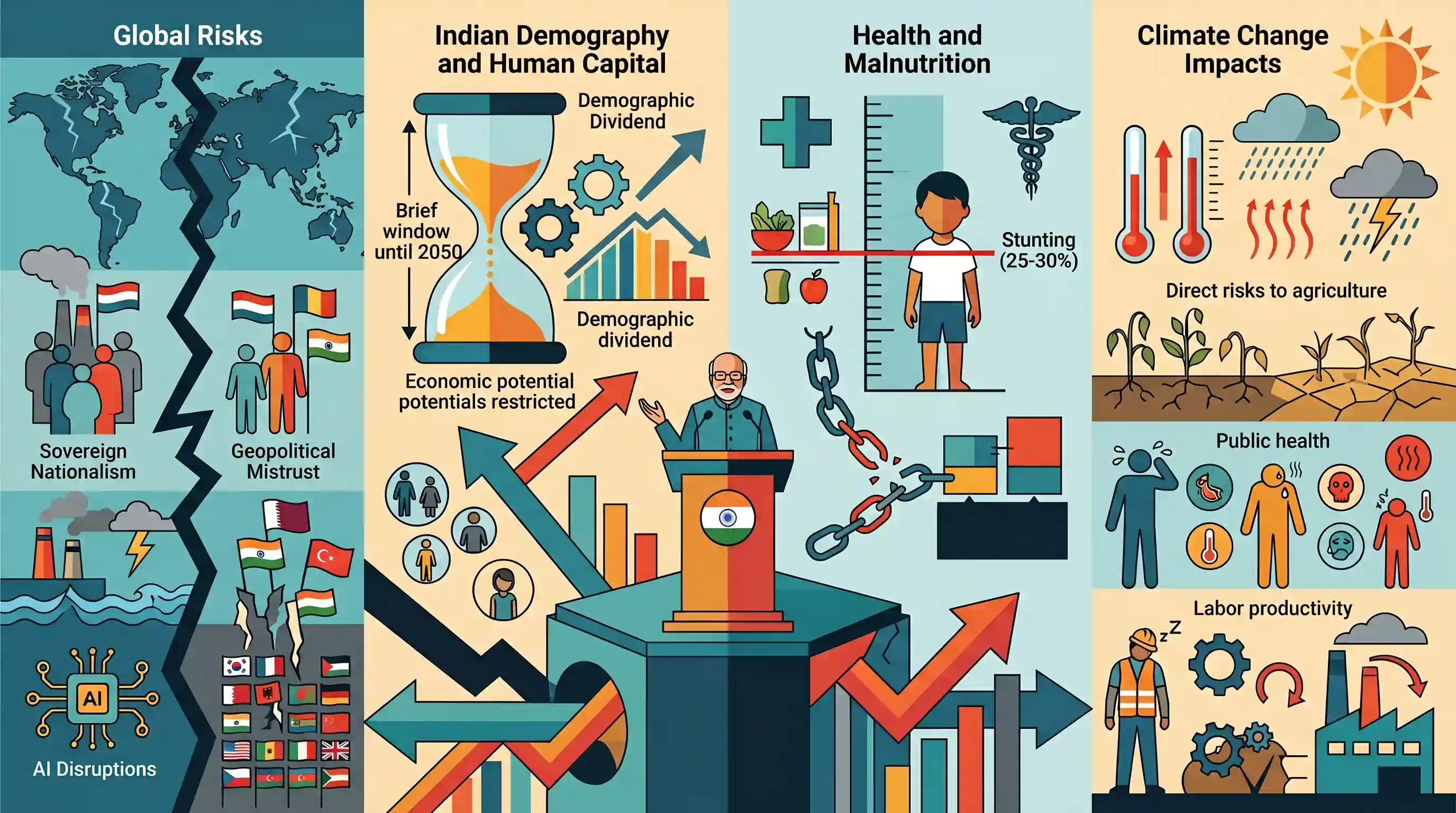
Why It Matters
It provides a comprehensive, multi-sectoral overview of the headwinds India faces, linking domestic developmental bottlenecks (malnutrition, demographic transitions, agriculture) with global macroeconomic and geopolitical trends (weakening multilateralism, climate change).
Summary
Speaking at the Nilgiris Economic Dialogue, Dr. Soumya Swaminathan highlighted that climate change, demographic constraints, and human capital deficits are critical challenges facing the Indian economy. She noted that global risks are compounding due to environmental threats, AI disruptions, and a fracturing multilateral system driven by sovereign nationalism and geopolitical mistrust. Domestically, India’s demographic dividend offers only a brief window of opportunity, projected to close by 2050. Persistent health issues, such as a 25-30% child stunting rate, threaten human capital formation, while climate-induced temperature variations pose direct risks to agricultural output, public health, and labor productivity.
Key Points
- Dr. Soumya Swaminathan identified climate change, demographic shifts, and human capital deficits as primary challenges to India's economic growth.
- The global multilateral system (e.g., the UN) is under threat due to rising geopolitical mistrust, inward-looking policies, and sovereign nationalism.
- India's window for a demographic dividend is limited and expected to decline by 2050 as birth rates fall and the population ages.
- High rates of child stunting (25-30% for children under five) severely impede human capital formation by restricting physical and cognitive development.
- Climate change and increasing temperature extremes are projected to negatively impact agriculture, human health, and overall labor productivity across both rural and urban areas.
Important Terms
Demographic Dividend

The economic growth potential resulting from a shift in a population's age structure, where the working-age population (15-64 years) is larger than the dependent population (children and elderly).
UPSC context
GS Paper I (Population) and Paper III (Economic Development); tests understanding of growth drivers and windows of opportunity.
Child Stunting
A condition defined as low height-for-age, resulting from chronic or recurrent undernutrition, usually associated with poor socioeconomic conditions and maternal health.
UPSC context
GS Paper II (Social Justice/Health); tests knowledge of malnutrition challenges and human capital formation.
M.S. Swaminathan Research Foundation (MSSRF)
A non-profit NGO trust based in Chennai that leverages science and technology for sustainable rural development, particularly agriculture, food security, and biodiversity.
UPSC context
GS Paper III (Agriculture/Science); relevant for contributions to the 'Evergreen Revolution' and climate-resilient farming.
Gavi, the Vaccine Alliance
A global public-private partnership founded in 2000 to increase access to new and underused vaccines for children in the world's poorest countries.
UPSC context
GS Paper II (International Relations/Global Health); tests role of international organizations in healthcare equity.
World Economic Forum (WEF)
A Swiss non-profit foundation that organizes annual summits in Davos and publishes reports like the Global Risks Report to shape global agendas.
UPSC context
GS Paper II (International Orgs) and Paper III (Economy); source for global risks and economic trends.
Multilateralism
A system of international cooperation involving three or more nations to resolve shared challenges through treaties and international organizations.
UPSC context
GS Paper II (International Relations); tests understanding of the global institutional order vs. unilateralism or nationalism.
Human Capital
The collective skills, knowledge, and health that people invest in and accumulate, which enables them to realize their potential as productive members of society.
UPSC context
GS Paper III (Economy/Growth); tests link between education, health, and national economic productivity.
Prelims Trap
India's demographic dividend is continually expanding and the window of opportunity will remain open until the end of the 21st century.
The UN Population Fund (UNFPA) projects India's demographic dividend window (which opened around 2005) will definitively close by 2055-56 due to falling birth rates and an aging population.
Static Concepts Connected
What constitutes a 'Demographic Dividend' and what is India's timeline?
- Definition: Accelerated economic growth resulting from a decline in a country's mortality and fertility, leading to a higher proportion of working-age adults compared to dependents.
- India's Window: According to the UN Population Fund (UNFPA), India's dividend window spans roughly five decades, starting around 2005-06 and projected to close by 2055-56.
- Human Capital Link: Realizing the dividend requires targeted investments in health, education, and skill development; without these, the youth bulge becomes a demographic liability.
How are the three primary indicators of child malnutrition differentiated?
- Stunting: Low height-for-age, indicating chronic or recurrent undernutrition. It severely impacts long-term cognitive and physical capacity, permanently lowering adult productivity.
- Wasting: Low weight-for-height, indicating severe acute malnutrition, often linked to recent severe food shortage or sudden disease.
- Underweight: Low weight-for-age, which serves as a composite indicator that can reflect stunting, wasting, or a combination of both.
Cross-Topic Patterns
Stunting limits the demographic dividend
Merges GS2 Social Issues (NFHS data) with GS3 Economic Growth. A high stunting rate diminishes adult labor productivity, actively neutralizing India's brief demographic window.
Heat stress as a macroeconomic risk
Links GS3 Environment directly to Economy. ILO metrics on lost working hours due to temperature extremes prove climate change is an immediate labor and GDP risk, not just an ecological one.

Expect a 2026 multi-statement Prelims question merging NFHS malnutrition definitions with ILO/World Bank metrics on economic productivity.
Linked PYQs · 4
Linked PYQs · 4
- 2014MainsGS3
While we flaunt India's demographic dividend, we ignore the dropping rates of employability. What are we missing while doing so? Where will the jobs that India desperately needs come from? Explain.
- 2024MainsGS2
Poverty and malnutrition create a vicious cycle, adversely affecting human capital formation. What steps can be taken to break the cycle ?
- 2025MainsGS2
"With the waning of globalization, post-Cold War world is becoming a site of sovereign nationalism.” Elucidate.
- 2022MainsGS3
Discuss global warming and mention its effects on the global climate. Explain the control measures to bring down the level of greenhouse gases which cause global warming, in the light of the Kyoto Protocol, 1997.
