Macroeconomic distress and declining consumer demand in Indian economy
Source:The Hindu ↗
Why It Matters
The article touches upon critical macroeconomic indicators such as consumer demand, inflation, private investment, and wage growth. These are pivotal for UPSC aspirants to understand the nuances of India's current economic performance, the debate over 'K-shaped' vs inclusive recovery, and the tangible impacts of wealth concentration on the broader population.
Summary
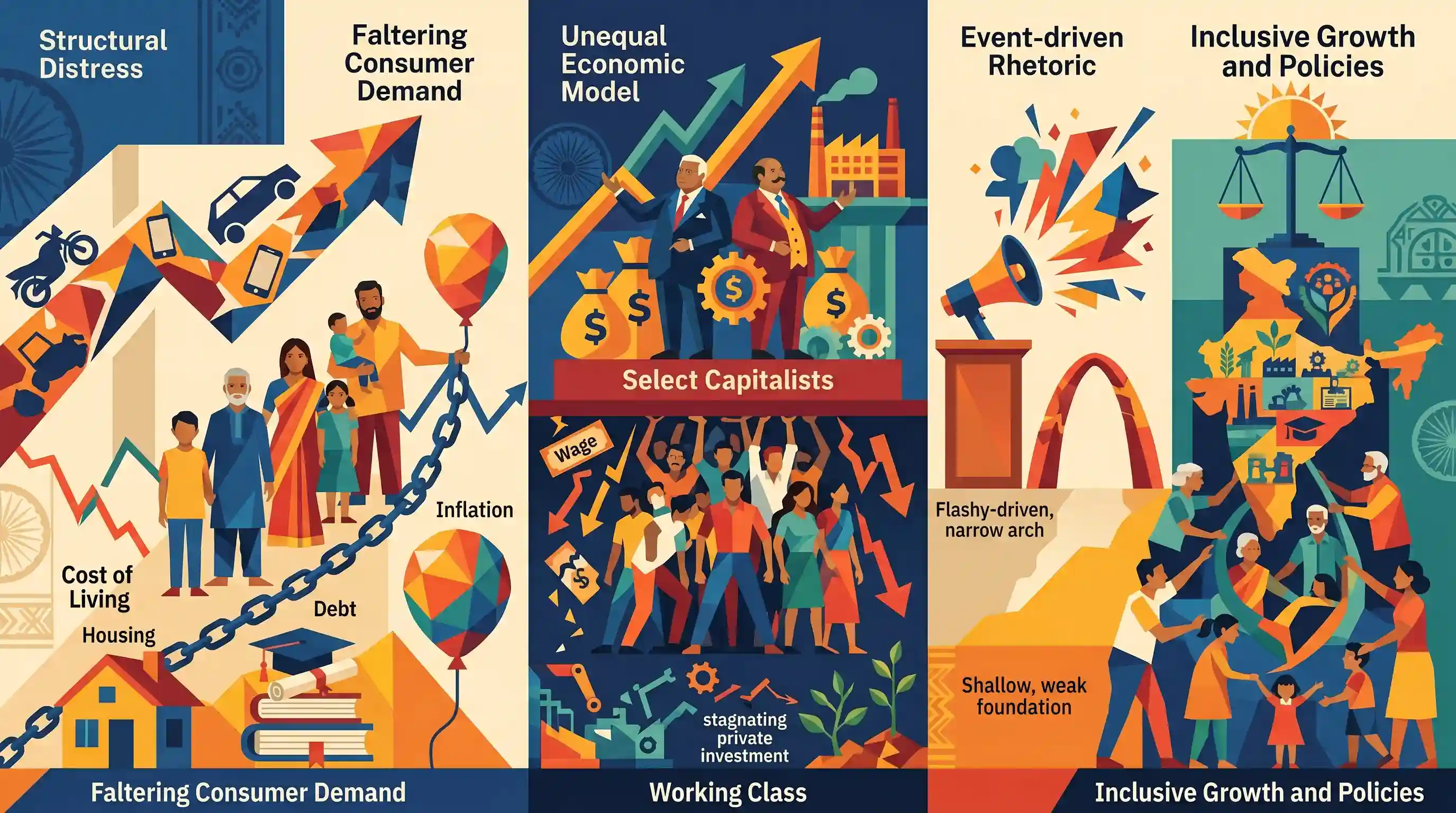
Congress leader Rahul Gandhi highlighted structural distress in the Indian economy, pointing to sharp declines in the sales of two-wheelers, cars, and mobile phones over the past year. Contrasting these metrics of faltering consumer demand with rising household debt and living costs—including housing, education, and broader inflation—he criticized an economic model that allegedly benefits select capitalists disproportionately. The Congress party further emphasized concerns over decreasing private investment and stagnating wages, advocating for inclusive economic policies and politics grounded in everyday realities rather than event-driven rhetoric.
Key Points
- Sales of consumer goods have witnessed a sharp decline over the past year, with two-wheelers dropping by 17%, cars by 8.6%, and mobile phones by 7%.
- The cost of living and household debt are escalating due to high domestic inflation, rising house rents, and increasing education expenses.
- The Opposition has raised concerns over structural macroeconomic issues, citing decreasing private investment and stagnating wages.
- There is a political and economic push for inclusive growth that benefits the broader population rather than concentrating wealth among select capitalists.
Important Terms
Inclusive Growth

Economic growth that is broad-based, shared, and sustainable, ensuring all sections of society—especially marginalized groups—participate in and benefit from development opportunities like jobs, health, and education.
UPSC context
Core GS Paper 3 syllabus topic; fundamental for questions on planning, poverty, and development.
Household Debt
The total financial liabilities of households requiring future interest or principal payments; in India, it includes housing, personal, and education loans, often measured as a percentage of GDP.
UPSC context
GS Paper 3; critical for analyzing economic stability, mobilization of resources, and consumer demand.
Private Investment
Fixed capital formation by private companies in assets like machinery and infrastructure to expand production; it is a primary driver of sustainable long-term economic growth.
UPSC context
GS Paper 3 topic "Investment Models"; tests understanding of factors driving GDP and employment.
Consumer Demand
The total amount of goods and services that consumers are willing and able to purchase; it is the largest component of India's GDP (Private Final Consumption Expenditure).
UPSC context
GS Paper 3; essential for analyzing growth dynamics and the impact of fiscal/monetary policies.
Real Wage Stagnation
A situation where workers' earnings, adjusted for inflation (real wages), fail to rise or actually decline despite overall growth in the country's Gross Domestic Product.
UPSC context
GS Paper 3; relevant to labor issues, income inequality, and the "inclusive growth" challenge.
Inflation
The rate at which the general level of prices for goods and services rises, typically measured by the Consumer Price Index (CPI) in India, eroding the purchasing power of money.
UPSC context
GS Paper 3; fundamental economic indicator impacting monetary policy and the cost of living.
Prelims Trap
"A decline in 'net household financial savings' indicates that gross household financial assets have contracted."
False. Net savings can plummet even if gross savings grow, provided financial liabilities (like unsecured personal debt) rise at a significantly faster pace.
Static Concepts Connected
What characterizes a K-shaped economic recovery?
- Divergent Paths: Different sectors and income groups recover at drastically different rates, diverging like the arms of a 'K'.
- Wealth Concentration: Top percentiles see rapid wealth and income growth, driven by formal sector resilience and asset price inflation.
- Mass Distress: Lower percentiles face prolonged wage stagnation, evidenced by sluggish rural demand, falling entry-level consumer goods sales, and high MNREGA reliance.
How do Net Household Financial Savings (NHFS) impact macroeconomic stability?
- Resource Mobilization: Households are the primary net suppliers of funds. Low NHFS limits the domestic capital pool available for private corporate investment and government borrowing.
- Crowding Out Risk: If NHFS plummets while government borrowing remains high, it can restrict available credit for the private sector, hindering capacity expansion.
- Debt Vulnerability: A shift from savings to debt-fueled consumption increases financial fragility, leaving households highly vulnerable to interest rate shocks and inflation.
Cross-Topic Patterns
Rural Demand + NBFC Stress
Declining two-wheeler sales proxy rural wage distress, simultaneously serving as a leading indicator for rising Non-Performing Assets (NPAs) among NBFCs heavily exposed to rural vehicle financing.
Core Inflation vs Monetary Policy Limits
Persistent inflation in housing and education highlights structural core inflation, testing the limits of RBI's monetary policy which struggles to tame non-discretionary, supply-rigid expenses.

Expect a 2026 Prelims statement linking multi-decade low Net Household Financial Savings to constraints on Gross Fixed Capital Formation.
Linked PYQs · 4
Linked PYQs · 4
- 2022MainsGS3
Is inclusive growth possible under market economy ? State the significance of financial inclusion in achieving economic growth in India.
- 2024MainsGS3
What are the causes of persistent high food inflation in India? Comment on the effectiveness of the monetary policy of the RBI to control this type of inflation.
- 2019MainsGS3
Do you agree with the view that steady GDP growth and low inflation have left the Indian economy in good shape? Give reasons in support of your arguments.
- 2020MainsGS3
Explain intra-generational and inter-generational issues of equity from the perspective of inclusive growth and sustainable development.
