UN Warns Millions of Impoverished People Face Severe Climate Shocks
Source:The Hindu ↗
Why It Matters
This report provides crucial data for UPSC aspirants to link climate change with socioeconomic vulnerabilities (GS3 and GS2). The specific statistics on multidimensional poverty and climate hazards are highly useful for enriching Mains answers on the disproportionate impact of global warming on the global south and marginalized communities.
Summary
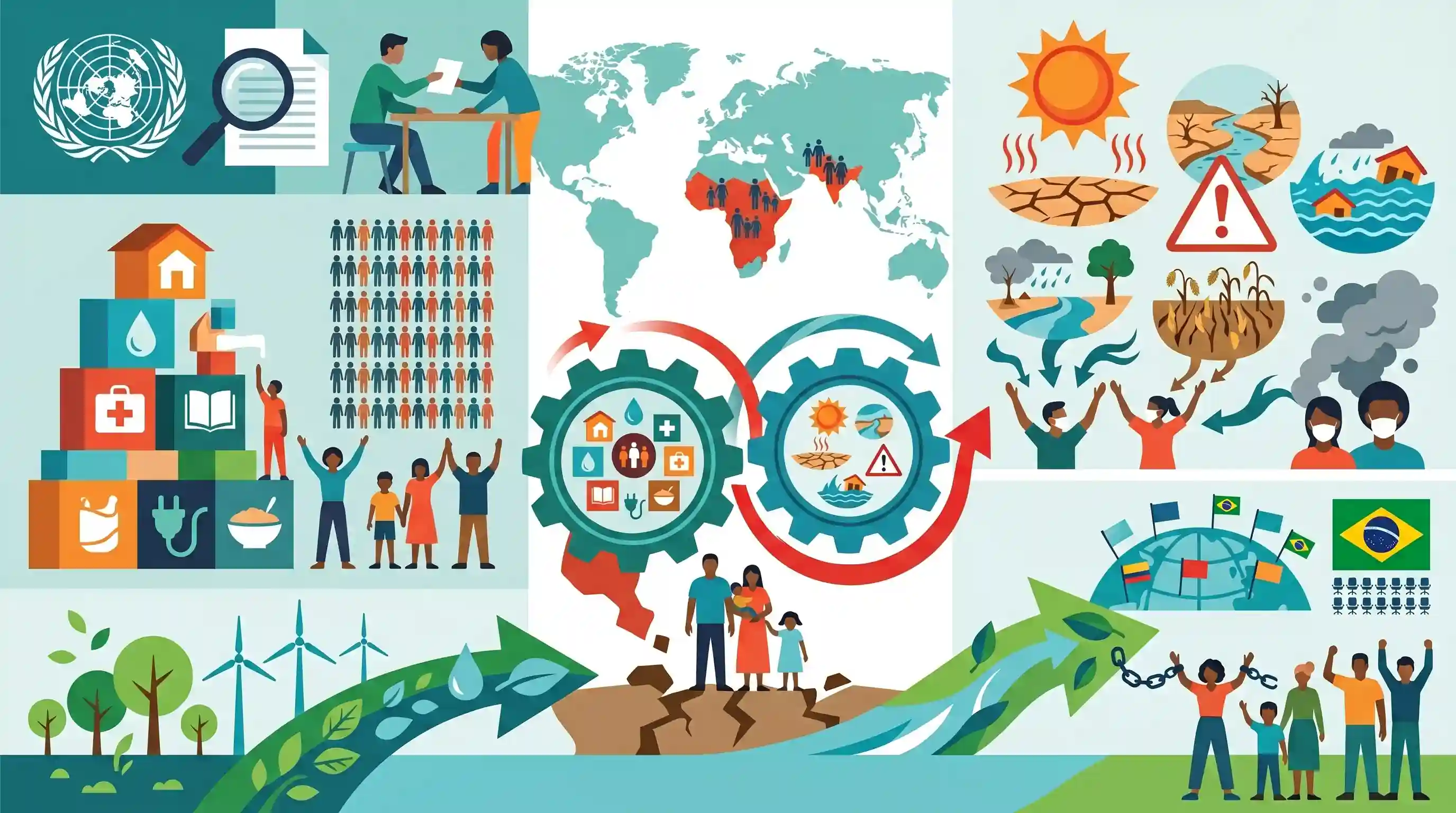
A recent United Nations report warns that nearly 900 million poor people are exposed to escalating climate shocks, facing compounding vulnerabilities from both extreme poverty and global warming. Published jointly by the UNDP and the Oxford Poverty and Human Development Initiative, the study reveals that 1.1 billion people live in acute multidimensional poverty, heavily concentrated in regions like South Asia and Sub-Saharan Africa. These populations face severe risks from extreme heat, droughts, floods, and air pollution. The UN urges global leaders to view climate action as anti-poverty action, a central theme for the upcoming COP30 summit in Brazil.
Key Points
- Nearly 900 million of the world's poorest people (80% of the global poor) are directly exposed to severe climate hazards, bearing a 'double burden' of poverty and environmental shocks.
- A joint study by the UNDP and the Oxford Poverty and Human Development Initiative identifies 1.1 billion people living in acute multidimensional poverty across 109 countries.
- Impoverished households in highly vulnerable regions like South Asia and Sub-Saharan Africa are hit hardest due to their reliance on agriculture and informal labor.
- Over 887 million impoverished individuals face at least one major environmental threat (extreme heat, drought, floods, or air pollution), with millions facing multiple hazards concurrently.
- The UN emphasizes that climate action must be integrated with poverty eradication strategies, setting a crucial agenda for the upcoming COP30 summit in Brazil.
Important Terms
Multidimensional Poverty Index (MPI)

An international measure of poverty covering over 100 developing countries, evaluating deprivations across health, education, and living standards using 10 specific indicators beyond just income levels.
UPSC context
GS Paper 2: Issues relating to poverty and hunger; GS Paper 3: Inclusive growth and developmental issues.
COP30
The 30th UN Climate Change Conference, scheduled for 2025 in Belém, Brazil; it marks a decade since the Paris Agreement and focuses on updating Nationally Determined Contributions (NDCs).
UPSC context
GS Paper 3: Environmental pollution and degradation; International environmental conventions.
United Nations Development Programme (UNDP)
The United Nations' lead agency on international development, established in 1965 to eradicate poverty, reduce inequality, and build resilience to crises through technical and investment cooperation.
UPSC context
GS Paper 2: Important International institutions and agencies, their structure and mandate.
Climate Shocks
Severe, unexpected environmental disruptions like extreme heat, floods, or droughts intensified by climate change that exceed the adaptive capacities of individuals and societies.
UPSC context
GS Paper 3: Disaster Management; Environment conservation; Impact of climate change on vulnerable sections.
Oxford Poverty and Human Development Initiative (OPHI)
An economic research center at Oxford University that develops multidimensional measures of poverty and wellbeing, including the Alkire-Foster method used for the global MPI.
UPSC context
GS Paper 2: Poverty and Developmental Issues; Research-based tools for policy formulation.
United Nations (UN)
An international organization founded in 1945 to maintain global peace, security, and cooperation; it provides the overarching framework for global climate and development goals.
UPSC context
GS Paper 2: International Relations; Structure and functioning of global governing bodies.
Prelims Trap
"The Global MPI incorporates climate vulnerability and extreme weather events as standard indicators for calculating acute multidimensional poverty."
The standard Global MPI relies strictly on 10 indicators across health, education, and living standards. Climate risk is overlaid in this specific report, but isn't a mathematical component of the index itself.
Static Concepts Connected
What are the dimensions and indicators of the Global MPI?
- Health: Nutrition and child mortality.
- Education: Years of schooling and school attendance.
- Living Standards: Cooking fuel, sanitation, drinking water, electricity, housing, and assets. A household must be deprived in multiple indicators to be classified as multidimensionally poor.
How does the UNFCCC framework address disproportionate climate vulnerability?
- CBDR-RC Principle: Common But Differentiated Responsibilities and Respective Capabilities acknowledges that developed countries must lead, protecting vulnerable developing nations.
- Loss & Damage Fund: Operationalized at COP28, it aims to financially compensate vulnerable developing countries facing irreversible climate shocks (floods, sea-level rise).
Cross-Topic Patterns
Global vs. National MPI parameters
UPSC often tests NITI Aayog's National MPI, which modifies the Global MPI framework by adding 'Maternal Health' and 'Bank Accounts' to better align with Indian policy realities.
Climate shocks & distress migration
Extreme weather disrupts South Asian agriculture, serving as a primary push factor for rural-to-urban distress migration and the subsequent expansion of informal urban slums (GS1/GS3 crossover).

Expect a 2026 Prelims question testing the exact 10 indicators of the Global MPI vs NITI Aayog's National MPI and their publishing bodies.
Linked PYQs · 3
Linked PYQs · 3
- 2012PrelimsGS1
The Multi-dimensional Poverty Index developed by Oxford Poverty and Human Development Initiative with UNDP support covers which of the following? 1. Deprivation of education, health, assets and services at household level 2. Purchasing power parity at national level 3. Extent of budget deficit and GDP growth rate at national level Select the correct answer using the codes given below:
- 2020MainsGS2
The incedence and intensity of poverty are more important in determining poverty based on income alone". In this context analyse the latest United Nations Multidimensional Poverty Index Report.
- 2017MainsGS3
'Climate change' is a global problem. How India will be affected by climate change? How Himalayan and coastal states of India will be affected by climate change?
