Climate Change Perception and Public Experience of Extreme Weather
Source:The Hindu ↗
Why It Matters
Provides crucial, data-backed insights into India's regional climate vulnerability and public perception of global warming. These statistics (e.g., extreme weather on 322 days in 2024) are highly valuable for enriching Mains answers on climate change impacts, disaster management, and the necessity of decentralized climate action plans.
Summary
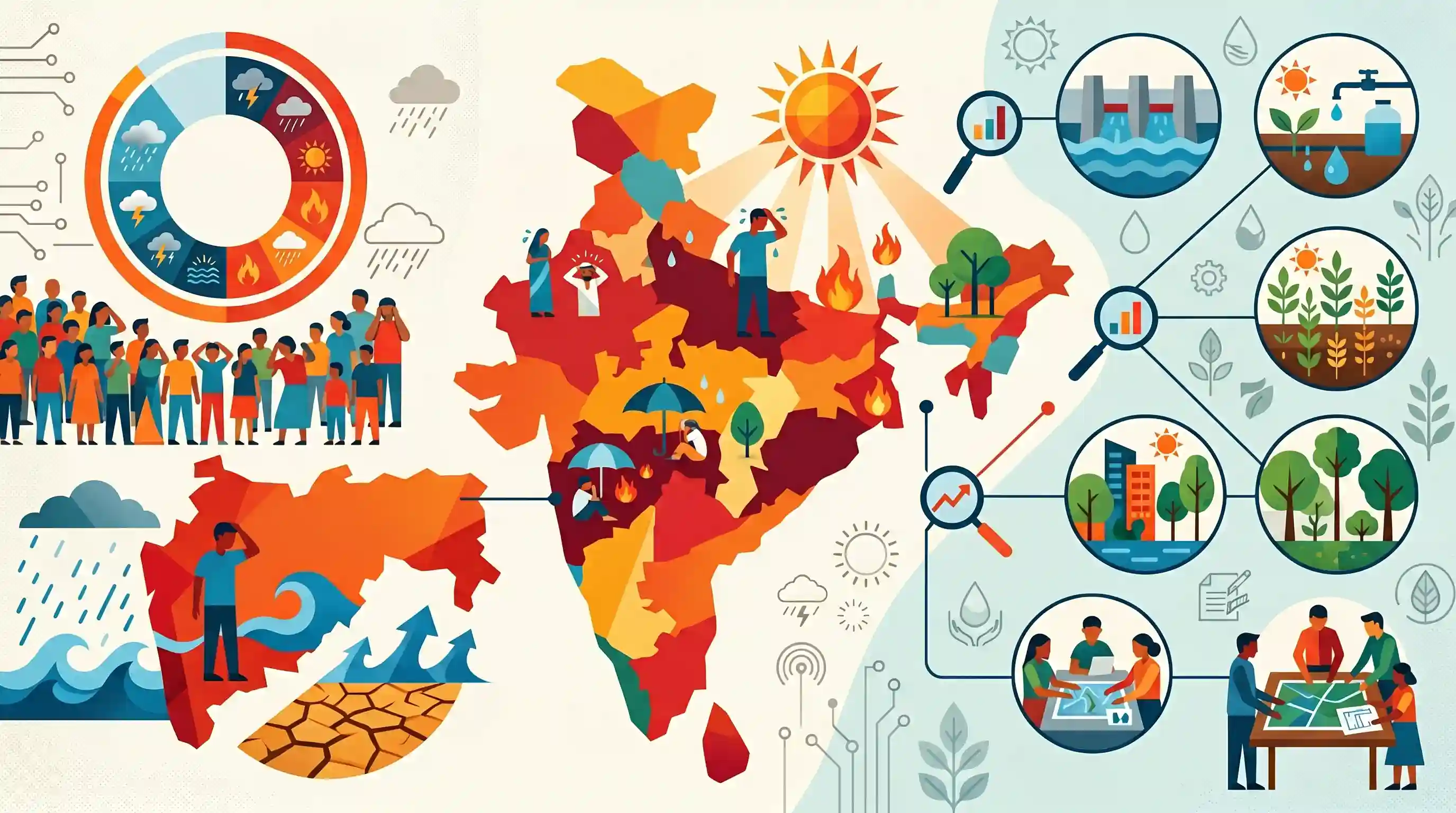
A new survey, the 'Climate Opinion Maps for India' by the Yale Program on Climate Change Communication, reveals that an overwhelming majority of Indians are personally experiencing the impacts of global warming. In Maharashtra, nearly 90% of adults report feeling these effects, particularly through erratic monsoons, floods, and droughts. Nationally, severe heat waves are the most commonly experienced extreme weather event, especially in northern and eastern states like UP, Rajasthan, and Odisha. The study highlights India's extreme climate vulnerability, having faced severe weather on almost 90% of the days in 2024. Researchers advocate using this district-level data to create targeted local climate action and adaptation plans.
Key Points
- The 'Climate Opinion Maps for India' survey by Yale University and C-Voter provides granular, district-level data on how Indians perceive and experience climate change.
- Nationally, 71% of people report experiencing severe heat waves, with states like UP, Rajasthan, Haryana, and Odisha recording the highest vulnerability at around 80%.
- India faced extreme weather events on 322 days in 2024, underlining its status as a highly climate-vulnerable nation and the third-largest emitter of greenhouse gases.
- The data highlights a gap between personal experience and attribution, with many blaming global warming for extreme weather even if they haven't personally experienced it recently.
- Experts emphasize utilizing this granular data to design localized climate action plans, adaptation policies, and communication strategies that reflect the lived realities of the public.
Important Terms
Yale Program on Climate Change Communication (YPCCC)

A research center at the Yale School of the Environment that investigates public climate knowledge, risk perceptions, and policy support to inform global climate communication strategies.
UPSC context
GS Paper III: Environmental Impact Assessment. Useful for discussing the gap between scientific consensus and public perception in India.
Climate Opinion Maps for India
An interactive digital tool providing the first district-level data on climate change beliefs, risk perceptions, and policy preferences across 34 Indian states and Union Territories.
UPSC context
GS Paper III: Disaster Management. Highlights the importance of localized data for decentralized climate adaptation and community resilience.
C-Voter
The Centre for Voting Opinion & Trends in Election Research; a prominent Indian polling agency that partners with international institutions for large-scale socio-political and environmental surveys.
UPSC context
GS Paper II: Governance. Relevant for methodology in public opinion polling and its role in shaping democratic policy responses.
Climate Adaptation
Adjustments in ecological, social, or economic systems in response to actual or expected climatic stimuli to moderate harm or exploit beneficial opportunities.
UPSC context
GS Paper III: Environment. A core pillar of India's National Action Plan on Climate Change (NAPCC) for long-term sustainability.
State Action Plan on Climate Change (SAPCC)
Policy frameworks designed by individual Indian states to outline region-specific strategies for climate mitigation and adaptation, aligned with India's national climate goals.
UPSC context
GS Paper III: Environment/Policy. Critical for understanding federalism in environmental governance and sub-national climate commitments.
University of Queensland
A top-tier Australian research institution whose faculty co-led the 'Climate Change in the Indian Mind' studies, providing academic rigor to Indian climate communication research.
UPSC context
GS Paper III: Environment. Represents international academic collaboration in developing India-specific climate vulnerability and perception datasets.
Prelims Trap
"The 'Climate Opinion Maps for India' index is published by NITI Aayog or the NDMA."
Aspirants often assume district-level indices mapping climate vulnerability or opinions are published by NITI Aayog, NDMA, or IMD. This specific survey is non-governmental.
Static Concepts Connected
What is the framework for decentralized climate planning in India?
- SAPCC Genesis: State Action Plans on Climate Change (SAPCC) were created to decentralize the core objectives of the National Action Plan on Climate Change (NAPCC).
- District-level focus: Planning is increasingly shifting towards District Climate Action Plans to address localized vulnerabilities, micro-climatic shifts, and targeted adaptation strategies.
What is the 'swapping trend' in Indian hydro-meteorological hazards?
- Hazard swapping: Districts traditionally prone to floods are increasingly experiencing severe droughts, while historically drought-prone regions are facing flash floods.
- Root causes: This is driven by changing monsoon dynamics, Arabian Sea warming, micro-climatic disruptions, and erratic land-use patterns across the subcontinent.
Cross-Topic Patterns
Climate Action + Local Governance (73rd/74th CAA)
District-level climate opinion and vulnerability data directly links to empowering Panchayats and Urban Local Bodies for localized disaster resilience and adaptation planning.
Hazard Swapping + Cropping Patterns
The shifting of flood-prone districts to drought (and vice versa) severely threatens traditional, static cropping systems, necessitating urgent climate-smart agriculture interventions.

Expect a 2026 Prelims question pairing India's 3rd-rank in absolute emissions with its low per-capita footprint and hazard swapping trends.
Linked PYQs · 4
Linked PYQs · 4
- 2017MainsGS3
'Climate change' is a global problem. How India will be affected by climate change? How Himalayan and coastal states of India will be affected by climate change?
- 2019MainsGS3
Vulnerability is an essential element for defining disaster impacts and its threat to people. How and in what ways can vulnerability to disasters be characterized? Discuss different types of vulnerability with reference to disasters.
- 2022MainsGS3
Discuss global warming and mention its effects on the global climate. Explain the control measures to bring down the level of greenhouse gases which cause global warming, in the light of the Kyoto Protocol, 1997.
- 2024MainsGS3
Flooding in urban areas is an emerging climate-induced disaster. Discuss the causes of this disaster. Mention the features of two such major floods in the last two decades in India. Describe the policies and frameworks in India that aim at tackling such floods.
