World Health Organization Declares Ebola Outbreak in Central Africa
Source:The Hindu ↗
Why It Matters
The recurring outbreaks of viral hemorrhagic fevers like Ebola underscore the vulnerability of global health security. UPSC candidates must understand the geographical spread (Congo basin, Central Africa), the nature of the virus (transmission, lack of vaccines for specific strains), and the role of international bodies like WHO in declaring and managing Public Health Emergencies of International Concern (PHEIC).
Summary
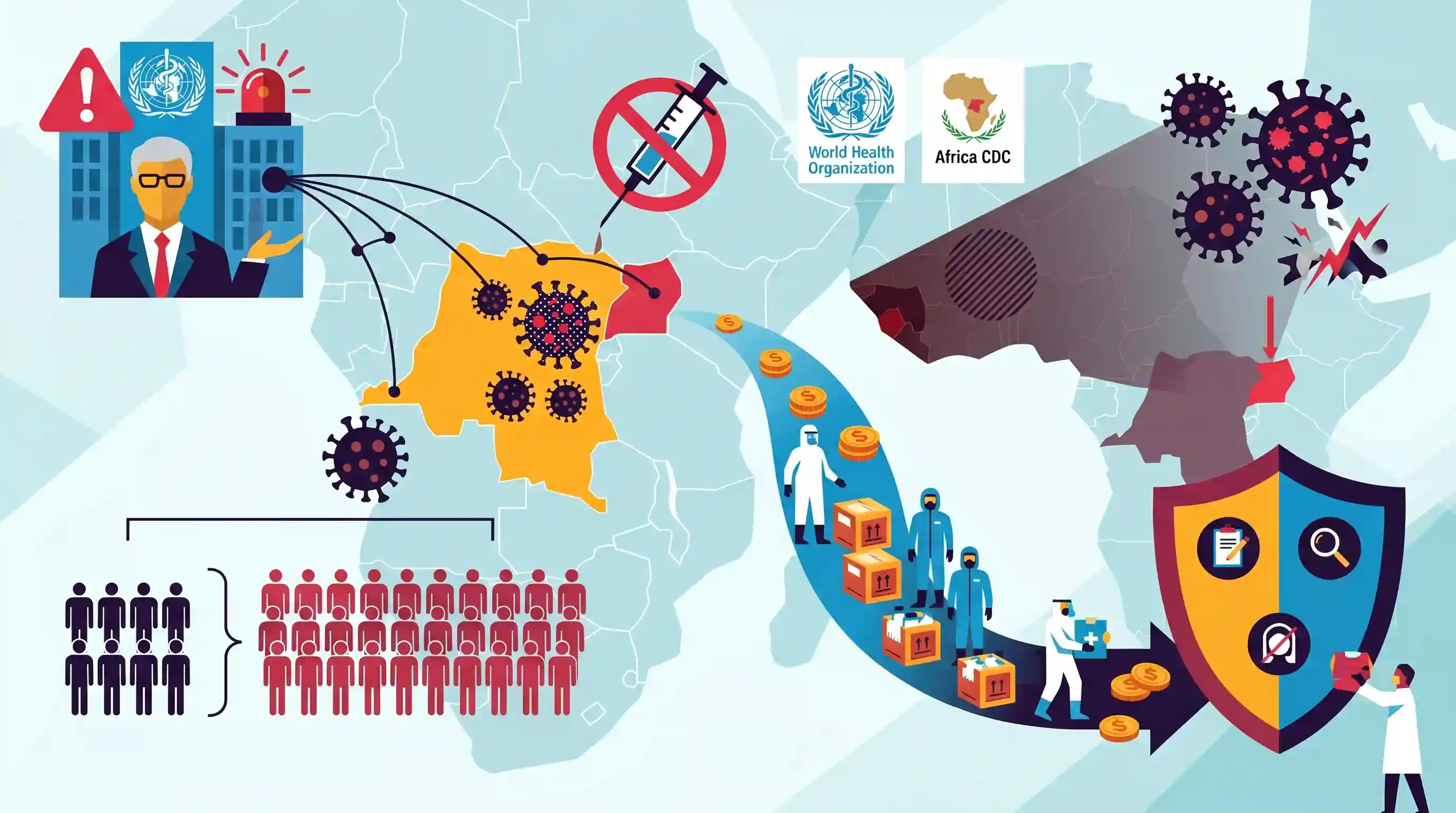
The World Health Organization (WHO) has declared a new Ebola outbreak in the Democratic Republic of Congo and Uganda a public health emergency of international concern. Driven by the rare Bundibugyo strain, for which no vaccines currently exist, the outbreak has claimed 84 lives from nearly 500 confirmed cases. In response, WHO and the Africa CDC have launched a $518-million containment plan, amid fears it could rival the devastating 2014 West Africa epidemic.
Key Points
- Nearly 500 confirmed cases and 84 deaths have been recorded in the DRC and Uganda due to a new Ebola outbreak.
- The outbreak is caused by the rare Bundibugyo ebolavirus strain, which currently lacks approved vaccines or targeted treatments.
- The World Health Organization (WHO) has officially declared the situation a Public Health Emergency of International Concern (PHEIC).
- WHO and the Africa CDC have rolled out a $518-million regional response plan to control the spread of the virus.
Important Terms
Public Health Emergency of International Concern (PHEIC)

A formal declaration by the WHO for extraordinary events that constitute a global public health risk through international spread, necessitating a coordinated international response under IHR 2005.
UPSC context
GS Paper II (International Relations) and GS III (Health); tests knowledge of global health governance frameworks and WHO's emergency powers.
Africa Centres for Disease Control and Prevention (Africa CDC)
A specialized, autonomous public health agency of the African Union (AU) established to strengthen the capacity of member states to detect and respond to disease threats.
UPSC context
GS Paper II (International Relations/Institutions); tests understanding of regional health organizations and South-South cooperation in disease management.
Bundibugyo virus (BDBV)
One of the rare species of Ebola virus; it is characterized by high fatality rates and, as of current outbreaks, a lack of approved vaccines or treatments.
UPSC context
GS Paper III (Science and Technology); tests knowledge of viral diseases, zoonoses, and the challenges of vaccine development for rare strains.
International Health Regulations (IHR) 2005
A legally binding international agreement involving 196 countries, aimed at helping the global community prevent and respond to public health risks that cross borders.
UPSC context
GS Paper II (Governance/Health); critical for understanding the legal obligations of states during pandemics and global health security.
World Health Organization (WHO)
The United Nations specialized agency for international public health, responsible for setting global standards, coordinating emergency responses, and declaring global health emergencies.
UPSC context
GS Paper II (International Institutions); fundamental for questions on global governance and multilateralism in the health sector.
Ebola Virus Disease (EVD)
A severe, often fatal illness in humans caused by orthoebolaviruses; it is a zoonotic disease typically transmitted through contact with infected bodily fluids.
UPSC context
GS Paper III (Science/Health); relevant for topics on infectious diseases, biosecurity, and public health infrastructure.
Prelims Trap
Existing Ebola vaccines provide broad immunity against all major strains, including the Bundibugyo ebolavirus.
Ervebo, the main licensed vaccine, only protects against the Zaire strain. The Bundibugyo strain currently has no approved vaccines or targeted treatments.
Static Concepts Connected
What constitutes a Public Health Emergency of International Concern (PHEIC)?
- IHR 2005: Declared under the legally binding International Health Regulations (IHR) 2005 by the WHO Director-General.
- Key Criteria: An extraordinary event that poses a public health risk to other countries through international spread.
- Global Response: Triggers temporary recommendations for global coordination, funding, and potential travel or trade advisories.
What are the transmission and reservoir characteristics of the Ebola virus?
- Natural Reservoir: The virus is zoonotic, with fruit bats of the Pteropodidae family considered its primary natural hosts.
- Transmission Mechanism: Spreads through direct contact with infected blood, organs, or bodily fluids. It is explicitly not an airborne disease.
- Pathogen Family: It causes severe viral hemorrhagic fever and belongs to the Filoviridae family, alongside the Marburg virus.
Cross-Topic Patterns
Zoonosis and Congo Basin Geography
The DRC's geography (Cuvette Centrale peatlands, rainforests) frequently links deforestation and human encroachment to the spillover of zoonotic diseases like Ebola and Mpox.
Rise of Regional Health Governance
Co-leadership by the Africa CDC (African Union) alongside WHO highlights a decentralizing shift in global health security management following recent global pandemics.

Expect a 2026 multi-statement question combining WHO's PHEIC criteria with the transmission traits of viral hemorrhagic fevers like Ebola.
Linked PYQs · 4
Linked PYQs · 4
- 2015PrelimsGS1
Among the following, which were frequently mentioned in the news for the outbreak of Ebola virus recently?
- 2016PrelimsGS1
'Doctors Without Borders (Medecins Sans Frontieres)', often in the news, is
- 2023PrelimsGS1
Which one of the following is a part of the Congo Basin?
- 2024PrelimsGS1
One of the following regions has the world's largest tropical peatland, which holds about three years worth of global carbon emissions from fossil fuels; and the possible destruction of which can exert detrimental effect on the global climate. Which one of the following denotes that region?
