RBI Bulletin Macroeconomic Stability and Growth Outlook
Source:The Hindu ↗
Why It Matters
The RBI Bulletin is a primary source of macroeconomic data and policy direction. This extraction touches upon critical GS3 topics like inflation targeting, Capex-led growth, foreign capital inflows (FDI/FPI), and global trade agreements, which are frequent subjects in both Prelims and Mains.
Summary
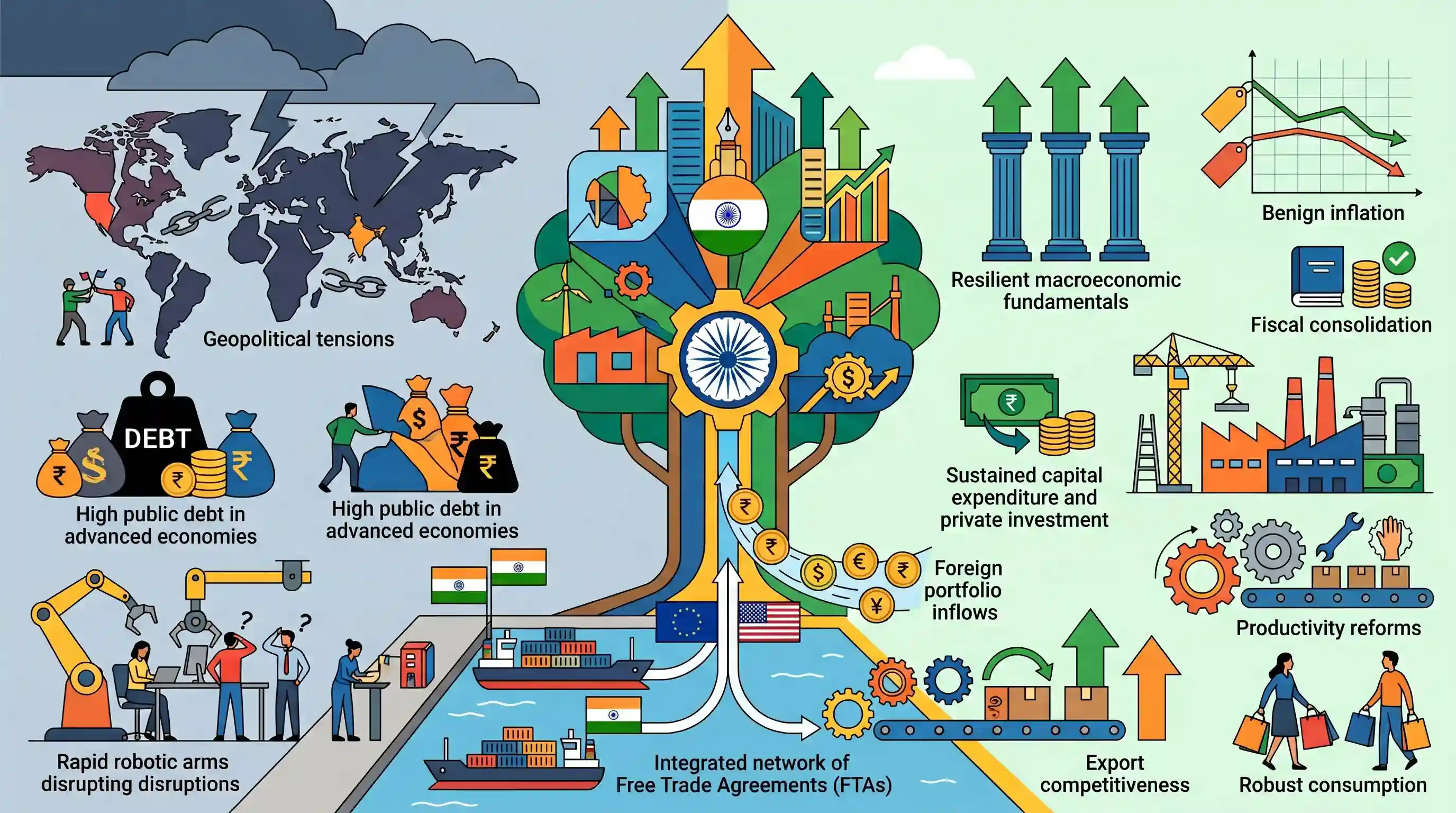
The Reserve Bank of India (RBI) Bulletin underscores a favorable near-term economic outlook for India, driven by robust consumption, investment, and productivity reforms. While global markets navigate volatility due to geopolitical tensions, high public debt in advanced economies, and AI-related disruptions, India's macroeconomic fundamentals remain resilient. Benign inflation, fiscal consolidation, and sustained capital expenditure have bolstered private investment. Moreover, advancements in Free Trade Agreements (FTAs) with the EU and the US are poised to boost export competitiveness and integrate domestic firms into global value chains, supported by a healthy resurgence in foreign portfolio inflows.
Key Points
- The RBI Bulletin highlights that India's near-term economic growth is largely propelled by consumption, investment, and ongoing productivity-enhancing reforms.
- Inflation is projected to remain benign and closely aligned with the central bank's target, reinforcing macroeconomic stability.
- Trade negotiations, including the India-EU FTA and an interim agreement with the US, are expected to improve market access and integrate Indian companies into global value chains.
- Despite global volatility from geopolitical tensions and public debt issues in Advanced Economies, India saw a strong rebound in Foreign Portfolio Investment (FPI) and sustained government capital expenditure (capex).
- Emerging risks highlighted include the stretched valuations of AI firms and the potential disruptive impact of AI on the software services sector.
Important Terms
India-EU Free Trade Agreement (FTA)

A comprehensive economic pact concluded in January 2026, aimed at liberalizing trade in goods, services, and investments between India and the 27-member European bloc.
UPSC context
GS Paper II (International Relations) & III (Economy); tests bilateral groupings and global value chain integration.
India-US Interim Trade Agreement
A 2026 trade framework focused on reciprocal tariff reductions and market access, acting as a precursor to a comprehensive Bilateral Trade Agreement (BTA).
UPSC context
GS Paper II (IR); covers India-US strategic-economic ties and trade barrier negotiations.
RBI Bulletin
A monthly publication providing authoritative data and analysis on India’s macroeconomic health, monetary policy, and the 'State of the Economy'.
UPSC context
GS Paper III (Economy); essential for tracking official growth projections and inflation trends.
Fiscal Consolidation
Policies aimed at reducing government deficits and debt-to-GDP ratios to ensure long-term financial sustainability and macroeconomic stability.
UPSC context
GS Paper III (Budgeting); relates to deficit targets and the impact of fiscal discipline on private investment.
Capital Expenditure (CAPEX)
Government spending on asset creation (e.g., infrastructure) intended to boost the economy's productive capacity and 'crowd in' private investment.
UPSC context
GS Paper III (Investment Models); focuses on growth drivers and long-term economic development.
European Union (EU)
A supranational political and economic union of 27 member states that functions as a single market and is India's largest trading partner.
UPSC context
GS Paper II (IR); significant for regional groupings and India’s interests in the Western hemisphere.
Prelims Trap
"Increased government expenditure invariably leads to the 'crowding out' of private sector investment."
While high government borrowing generally crowds out private credit, government capital expenditure (capex) on infrastructure actually "crowds in" private investment by lowering operational costs and creating demand.
Static Concepts Connected
How does government expenditure impact private investment?
- Crowding Out: High government revenue expenditure and borrowing can increase interest rates, making credit expensive and limiting funds for the private sector.
- Crowding In: Government capital expenditure (capex) on physical infrastructure lowers logistical costs and boosts aggregate demand, directly encouraging private sector capacity expansion.
What is the Flexible Inflation Targeting (FIT) framework?
- Statutory Mandate: The RBI Act, 1934 was amended in 2016 to legally mandate the RBI to maintain price stability while keeping growth in mind.
- CPI Anchor: The target is anchored exclusively to the Consumer Price Index (CPI) at 4%, with an upper tolerance of 6% and a lower tolerance of 2%.
Cross-Topic Patterns
AI disruption and Balance of Payments
AI's threat to the software sector connects directly to India's Balance of Payments, as robust IT service exports are historically crucial for offsetting the country's persistent merchandise trade deficit.
FTAs and GVC Integration
The push for FTAs with developed markets (EU, US) reflects a geoeconomic strategy to integrate domestic MSMEs into Global Value Chains (GVCs), pivoting from earlier deficits run under Asian FTAs.

Expect a 2026 question linking government capex's "crowding in" effect with inflation targeting and FPI volatility in advanced economies.
Linked PYQs · 5
Linked PYQs · 5
- 2022MainsGS3
Economic growth in the recent past has been led by increase in labour productivity." Explain this statement. Suggest the growth pattern that will lead to creation of more jobs without compromising labour productivity.
- 2020MainsGS3
Explain the meaning of investment in an economy in terms of capital formation. Discuss the factors to be considered while designing a concession agreement between a public entity and a private entity.
- 2011MainsGS2
Compared to the South Asian Free Trade Area (SAFTA), the Bay of Bengal Initiative for Multisectoral Technical and Economic Cooperation Free Trade Area (BIMSTEC FTA) seems to be more promising." Critically evaluate.
- 2021PrelimsGS1
Consider the following : 1. Foreign currency convertible bonds 2. Foreign institutional investment with certain conditions 3. Global depository receipts 4. Non-resident external deposits Which of the above can be included in Foreign Direct Investments?
- 2020PrelimsGS1
With reference to Foreign Direct Investment in India, which one of the following is considered its major characteristic?
