RBI bulletin highlights positive near term economic growth outlook
Source:The Hindu ↗
Why It Matters
The article synthesizes the RBI's official assessment of India's macroeconomic fundamentals. Understanding the interplay between capital expenditure, fiscal consolidation, inflation targeting, and external trade (FTAs, FPI flows) is critical for answering analytical questions in GS Paper 3.
Summary
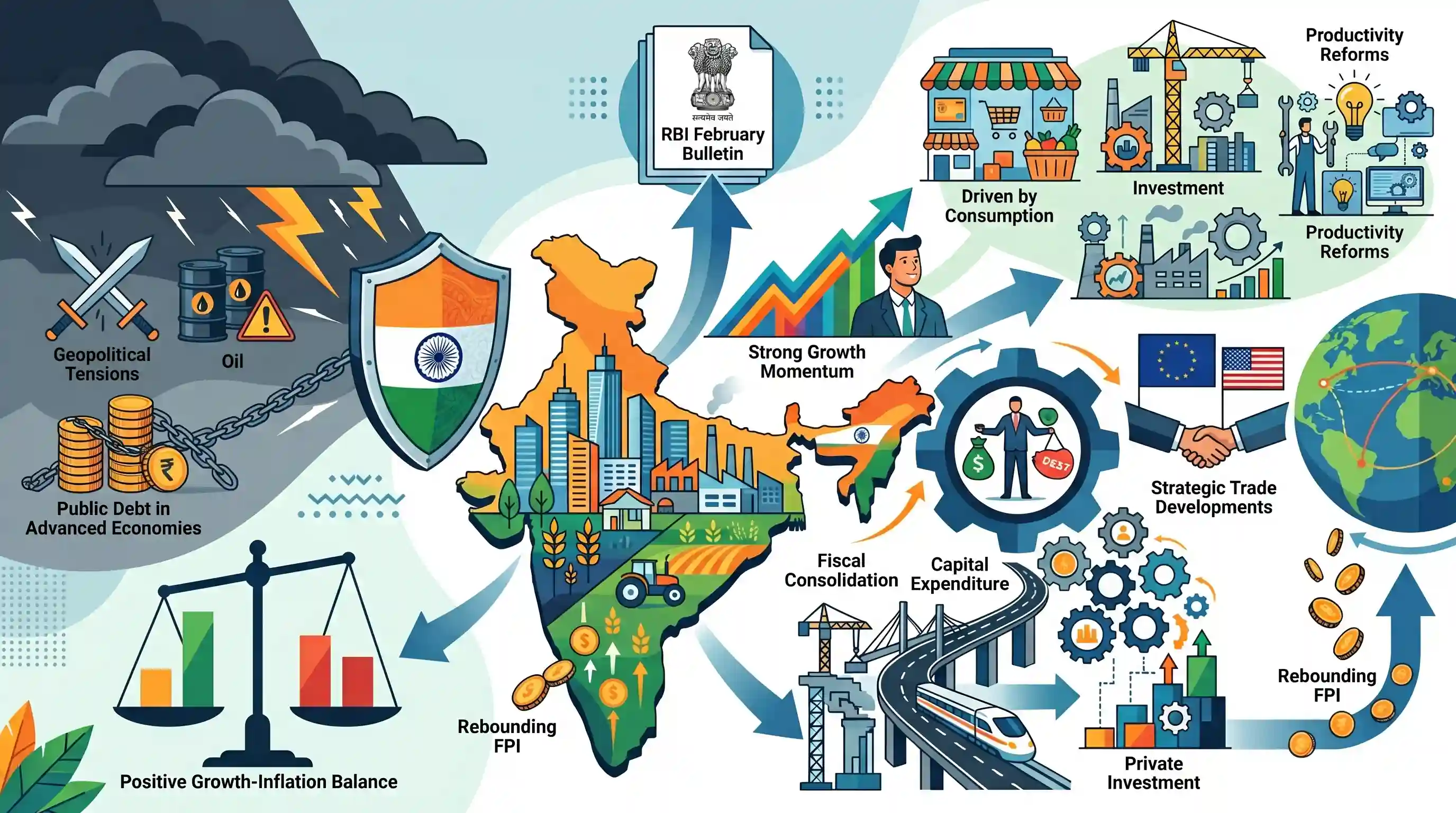
The RBI's February Bulletin presents a highly optimistic near-term economic outlook for India, pointing to strong growth momentum fueled by consumption, investment, and productivity-enhancing reforms. Defying global headwinds such as geopolitical tensions and public debt concerns in advanced economies, India maintains a positive growth-inflation balance. The central bank emphasizes that ongoing fiscal consolidation and sustained capital expenditure will crowd in private investment. Additionally, strategic trade developments, including an impending India-EU FTA and an interim pact with the U.S., alongside rebounding Foreign Portfolio Investments (FPI), signal robust macroeconomic health and deeper integration into global value chains.
Key Points
- The RBI Bulletin highlights a favorable near-term economic outlook for India, driven by consumption, investment, and structural reforms.
- Inflation is expected to remain benign and align with the RBI's target, ensuring a positive growth-inflation balance.
- Progress on free trade agreements with the EU and the U.S. is anticipated to enhance market access, export competitiveness, and integration into global value chains.
- Foreign Portfolio Investment (FPI) has staged a strong recovery in both equity and debt segments, despite global macroeconomic uncertainties.
- The government's continued focus on fiscal consolidation and capital expenditure is expected to crowd in private investment and support sub-national infrastructure development.
Important Terms
India-EU Free Trade Agreement (FTA)

A comprehensive trade pact (concluded Jan 2026) aimed at liberalizing trade in goods, services, and digital sectors, significantly reducing tariffs on over 90% of trade lines between the two partners.
UPSC context
GS II & III: International Relations and Liberalization. Tests understanding of deep economic integration and strategic trade partnerships with major blocs.
India-U.S. Interim Trade Framework
An agreement announced in early 2026 to lower reciprocal tariffs and ease trade tensions between India and the U.S., serving as a precursor to a full Bilateral Trade Agreement (BTA).
UPSC context
GS II: Bilateral Agreements. Tests knowledge of trade diplomacy, reciprocal tariffs, and evolving strategic-economic ties with the United States.
Fiscal Consolidation
A policy strategy aimed at reducing the government's fiscal deficit and debt-to-GDP ratio to ensure long-term macroeconomic stability; India's target is below 4.5% by 2025-26.
UPSC context
GS III: Government Budgeting. Tests knowledge of the 'fiscal glide path' and the balance between spending and deficit management.
Capital Expenditure (Capex)
Government spending on physical or social assets (like roads or schools) that provides long-term economic benefits and has a higher multiplier effect on GDP compared to revenue expenditure.
UPSC context
GS III: Growth and Development. Tests understanding of the 'Capex-led' growth model and its role in infrastructure development.
Crowding-in Effect
The phenomenon where targeted public investment in infrastructure enhances productivity and business confidence, thereby encouraging or 'crowding in' additional private sector investment.
UPSC context
GS III: Investment Models. Tests the ability to analyze how public spending complements rather than replaces private capital.
Foreign Portfolio Investment (FPI)
Investment by foreign entities in Indian financial assets like stocks, bonds, and notes. It is generally more volatile and short-term compared to Foreign Direct Investment (FDI).
UPSC context
GS III: Mobilization of Resources. Tests understanding of capital flows, market volatility, and their impact on the Indian Rupee.
Prelims Trap
"Increased government capital expenditure 'crowds out' private investment by exhausting domestic financial savings."
UPSC often swaps 'crowding in' and 'crowding out'. High revenue deficits crowd out private credit, but infrastructure Capex crowds in private investment by lowering structural costs.
Static Concepts Connected
What is the 'Crowding In' effect of government spending?
- The Mechanism: When government invests heavily in physical infrastructure, it creates a multiplier effect and lowers logistics costs for businesses.
- The Outcome: This improved business environment encourages private sector investments that might not have happened otherwise.
- Contrast: 'Crowding out' occurs when excessive government borrowing (usually for revenue expenditure) dries up private credit and drives up interest rates.
How does the RBI's Flexible Inflation Targeting (FIT) work?
- Statutory Mandate: Governed by the amended RBI Act, 1934, making price stability the primary objective while keeping economic growth in mind.
- The Target: A Consumer Price Index (CPI) target of 4%, with a tolerance band of +/- 2% monitored by the Monetary Policy Committee.
Cross-Topic Patterns
FTAs + Global Value Chains (GVCs)
The India-EU FTA represents a shift from traditional tariff-reduction treaties to 'deep' FTAs that focus on regulatory standards, enabling Indian MSMEs to plug into global supply networks.
FPI surges + RBI sterilization
Rebounding FPI ('hot money') injects dollar liquidity. Aspirants must link this to the RBI's Open Market Operations (OMOs) used to sterilize excess rupee liquidity and curb inflation.

A 2026 prelims multi-statement question linking govt Capex ('crowding in') with inflation targeting outcomes is highly probable.
Linked PYQs · 5
Linked PYQs · 5
- 2020MainsGS3
Explain the meaning of investment in an economy in terms of capital formation. Discuss the factors to be considered while designing a concession agreement between a public entity and a private entity.
- 2019MainsGS3
The public expenditure management is a challenge to the Government of India in the context of budget making during the post-liberalization period. Clarify it.
- 2020PrelimsGS1
With reference to Foreign Direct Investment in India, which one of the following is considered its major characteristic?
- 2022PrelimsGS1
With reference to the Indian economy, consider the following statements: 1. If the inflation is too high, Reserve Bank of India (RBI) is likely to buy government securities. 2. If the rupee is rapidly depreciating, RBI is likely to sell dollars in the market. 3. If interest rates in the USA or European Union were to fall, that is likely to induce RBI to buy dollars. Which of the statements given above are correct?
- 2017MainsGS3
Account for the failure of manufacturing sector in achieving the goal of labour-intensive exports. Suggest measures for more labour-intensive rather than capital-intensive exports.
