Indian American Lawyer Neal Katyal Challenges US Tariff Policy
Source:Indian Express ↗
Why It Matters
The article provides a concrete example for GS2 questions on the role and influence of the Indian diaspora in US politics. It also touches upon US protectionism and tariff policies, which directly impact the global economy and India's trade interests.
Summary
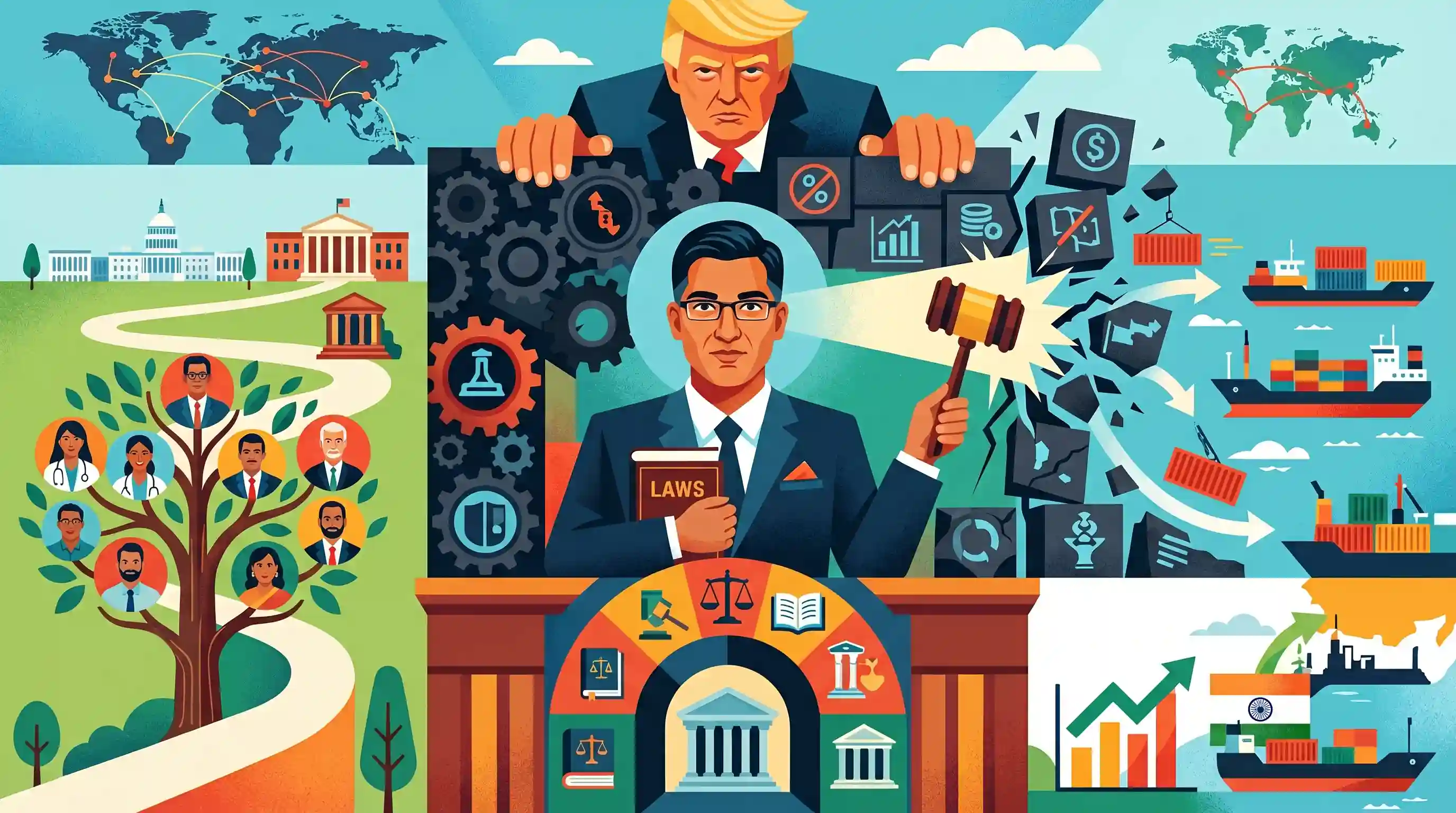
Indian-American lawyer and former US Acting Solicitor General Neal Katyal has played a critical role in legally challenging and dealing a blow to Donald Trump's "Trump 2.0" tariff agenda. His legal efforts highlight the power of the US judiciary to review executive trade actions and check broad protectionist policies. Additionally, Katyal's prominence serves as a prime example of the Indian diaspora's significant influence in the upper echelons of the American legal and political systems.
Key Points
- Prominent Indian-American lawyer Neal Katyal successfully led legal challenges dealing a major blow to Donald Trump's proposed 'Trump 2.0' protectionist tariff agenda.
- The case illustrates the role of the US judicial system in scrutinizing and potentially restricting broad executive actions concerning international trade and tariffs.
- Legal resistance to sweeping unilateral tariffs in the US helps shape global trade dynamics and provides checks on protectionism.
- The involvement of a high-profile Indian-American attorney underscores the decisive role and growing influence of the Indian diaspora in the highest echelons of US legal and political systems.
Important Terms
Separation of Powers

A constitutional principle dividing government into three branches (Legislative, Executive, Judiciary) to prevent absolute power. The US follows a 'rigid' model compared to India’s 'loose' parliamentary model.
UPSC context
GS Paper 2: Comparison of the Indian constitutional scheme with other countries; fundamental for understanding global democratic governance models.
Judicial Review
The power of the judiciary to examine and invalidate executive or legislative acts that violate the Constitution. In the US, it strictly checks presidential trade and taxing authority.
UPSC context
GS Paper 2: Structure, organization, and functioning of the Judiciary; tests the balance of power between different organs of state.
Indian Diaspora
The community of Indian citizens and people of Indian origin living outside India. They serve as a bridge of 'soft power' and influence host-country policies.
UPSC context
GS Paper 2: Indian Diaspora and its impact on India’s interests; highlights the political and legal clout of the overseas community.
Protectionism
Economic policies, such as tariffs and quotas, designed to restrict imports to protect domestic industries from foreign competition, often leading to global trade wars.
UPSC context
GS Paper 2/3: Effect of policies of developed countries on India's interests; evaluates the impact on India’s export-led growth.
Solicitor General
In the US, the chief advocate representing the federal government in the Supreme Court. In India, the Solicitor General assists the Attorney General (Article 76).
UPSC context
GS Paper 2: Constitutional and non-constitutional bodies; involves comparing the highest law officers across different jurisdictions.
Reciprocal Tariffs
Trade policies where a country imposes duties on imports at the same level as the duties imposed by the exporting country on its own goods.
UPSC context
GS Paper 3: Indian Economy and issues relating to planning, mobilization of resources, and growth; specifically international trade barriers.
Prelims Trap
"The US President has absolute, unreviewable constitutional authority to impose unilateral trade tariffs."
Under the US Constitution, Congress holds the power to regulate commerce. The President uses delegated statutory authority (e.g., Section 232), which is subject to judicial review.
Static Concepts Connected
How does the 'Separation of Powers' differ between the US and India?
- Strict vs Fusion: The US mandates strict separation among branches. India's parliamentary system features a functional fusion, where the executive is drawn from and responsible to the legislature.
- Delegated Authority limits: Unlike the Indian executive's broad mandate, US Presidents rely heavily on delegated congressional authority for trade tariffs, making executive overreach frequently subject to strict judicial scrutiny.
What are the primary macroeconomic tools of trade protectionism?
- Import Tariffs: Direct taxes levied on imported goods to artificially raise their prices, thereby shielding domestic industries from foreign competition.
- Import Quotas: Quantitative restrictions capping the maximum physical volume or monetary value of specific goods that can be imported over a timeframe.
- Non-Tariff Barriers: Regulatory hurdles such as stringent sanitary and phytosanitary (SPS) standards, complex licensing procedures, or mandatory local content requirements.
Cross-Topic Patterns
Diaspora as strategic policy shapers
The diaspora has evolved from generating remittances to actively influencing host-nation governance, acting as systemic checks against aggressive protectionism in developed countries.
US Protectionism & Indian Exports
Judicial checks on US executive tariff powers indirectly stabilize global supply chains, safeguarding vulnerable Indian export sectors like pharma and textiles from arbitrary shocks.

Expect a GS2 question comparing US-India executive powers, or evaluating the diaspora's role in checking host-nation protectionist policies.
Linked PYQs · 3
Linked PYQs · 3
- 2020MainsGS2
Indian diaspora has a decisive role to play in the politics and economy of America and European Countries'. Comment with examples.
- 2023MainsGS2
Indian diaspora has scaled new heights in the West. Describe its economic and political benefits for India.
- 2012MainsGS2
Discuss the likely negative impact of the protectionist measures proposed by the US on India's software industry.
