Jodhpur Umaid Hospital Postoperative Sepsis Healthcare Lapse
Source:ndtv ↗
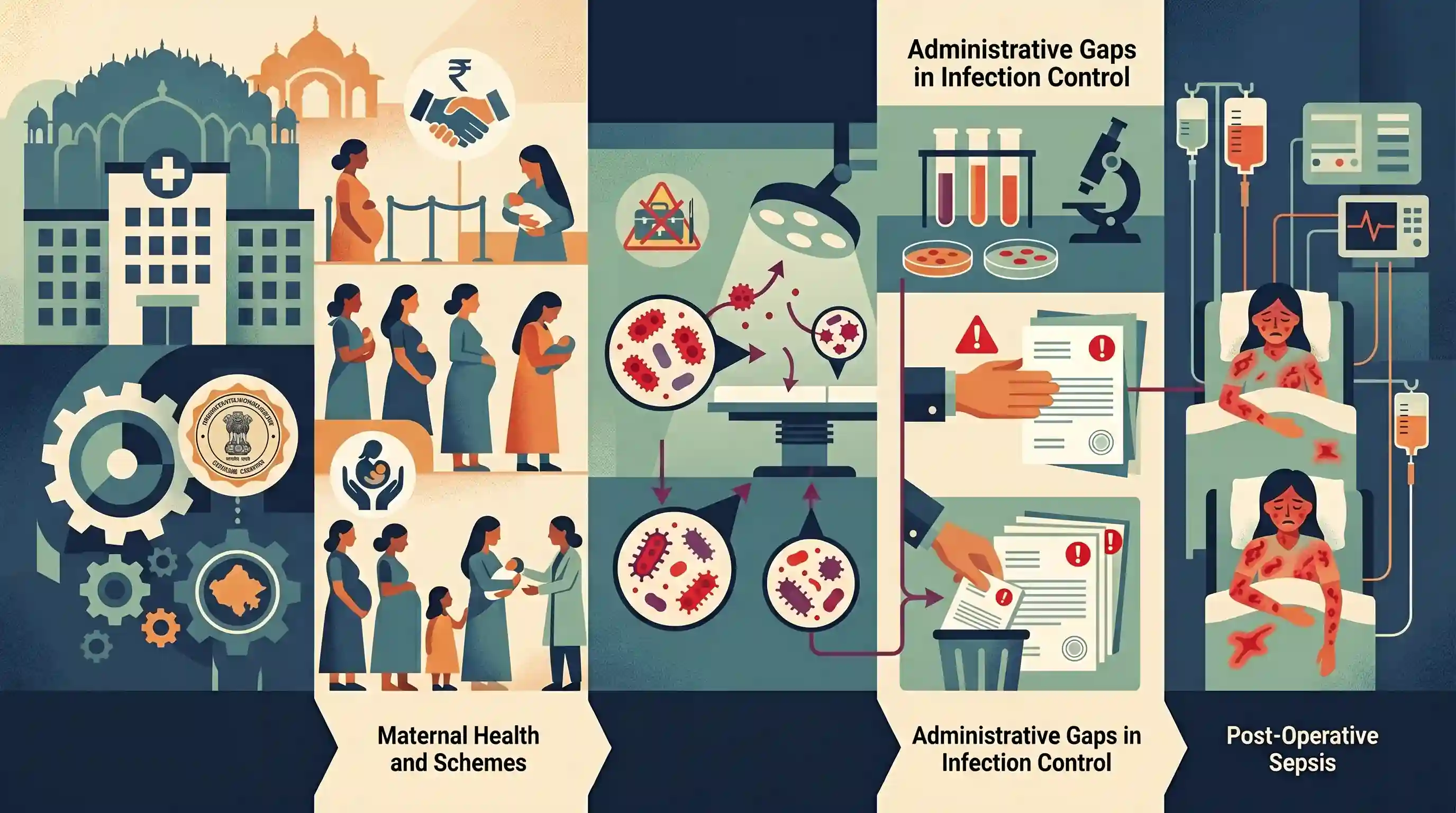
Why It Matters
This case study is highly relevant for understanding public health governance, the challenges of state healthcare delivery in Rajasthan, the implementation of maternal welfare schemes, and basic scientific principles of clinical infection control (microbiology). It directly relates to the RAS syllabus under Public Health, State Government Welfare Schemes, and General Science.
Summary
This NDTV investigation delves into a serious healthcare lapse at Jodhpur's Umaid Hospital, where eight new mothers developed critical post-operative sepsis after C-sections. The investigation revealed that routine OT culture tests, which had flagged severe bacterial contamination, were ignored by the hospital administration due to the high volume of maternal cases. This case highlights critical systemic failures in public healthcare, the biological threat of hospital-acquired (nosocomial) infections, and the administrative gaps in implementing infection-control protocols in Rajasthan's state hospitals.
Key Points
- At Jodhpur's state-run Umaid Hospital (attached to Dr. S.N. Medical College), eight new mothers suddenly fell critically ill and developed severe post-operative sepsis after undergoing Caesarean sections.
- The investigation exposed severe lapses in infection control, highlighting that routine operation theatre (OT) culture tests had shown heavy bacterial contamination, which went ignored because of the high patient load (overcrowding).
- The incident spotlights the clinical threat of hospital-acquired infections (nosocomial infections) caused by opportunistic pathogens like Pseudomonas aeruginosa and Staphylococcus aureus, which spread due to poor OT sterilization, inadequate autoclaving, or contaminated equipment/IV fluids.
- Post-operative sepsis and hospital-acquired infections are major contributors to maternal morbidity and mortality, severely hindering Rajasthan's targets for reducing the Maternal Mortality Ratio (MMR).
- The incident highlights the critical need for administrative accountability, strict quality testing of medical supplies through the Rajasthan Medical Services Corporation (RMSCL), and adherence to National Health Mission guidelines.
Important Terms
Janani Suraksha Yojana (JSY)

A centrally sponsored safe motherhood scheme under the National Health Mission that provides cash incentives to promote institutional delivery and reduce maternal and neonatal mortality among poor pregnant women.
UPSC context
GS Paper II: Welfare Schemes; tests knowledge of maternal health interventions, rural healthcare, and direct benefit transfers.
Janani Shishu Suraksha Karyakram (JSSK)
A central initiative that entitles all pregnant women and sick infants accessing public health institutions to completely free, zero-expense delivery (including C-sections), drugs, diagnostics, and transport.
UPSC context
GS Paper II: Welfare Schemes; tests awareness of policies eliminating out-of-pocket expenditure in maternal/neonatal healthcare.
Pradhan Mantri Matru Vandana Yojana (PMMVY)
A direct benefit transfer scheme under the National Food Security Act, 2013, offering maternity cash benefits to pregnant and lactating women to compensate for wage loss and ensure nutrition.
UPSC context
GS Paper II: Social Justice; tests knowledge of statutory maternity benefits, nutritional support, and female welfare policies.
Drugs and Cosmetics Act, 1940
A key Indian legislation regulating the import, manufacture, distribution, and sale of drugs and cosmetics to ensure their safety, quality, and efficacy in the public interest.
UPSC context
GS Paper II: Governance & Health Sector; tests understanding of the legal framework governing pharmaceutical standards and safety.
Central Drugs Standard Control Organisation (CDSCO)
The national regulatory authority of India responsible for drug approval, clinical trials, setting pharmaceutical standards, and ensuring quality control under the Drugs and Cosmetics Act.
UPSC context
GS Paper II: Regulatory Bodies; tests knowledge of the administrative structure and executive authority regulating health products.
Rajasthan Medical Services Corporation Limited (RMSCL)
A state government public sector undertaking in Rajasthan incorporated in 2011 to serve as the centralized procurement agency for generic medicines, surgical equipment, and medical gear.
UPSC context
GS Paper II: State Governance & Health; tests understanding of decentralized procurement models and free medicine distribution systems.
Prelims Trap
Nosocomial infections refer only to pathogens contracted and manifesting symptoms while physically present inside the hospital premises.
Surgical site infections, a critical subset of nosocomial infections, can clinically manifest up to 30 days post-discharge and still be classified as hospital-acquired.
Static Concepts Connected
What are Nosocomial Infections and their key clinical characteristics?
- Clinical Timeline: Infections manifesting 48 hours or more post-admission, or within 30 days post-discharge for surgical site infections.
- Common Pathogens: Predominantly driven by opportunistic bacterial agents such as Staphylococcus aureus, Pseudomonas aeruginosa, and Escherichia coli.
- Key Vectors: Unsterilized surgical equipment, contaminated intravenous fluids, inadequate ventilation, and compromised healthcare worker hand hygiene.
How do JSY and JSSK differ in their maternal healthcare strategies?
- JSY Strategy: Focuses on conditional cash transfers to incentivize institutional delivery, specifically targeting low-performing states.
- JSSK Entitlements: Eliminates out-of-pocket expenses by guaranteeing free diagnostics, drugs, blood, and transport for pregnant women and newborns.
Cross-Topic Patterns
Nosocomial Infections + Antimicrobial Resistance
Hospital environments with poor infection control act as hotspots for selecting multi-drug resistant strains, compounding the global challenge of antimicrobial resistance.
Maternal Health + Governance Accountability
While cash incentives increase institutional deliveries, lack of clinical quality oversight (like LaQshya standards) risks reversing maternal mortality rate reduction targets.

Maternal health schemes (JSY, JSSK) and clinical quality protocols (LaQshya) are likely to be evaluated via comparative statements in 2026.
Linked PYQs · 3
Linked PYQs · 3
- 2023RPSC_PRELIMSGS1
Which scheme aims to improve the health and nutritional status of pregnant women and lactating mothers and their infants (0 to 6 months) by promoting the use of appropriate practices, care, and services during pregnancy, safe delivery, and breastfeeding?
- 2021RPSC_PRELIMSGS1
Identify the incorrect characteristic of the 'Udan' scheme recently announced by the Rajasthan government
- 2021RPSC_PRELIMSGS1
Under the Ayushman Bharat Mahatma Gandhi Rajasthan Health Insurance Scheme, the amount provided per family per year in the event of a critical illness health insurance is
