Jagjivan Ram Legacy and Contemporary Social Justice Welfare Policies
Source:The Hindu ↗
Why It Matters
The ideologies of key post-independence leaders like Babu Jagjivan Ram continue to shape contemporary social justice narratives and welfare policies. Studying his contributions provides critical context for UPSC questions on post-independence consolidation and the ideological foundations of schemes targeting vulnerable sections.
Summary
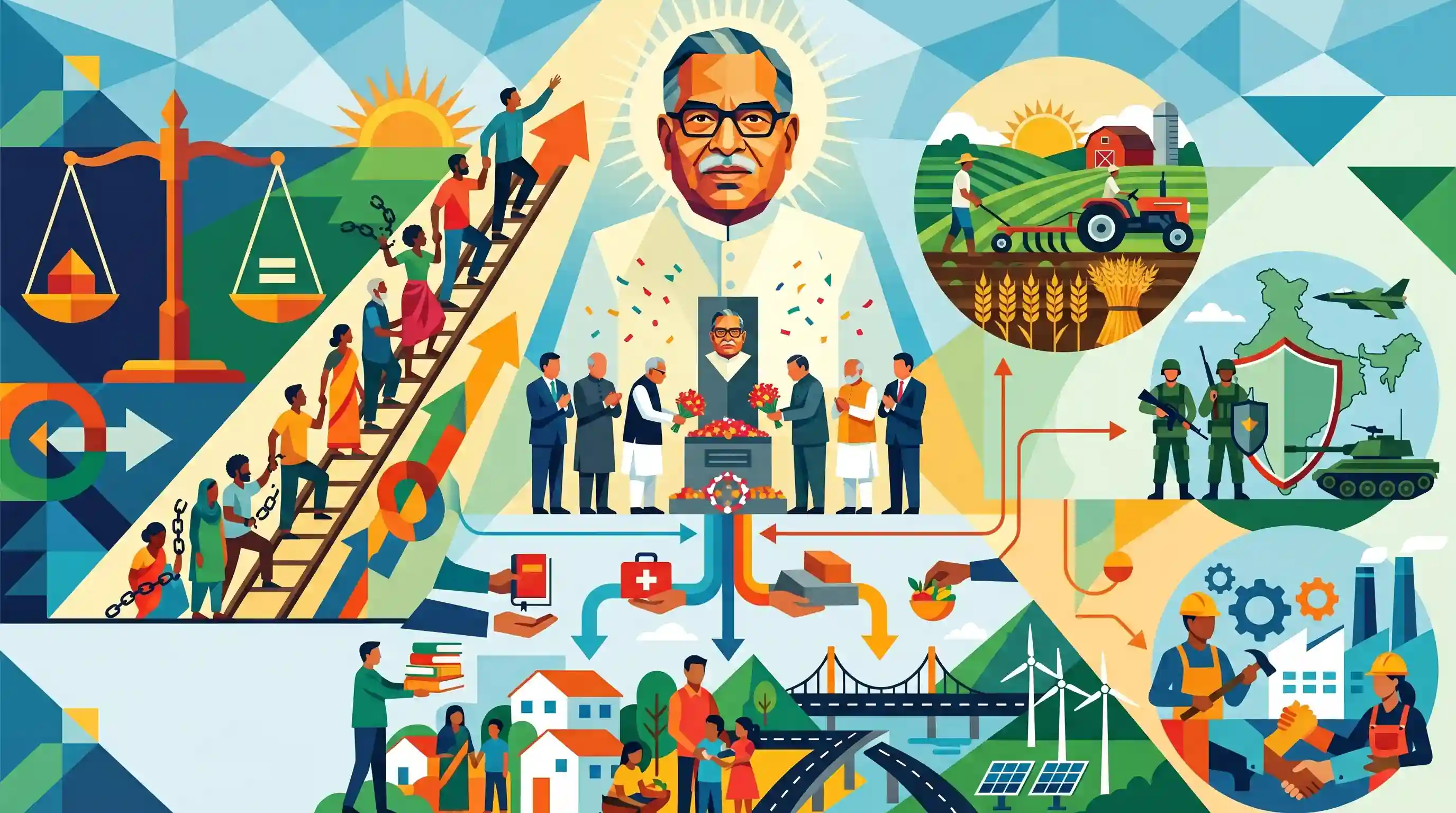
Andhra Pradesh Excise and Mines Minister Kollu Ravindra paid tributes to former Deputy Prime Minister Babu Jagjivan Ram on his 119th birth anniversary, asserting that the National Democratic Alliance (NDA) government's policies are deeply rooted in his ideology. He highlighted Jagjivan Ram's lifelong dedication to social justice, social equality, and the upliftment of marginalized and oppressed sections. The Minister reflected on Jagjivan Ram's three-decade-long contribution to nation-building across Agriculture, Defence, and Labour ministries, while linking this legacy to the ongoing developmental and welfare initiatives of the NDA and TDP regimes.
Key Points
- The 119th birth anniversary of former Deputy Prime Minister Babu Jagjivan Ram was commemorated, highlighting his legacy in championing social equality.
- Andhra Pradesh Minister Kollu Ravindra stated that the NDA government's policies for social justice are modeled on Jagjivan Ram’s ideology.
- Babu Jagjivan Ram served an influential three-decade tenure in the Cabinet, overseeing crucial portfolios like Agriculture, Defence, and Labour.
- The article draws continuity between historical visions for the upliftment of oppressed sections and the current welfare-oriented initiatives of the state and central coalition governments.
Important Terms
Babu Jagjivan Ram

Veteran freedom fighter, Dalit icon, and India's longest-serving Cabinet Minister. His portfolios included Labour (first), Food and Agriculture during the Green Revolution, and Defence during the 1971 Indo-Pak War.
UPSC context
GS Paper I (Modern History/Personalities) and GS Paper II (Social Justice). Tests knowledge of post-independence consolidation and contribution of Dalit leaders.
National Democratic Alliance (NDA)
A center-right political coalition in India led by the Bharatiya Janata Party (BJP), founded in 1998. It emphasizes national security, economic liberalisation, and social welfare through a cooperative federalist approach.
UPSC context
GS Paper II (Polity). Tests understanding of coalition politics, federalism, and the executive's functioning in India's multi-party system.
Telugu Desam Party (TDP)
A prominent regional party in Andhra Pradesh and Telangana, founded in 1982 by N.T. Rama Rao. It advocates for Telugu regionalism, welfare-oriented governance, and digital infrastructure.
UPSC context
GS Paper II (Polity). Relevant for topics on regional parties, state-level politics, and their role in national coalition governments.
Social Justice
A constitutional mandate ensuring equitable distribution of wealth, opportunities, and privileges. In India, it focuses on uplifting Scheduled Castes (SCs), Scheduled Tribes (STs), and other marginalized sections.
UPSC context
GS Paper II (Social Justice). A core syllabus theme testing government interventions for vulnerable sections and the performance of welfare schemes.
Green Revolution
A period of rapid increase in food grain production (especially wheat and rice) in India, catalyzed by high-yielding variety seeds and improved irrigation during Babu Jagjivan Ram's agriculture tenure.
UPSC context
GS Paper III (Agriculture). Tests knowledge of India's journey toward food self-sufficiency and the role of leadership in policy implementation.
Prelims Trap
"The All India Depressed Classes League was founded by Dr. B.R. Ambedkar to secure political rights for marginalized communities."
Dr. B.R. Ambedkar founded the Scheduled Castes Federation and Bahishkrit Hitakarini Sabha. The All India Depressed Classes League was established by Babu Jagjivan Ram in 1935.
Static Concepts Connected
Who founded the major Depressed Classes organizations in pre-independence India?
- Depressed Classes Mission: Founded by V.R. Shinde in 1906 to promote education and employment for the marginalized.
- Bahishkrit Hitakarini Sabha: Established by Dr. B.R. Ambedkar in 1924 for the socio-political upliftment of Dalits.
- Depressed Classes League: Founded by Babu Jagjivan Ram in 1935 to secure social equality and political rights for untouchables.
What were the key portfolios in the 1946 Interim Government?
- Labour: Held by Babu Jagjivan Ram, who later spearheaded the Minimum Wages Act.
- Defence: Held by Baldev Singh during the crucial transitional phase.
- Food and Agriculture: Held by Dr. Rajendra Prasad, focusing on stabilizing domestic food supplies.
Cross-Topic Patterns
Drivers of the Green Revolution
While M.S. Swaminathan is tested for scientific leadership, Jagjivan Ram provides the administrative parallel. UPSC increasingly tests policy-execution synergies in agriculture and food security.
Institutionalization of Labour Rights
Jagjivan Ram's role bridges pre-independence Dalit advocacy with post-independence statutory frameworks like the ESI and Minimum Wages Acts, linking social justice directly to economic rights.

Expect a 'matching pairs' Prelims question in 2026 contrasting Depressed Classes League (Jagjivan Ram) with bodies by Ambedkar and Shinde.
Linked PYQs · 4
Linked PYQs · 4
- 2019MainsGS2
Performance of welfare schemes that are implemented for vulnerable sections is not so effective due to absence of their awareness and active involvement at all stages of policy process. Discuss.
- 2023MainsGS2
“Development and welfare schemes for the vulnerable, by its nature, are discriminatory in approach.” Do you agree? Give reasons for your answer.
- 2025MainsGS1
Trace India's consolidation process during early phase of independence in terms of polity, economy, education and international relations.
- 2013MainsGS1
Discuss the contributions of Maulana Abul Kalam Azad to pre- and post-independent India.
