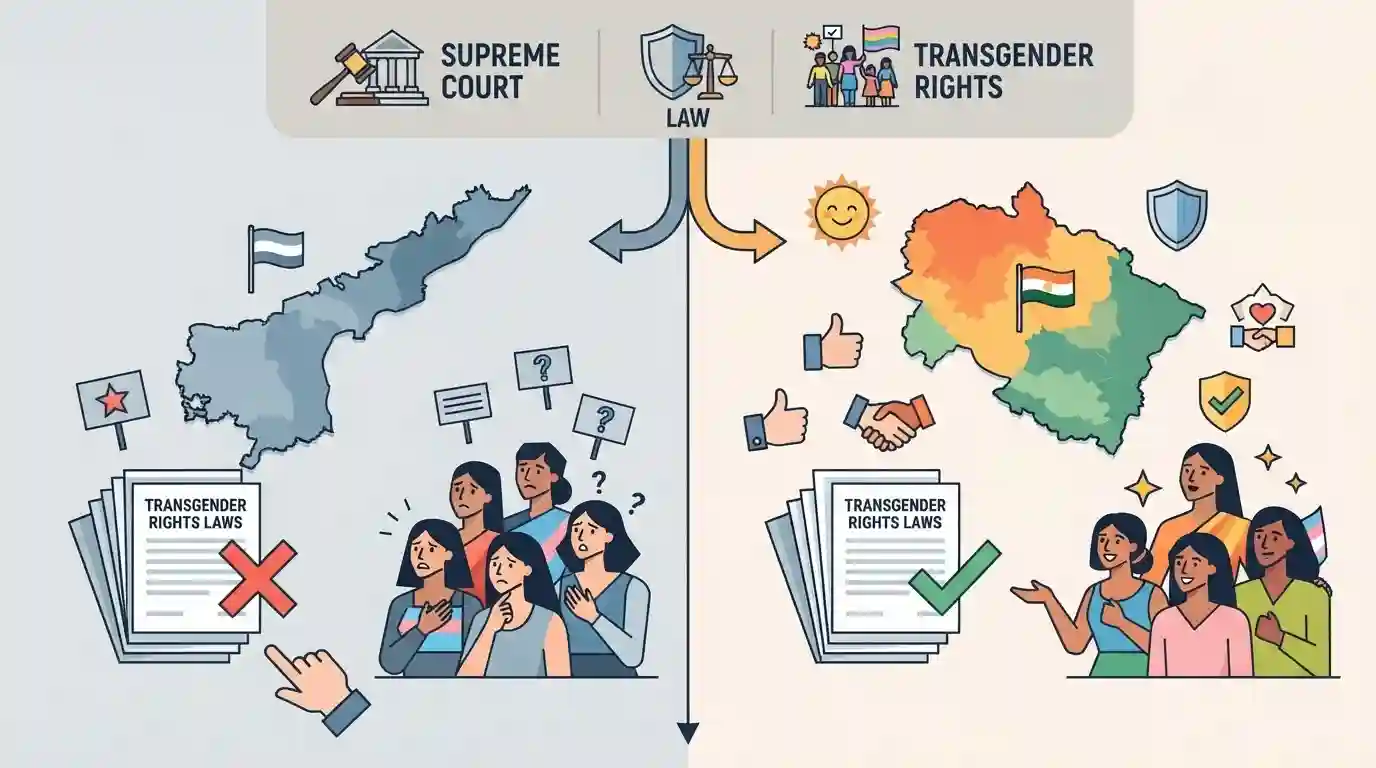
States display divergent stances on transgender rights laws
Source:The Hindu ↗
কেন এটি গুরুত্বপূর্ণ
The debate reflects evolving judicial and state-level stances on transgender rights, highlighting tensions between state implementation, statutory rights under the Transgender Persons Act, and broader constitutional gender justice imperatives.
সারসংক্ষেপ
The NDA-ruled Andhra Pradesh government has declined to defend changes to transgender rights laws in the Supreme Court, whereas Uttarakhand has supported the legislation, calling it beneficial. This highlights divergent state approaches toward statutory frameworks governing transgender rights, welfare, and legal protections in India.
মূল বিষয়
- The NDA-ruled Andhra Pradesh government refused to defend changes to transgender rights laws in the Supreme Court, diverging from its stance or creating political dialogue on minority/trans rights.
- Uttarakhand defended the law as beneficial, highlighting contrasting viewpoints among States regarding rights, welfare, and statutory protections for transgender persons.
- The case spotlights legal and constitutional perspectives on gender justice, inclusivity, and statutory implementation of trans welfare provisions in India.
গুরুত্বপূর্ণ শব্দ
Supreme Court

The apex judicial forum in India, responsible for interpreting the Constitution, reviewing legislative changes, and protecting fundamental rights, including gender self-determination under Articles 14, 19, and 21.
UPSC context
GS Paper II (Indian Constitution - Judiciary, Fundamental Rights, Separation of Powers). Essential for testing the judiciary's role in public interest litigation and minority rights.
Transgender Persons (Protection of Rights) Act
The statutory legislation regulating gender recognition, anti-discrimination, and welfare measures for transgender persons in India, subject to recent amendments and judicial scrutiny.
UPSC context
GS Paper II (Social Justice, Vulnerable Sections). Vital for examining state obligations, legal protections, and statutory rights of transgender individuals.
NALSA v. Union of India
The apex court's landmark 2014 ruling recognizing transgender individuals as the third gender and affirming their fundamental right to self-perceived gender identity.
UPSC context
GS Paper II (Judicial Activism, Constitutional Law, Social Justice). Frequently asked in relation to equality, non-discrimination, and fundamental rights.
প্রিলিমস ফাঁদ
The Transgender Persons Act fully operationalizes the unconditioned self-identification principle laid down in the NALSA judgment without statutory modification.
The 2019 Act mandates a district magistrate certificate for a change of gender, which civil society groups challenged for conflicting with the self-identification principle in the NALSA judgment.
সংযুক্ত স্থির ধারণা
What were the key mandates and constitutional underpinnings of the NALSA v. Union of India (2014) judgment?
- Third Gender: Third Gender: Formally recognized transgender persons as a third gender for all legal and welfare purposes.
- Self-Identification: Self-Identification: Affirmed the right to self-identified gender identity without mandatory surgical or medical interventions.
- Fundamental Freedoms: Fundamental Freedoms: Grounded rights under Articles 14 (equality), 19 (free expression), and 21 (life and personal liberty).
- Positive Obligations: Positive Obligations: Directed Centre and States to take positive steps for socio-economic welfare and reservations.
আন্তঃবিষয় প্যাটার্ন
Transgender Rights and Constitutional Morality
Supreme Court interpretations of Articles 14, 19, and 21 in NALSA (2014) anchor both transgender rights and broader privacy/autonomy jurisprudence like Puttaswamy.

NALSA judgment + Transgender Persons Act 2019 conflicts will feature as a multi-statement conceptual question in Prelims.
সংযুক্ত PYQ · 2
সংযুক্ত PYQ · 2
- 2023MainsGS2
Explain the constitutional perspectives of Gender Justice with the help of relevant Constitutional Provisions and case laws.
- 2020PrelimsGS1
In India, Legal Services Authorities provide free legal services to which of the following type of citizens? 1. Person with an annual income of less than ₹ 1,00,000 2. Transgender with an annual income of less than ₹ 2,00,000 3. Member of Other Backward Classes (OBC) with an annual income of less than ₹ 3,00,000 4. All Senior Citizens Select the correct answer using the code given below:
