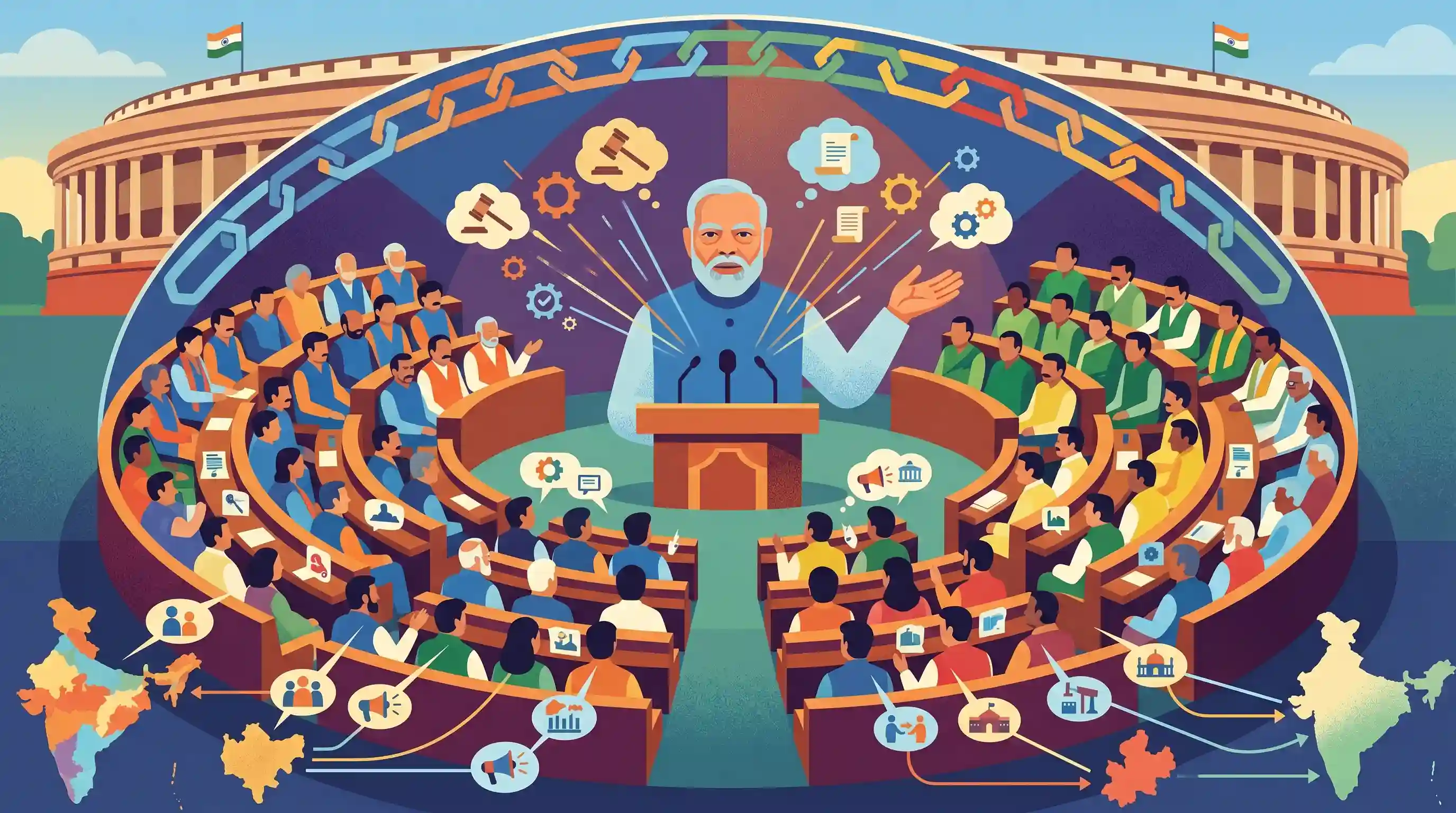
NDA parliamentary party convenes to coordinate legislative agenda
Source:The Hindu ↗
Why It Matters
While a standard political event, the meeting illustrates the practical functioning of parliamentary parties and coalition governments in India, where national parties must coordinate with regional allies on legislative agendas and governance priorities.
Summary
The National Democratic Alliance (NDA) is scheduled to convene a parliamentary party meeting on February 3 at the Parliament House complex in Delhi. The meeting will bring together MPs from the BJP and key regional allies including the TDP, JD(U), LJP (R), Shiv Sena, and JD(S). Prime Minister Narendra Modi is expected to address the parliamentarians to discuss the government's legislative agenda, governance matters, and provide strategic talking points for them to use in their respective constituencies, reflecting the operational dynamics of coalition politics in Parliament.
Key Points
- The NDA parliamentary party will hold a meeting in Delhi involving Lok Sabha and Rajya Sabha MPs from the BJP and allied regional parties.
- The inclusion of multiple regional allies like TDP, JD(U), Shiv Sena, and JD(S) highlights the dynamics of coalition politics at the national level.
- Prime Minister Modi is anticipated to outline the government's legislative agenda, discuss governance issues, and offer political talking points for MPs to utilize in their constituencies.
Important Terms
National Democratic Alliance (NDA)

A centre-right political coalition in India formed in 1998, led by the Bharatiya Janata Party (BJP). it represents multi-party alliances in a federal democracy.
UPSC context
GS-II: Indian Constitution, Federalism, and Political Parties; tests understanding of coalition dynamics and government formation.
Lok Sabha
The lower house of India's bicameral Parliament, consisting of representatives directly elected by the people. It holds primary power over financial matters and the Council of Ministers.
UPSC context
GS-II: Parliament and State Legislatures; essential for understanding legislative procedures, Money Bills, and executive accountability.
Rajya Sabha
The upper house of Parliament representing States and Union Territories. It is a permanent body that ensures federal balance and continuous legislative review.
UPSC context
GS-II: Federal Structure and Parliament; tests knowledge of the Council of States' special powers and role in stable governance.
Bharatiya Janata Party (BJP)
A major national political party in India with a right-wing ideology. It currently leads the NDA government and holds a significant pan-India presence.
UPSC context
GS-II: Political Parties; relevant for studying national party recognition criteria by the Election Commission and party-system shifts.
Telugu Desam Party (TDP)
A significant regional party from Andhra Pradesh. As a key NDA ally, it exemplifies the influence of state-based parties on national policy and federal negotiations.
UPSC context
GS-II: Federalism and Coalition Politics; tests the impact of regional aspirations on central governance and cooperative federalism.
Janata Dal (United) (JD(U))
A Bihar-based regional party that plays a pivotal role in national coalition stability. It highlights the strategic importance of state leaders in central power-sharing.
UPSC context
GS-II: Political Parties; illustrates the dynamics of regional interests within national alliances and the role of 'kingmakers.'
Shiv Sena
A Maharashtra-based regional party. Its participation in the NDA underscores the intersection of regional identity and national ideological alliances.
UPSC context
GS-II: Parliament and State Legislatures; relevant for studying anti-defection laws, party splits, and regional political movements.
Prelims Trap
"A recognized pre-poll coalition functions as a single entity in Parliament and can issue a common whip."
The Anti-Defection Law (10th Schedule) only recognizes individual political parties. A coalition cannot issue a legally binding common whip; each constituent party must issue its own.
Static Concepts Connected
What are the rules for recognizing a Parliamentary Party and issuing a Whip?
- Mavalankar Rule: To be recognized as a Parliamentary Party in Lok Sabha, a group must have a minimum strength equal to the quorum (1/10th of total membership).
- Legislature Party: The 10th Schedule defines it strictly as elected members of a single political party in the House, distinct from the broader organizational party or alliance.
- Whip Issuance: Only an individual political party can issue a binding whip to its members; alliances/coalitions cannot issue a unified statutory whip.
What is the constitutional and operational status of the 'Leader of the House'?
- Legal Backing: The office is defined in the Rules of Procedure of the House, not in the Constitution of India.
- Default Role: The Prime Minister acts as Leader of the Lok Sabha by default, provided they are a member of that House.
- Primary Functions: Responsible for arranging government business, setting the legislative agenda, and acting as the primary spokesperson for the government in the House.
Cross-Topic Patterns
Coalition Politics & Electoral Federalism
National coalitions relying on regional parties shift policy-making from centralized executive dominance to negotiated federalism, acting as a moderating force on subjects in the Concurrent List.
Anti-Defection Nuances in Alliances
The distinction between a 'political party' and a 'legislature party' frequently features in Prelims when examining how splits, mergers, and whips operate within pre-poll alliances.

A multi-statement question on whether pre-poll alliances can issue common whips under the 10th Schedule is highly likely for Prelims 2026.
Linked PYQs · 1
Linked PYQs · 1
- 2022MainsGS2
“While the national political parties in India favour centralisation, the regional parties are in favour of State autonomy.” Comment.
