NDA meeting lauds trade deals and roadmap to 2047
Source:The Hindu ↗
Why It Matters
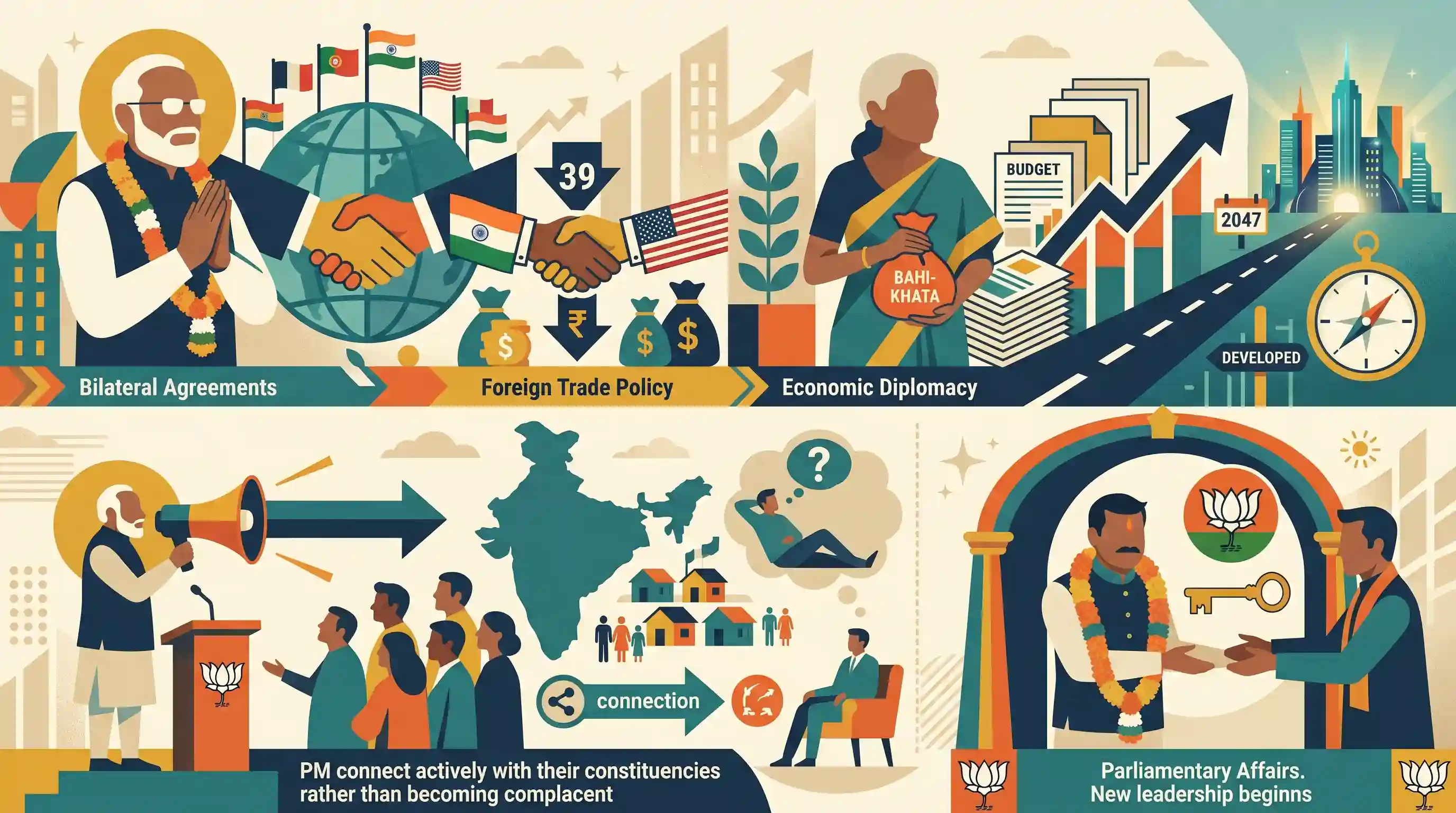
It underscores India's active pursuit of economic diplomacy through FTAs and tariff deals with developed countries to boost economic integration. It also reflects the political executive's focus on long-term economic planning (Vision 2047) through the Union Budget.
Summary
At a recent NDA Parliamentary Party meeting, PM Narendra Modi was felicitated for finalizing trade agreements with 39 countries, notably including a major tariff deal with the United States. The gathering also praised Finance Minister Nirmala Sitharaman for her ninth consecutive Union Budget outlining the nation's developmental roadmap toward 2047. Additionally, the meeting marked the welcome of newly elected BJP national president Nitin Nabin, with PM Modi taking the opportunity to advise MPs to stay actively connected with their constituencies rather than becoming complacent after electoral wins.
Key Points
- The NDA Parliamentary Party felicitated PM Narendra Modi for successfully concluding trade agreements with 39 developed countries, including a significant tariff agreement with the US.
- Finance Minister Nirmala Sitharaman was commended for presenting her ninth consecutive Union Budget, emphasizing its role in laying the roadmap for India's development by 2047.
- The meeting welcomed Nitin Nabin as the newly elected national president of the BJP.
- PM Modi urged Parliamentarians to avoid complacency following election victories and to maintain continuous engagement with the public at the ground level.
Important Terms
India-US Tariff Agreement (2026)

A landmark 2026 bilateral framework where the U.S. reduced reciprocal tariffs on Indian exports (textiles, leather, etc.) to 18% in exchange for improved market access for American industrial and agricultural goods.
UPSC context
GS-II/III: Important for India-US bilateral relations, trade diplomacy, and impacts on the export-oriented domestic manufacturing sectors.
Vision 2047 (Viksit Bharat)
The government's strategic roadmap to transform India into a developed nation by the 100th anniversary of its independence (2047), emphasizing economic growth, social inclusion, and infrastructure development.
UPSC context
GS-III: Key theme in economic planning, governance, and long-term developmental goals of the Indian state.
Union Budget
Presented annually under Article 112, it is the government's financial roadmap. The 2026 budget, Finance Minister Nirmala Sitharaman’s ninth consecutive, focused on 'Viksit Bharat' and sector-specific developmental goals.
UPSC context
GS-III: Core topic for government budgeting, fiscal policy, and macroeconomic management.
National Democratic Alliance (NDA)
A center-right political coalition in India led by the Bharatiya Janata Party (BJP). It emphasizes cooperative federalism and coalition management to achieve national governance objectives.
UPSC context
GS-II: Relevant for understanding Indian polity, the evolution of coalition governments, and political alliance dynamics.
Nitin Nabin
An Indian politician from Bihar who assumed charge as the 16th National President of the BJP in January 2026, succeeding JP Nadda as the youngest individual to hold the post.
UPSC context
Prelims: Important for 'Person in News' and political leadership transitions within national parties.
Prelims Trap
"International trade agreements and FTAs negotiated by the Executive require mandatory ratification by the Parliament to become valid."
In India, treaty-making is exclusively an executive power (Article 73). Parliamentary ratification is not required unless implementing the treaty necessitates changes to existing domestic laws (Article 253).
Static Concepts Connected
How are international treaties negotiated and ratified under the Indian Constitution?
- Executive Power: Treaty-making is an executive action under Article 73. The Union Cabinet holds the sole authority to negotiate, sign, and ratify international agreements.
- Legislative Role: Parliament does not ratify treaties. However, under Article 253, Parliament must pass legislation if implementing the treaty alters existing domestic laws.
What differentiates a Comprehensive Economic Partnership Agreement (CEPA) from a standard FTA?
- Broader Scope: While standard FTAs typically focus on eliminating tariffs on goods, a CEPA extends deeper into services, investments, intellectual property, and mutual regulatory recognition.
- Regulatory Depth: CEPAs are often viewed as more integrated economic partnerships, moving beyond mere border-tariff reductions to address behind-the-border trade barriers.
Cross-Topic Patterns
Trade Pacts + PLI Integration
Securing US and Western tariff reductions acts as a crucial demand-side pull to absorb the manufacturing output generated by India's domestic Production Linked Incentive (PLI) schemes.
Viksit Bharat + Demographic Transition
Achieving the 2047 developmental roadmap relies on translating foreign market access into high-volume, labour-intensive manufacturing jobs before India's demographic dividend window closes.

Expect a 2026 Prelims question mapping recent major trade deals (like CEPA, ECTA, and US tariff pacts) against target export sectors.
Linked PYQs · 3
Linked PYQs · 3
- 2011MainsGS2
Compared to the South Asian Free Trade Area (SAFTA), the Bay of Bengal Initiative for Multisectoral Technical and Economic Cooperation Free Trade Area (BIMSTEC FTA) seems to be more promising." Critically evaluate.
- 2016MainsGS2
The broader aims and objectives of WTO are to manage and promote international trade in the era of globalization. But the Doha round of negotiations seem doomed due to differences between the developed and the developing countries." Discuss in the Indian perspective.
- 2017MainsGS3
Account for the failure of manufacturing sector in achieving the goal of labour-intensive exports. Suggest measures for more labour-intensive rather than capital-intensive exports.
