MSP and Crop Procurement Trends in Parliament
Source:The Hindu ↗
Why It Matters
The debate on MSP is a core component of India's agricultural economics and food security. Understanding the pricing mechanisms, the Swaminathan Commission formula, and supplemental schemes like MIS and PM-ASHA is crucial for GS3. The persistent issues of farm debt and suicides also reflect the limitations and challenges in agricultural policy implementation.
Summary
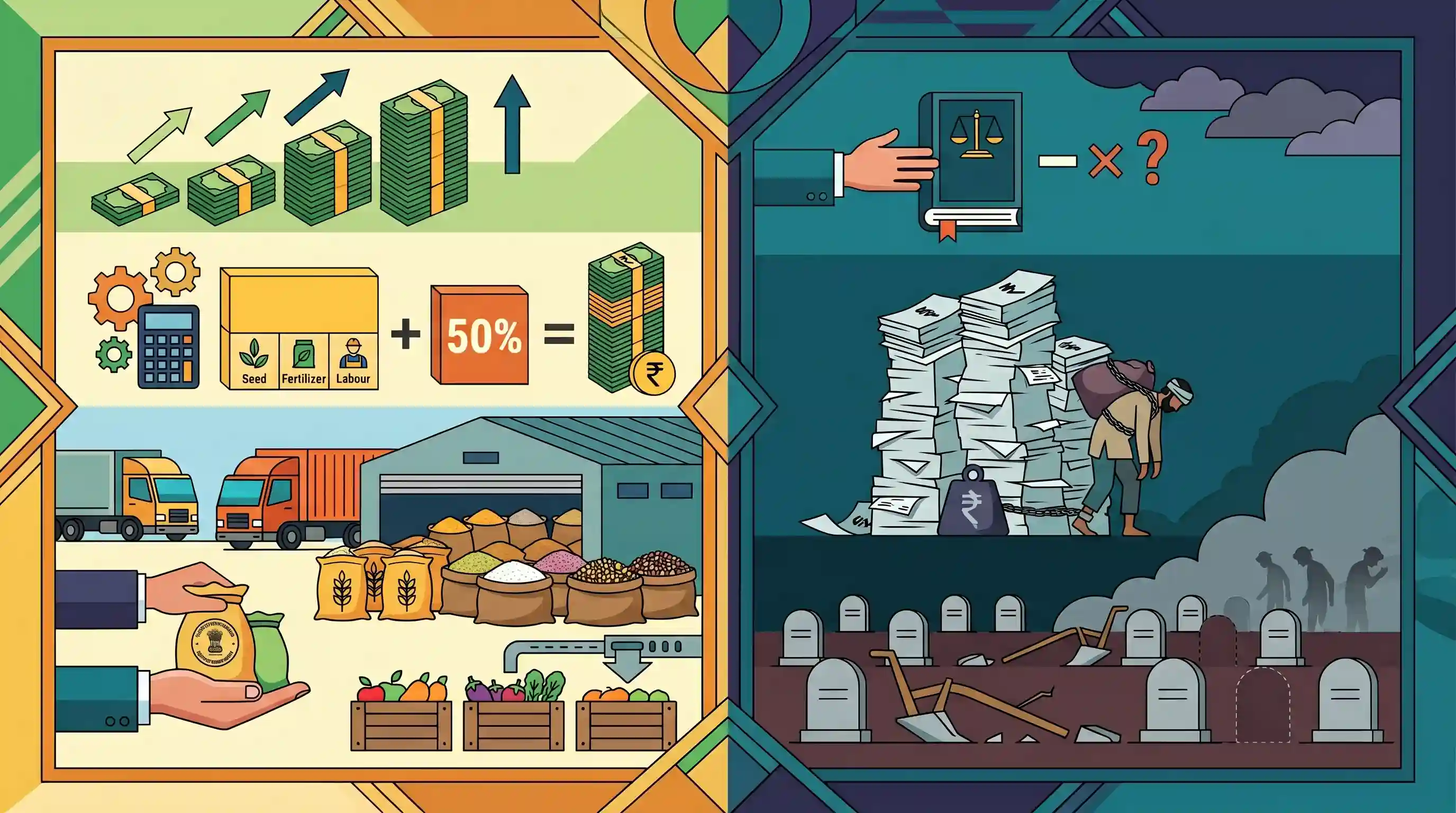
Union Agriculture Minister Shivraj Singh Chouhan informed the Rajya Sabha that the NDA government has doubled the Minimum Support Price (MSP) and quadrupled crop procurement compared to the UPA era. The government has implemented the Swaminathan Commission's recommendation to fix MSP at a 50% margin over production costs. Opposition MPs countered by questioning the absence of a legal guarantee for MSP and highlighting acute agrarian distress, pointing to over 1.12 lakh farmer suicides and ₹28.5 lakh crore in accumulated farm debt. Chouhan noted that procurement has expanded beyond the 22 scheduled crops to include pulses (with a 100% procurement promise for tur, masur, and urad) and perishables via the Market Intervention Scheme (MIS) and PM-ASHA.
Key Points
- Agriculture Minister Shivraj Singh Chouhan stated the government adopted the Swaminathan Commission\'s recommendation to provide an MSP with a 50% margin over the cost of production.
- Crop procurement has reportedly quadrupled under the current NDA government compared to the preceding UPA administration.
- The government intends to procure 100% of the production for pulses like tur, masur, and urad under the MSP scheme.
- Opposition MPs highlighted severe agrarian distress, citing 1.12 lakh farmer suicides and a mounting farm debt of ₹28.5 lakh crore over the past 11 years.
- Beyond the 22 scheduled crops, the Centre is utilizing the Market Intervention Scheme (MIS) and PM-ASHA to procure fruits, vegetables, and other crops.
Important Terms
Minimum Support Price (MSP)

The floor price at which the government purchases 22 mandated crops (and sugarcane at FRP) from farmers, ensuring price stability and protecting against market volatility and distress sales.
UPSC context
GS III (Agriculture). Essential for understanding farm subsidies, food security, and government market intervention.
PM-ASHA
An umbrella scheme launched in 2018 ensuring remunerative prices to farmers. It includes components like physical procurement (PSS), price deficiency payments (PDPS), and private procurement pilots (PPPS).
UPSC context
GS III (Government Schemes). Tests knowledge of price assurance mechanisms and agricultural marketing reforms.
Commission for Agricultural Costs and Prices (CACP)
An advisory body (est. 1965) under the Ministry of Agriculture that recommends MSPs based on cost of production, demand-supply, and price trends. Recommendations are not legally binding.
UPSC context
GS III (Institutional Framework). Key body for agricultural price policy and MSP determination.
Swaminathan Commission
The 'National Commission on Farmers' which famously recommended that MSP should be fixed at at least 50% more than the comprehensive cost (C2) of production.
UPSC context
GS III (Land Reforms/Agriculture). Central to debates on farmer welfare and the legal guarantee of MSP.
Market Intervention Scheme (MIS)
An ad-hoc price support mechanism for horticultural and perishable commodities not covered under MSP, activated at a state’s request when prices drop at least 10% below previous levels.
UPSC context
GS III (Economics of Animal-Rearing/Horticulture). Focuses on price stabilization for perishable goods.
Cabinet Committee on Economic Affairs (CCEA)
The highest decision-making body on economic policy, chaired by the Prime Minister, which gives the final approval for MSP levels recommended by the CACP.
UPSC context
GS II (Executive). Important for understanding the final authority in agricultural pricing and procurement policy.
Prelims Trap
The government provides MSP at 50% over the comprehensive cost of production (C2) as recommended by Swaminathan.
The government calculates the 50% margin over the A2+FL baseline (actual costs + family labour), not the comprehensive C2 baseline recommended by the Swaminathan Commission.
Static Concepts Connected
What are the three formulas used to calculate crop production costs by CACP?
- A2 Cost: Covers all direct cash and in-kind expenses incurred by the farmer on seeds, fertilizers, chemicals, hired labour, and fuel.
- A2+FL Cost: Includes A2 plus an imputed value of unpaid family labour. This is the current baseline used by the government to calculate the 50% MSP margin.
- C2 Cost: A comprehensive cost that includes A2+FL plus imputed rent on owned land and interest on fixed capital. Recommended by Swaminathan Commission but not currently used as the baseline.
How does PM-AASHA differ from the Market Intervention Scheme (MIS)?
- PM-AASHA: An umbrella scheme mainly for pulses, oilseeds, and copra. Includes physical procurement (PSS) by NAFED/FCI and a Price Deficiency Payment Scheme (PDPS) for oilseeds.
- MIS: An ad-hoc scheme for perishable/horticultural commodities not covered under MSP. Implemented at the request of State governments, which share the financial losses evenly with the Centre.
Cross-Topic Patterns
MSP Legalization vs Macro-stability
Demands for a legal MSP guarantee directly connect to fiscal deficit concerns, WTO agricultural subsidy caps (De Minimis limits/Peace Clause), and RBI's inflation targeting frameworks.
Pulses Procurement & Crop Diversification
The promise to procure 100% of tur, urad, and masur links to soil health (nitrogen fixation), import substitution, and incentivizing a shift away from water-guzzling paddy in the Northwest.

Expect a 2026 Prelims question mixing A2+FL vs C2 calculations with PM-AASHA components and Market Intervention Scheme (MIS) triggers.
Linked PYQs · 4
Linked PYQs · 4
- 2018MainsGS3
What do you mean by Minimum Support Price (MSP)? How will MSP rescue the farmers from the low income trap?
- 2017MainsGS3
How do subsidies affect the cropping pattern, crop diversity and economy of farmers? What is the significance of crop insurance, minimum support price and food processing for small and marginal farmers?
- 2013MainsGS3
What are the different types of agriculture subsidies given to farmers at the national and at state levels ? Critically analyse the agricultural subsidy regime with reference to the distortions created by it.
- 2025MainsGS3
Elaborate the scope and significance of supply chain management of agricultural commodities in India.
