Maharashtra Crime Rate Surpasses National Average in NCRB Data
Source:Indian Express ↗
Why It Matters
NCRB data forms the factual basis for evaluating law enforcement effectiveness, understanding crime patterns (like organized crime or violence against vulnerable groups), and framing policies for police reforms. It is highly relevant for GS2 (Governance/Justice) and GS3 (Internal Security) answers.
Summary
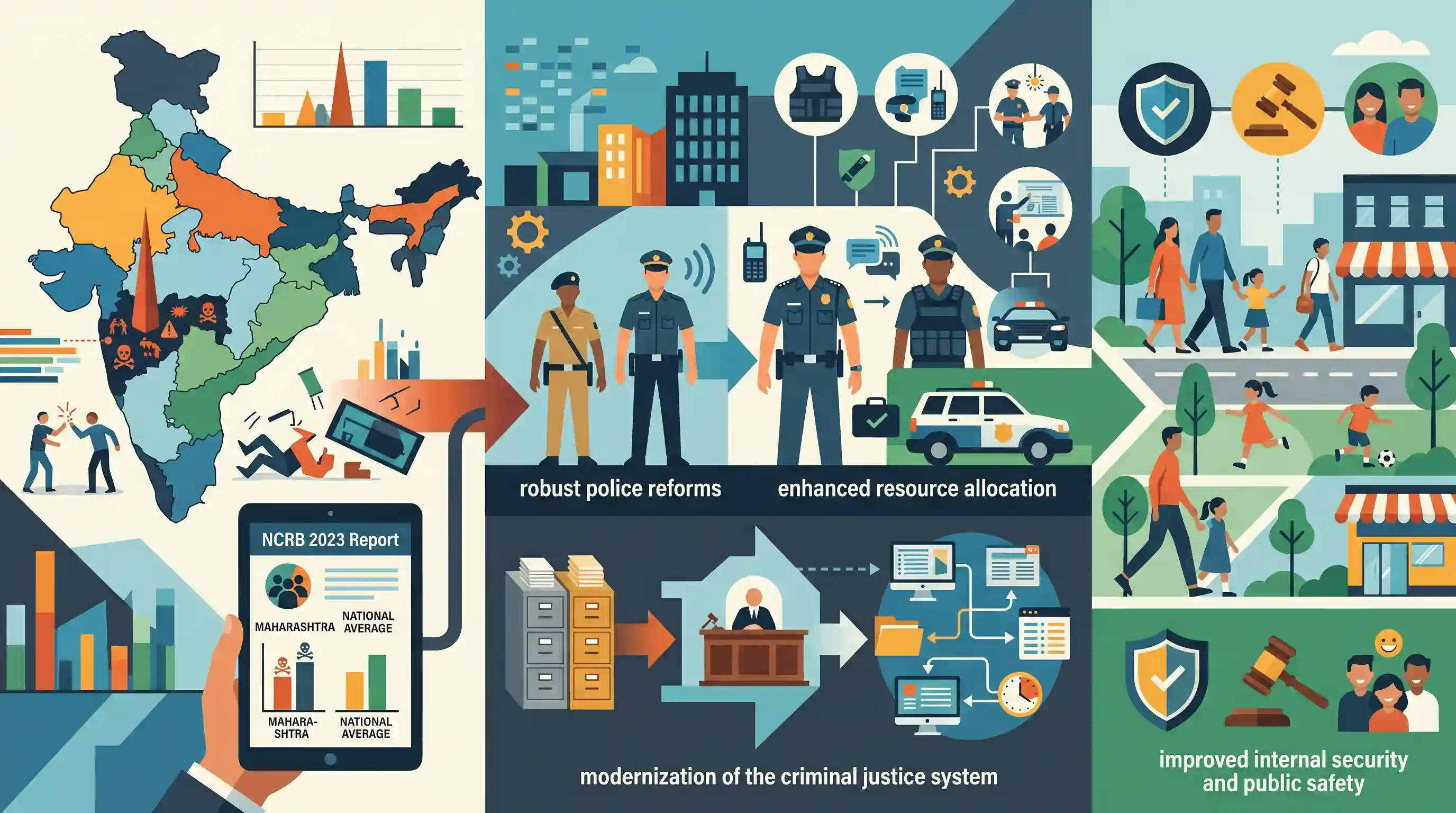
The National Crime Records Bureau (NCRB) report for 2023 indicates that Maharashtra's crime rate has surpassed the national average, positioning the state 9th overall in India. These statistics point to growing law and order challenges at the state level, emphasizing the need for robust police reforms, enhanced resource allocation, and modernization of the criminal justice system to improve internal security and public safety.
Key Points
- According to the NCRB data for 2023, Maharashtra's overall crime rate has exceeded the national average.
- Maharashtra now ranks 9th among all Indian states in terms of crime rate, indicating rising challenges in law enforcement.
- Such regional crime statistics are essential for identifying vulnerabilities in the criminal justice system and guiding targeted police reforms.
- The data highlights the need for capacity building and modernization of state police forces to effectively manage internal security and law and order.
Important Terms
National Crime Records Bureau (NCRB)

An attached office of the Ministry of Home Affairs established in 1986. It serves as the national repository for crime data, fingerprint records, and publishes the annual 'Crime in India' report.
UPSC context
GS Paper II (Governance) and III (Internal Security). Tests knowledge of institutional frameworks for monitoring internal security and criminal justice.
Ministry of Home Affairs (MHA)
The nodal ministry of the Government of India responsible for maintenance of internal security, border management, and administrative control over the NCRB and Central Armed Police Forces.
UPSC context
GS Paper II. Relevant for understanding executive functions and the division of power in federal governance and security administration.
Crime Rate
A statistical measure used by the NCRB, calculated as the number of cognizable crimes registered per one lakh (100,000) of the population.
UPSC context
GS Paper II and III. Used for comparative analysis of law and order efficiency and social security across different states.
Seventh Schedule
The constitutional framework under Article 246 that distributes legislative powers between the Union and States. 'Police' and 'Public Order' are placed under Entry 2 and 1 of the State List.
UPSC context
GS Paper II (Polity). Essential for understanding federalism and the jurisdictional limits of the Centre and States regarding law enforcement.
State Police
The primary law enforcement agency of a state, responsible for prevention, detection, and investigation of crimes as a 'State List' subject under the Indian Constitution.
UPSC context
GS Paper II and III. Key to discussions on police reforms (Prakash Singh judgment) and strengthening the criminal justice system.
Crime and Criminal Tracking Network & Systems (CCTNS)
A mission-mode project under the National e-Governance Plan (NeGP) that creates a comprehensive and integrated system for enhancing the efficiency of policing through a nationwide networking of police stations.
UPSC context
GS Paper III (Technology and Internal Security). Relevant for modernization of police and use of ICT in governance.
Prelims Trap
NCRB is a statutory body under the Ministry of Home Affairs tasked with investigating inter-state crimes.
NCRB is an attached office under the MHA formed via a 1986 executive resolution, not a statutory body. Furthermore, it functions as a repository, not an investigative agency.
Static Concepts Connected
What are the key Supreme Court directives from the Prakash Singh case (2006)?
- State Security Commission: Establish SSCs to ensure state governments do not exercise unwarranted influence or pressure on the state police.
- Tenure & Selection: Ensure a fixed two-year tenure for DGPs, appointed from a UPSC-empanelled list based on merit and seniority.
- Separation of Functions: Separate the investigating police from the law and order police to ensure speedier investigation and better expertise.
- Police Complaints Authority: Set up authorities at state and district levels to look into public complaints against police officers for serious misconduct.
How is the jurisdiction over policing defined in the Indian Constitution?
- State List subjects: 'Police' and 'Public Order' are placed in the State List (List II) of the Seventh Schedule, giving states primary legislative and administrative power.
- CBI Jurisdiction: Under the DSPE Act, central agencies like the CBI require general or specific consent from the state government to investigate crimes within state borders.
- NCRB's Role: As an attached MHA office, it standardizes national data collection, enabling policy framing and capacity building despite constitutional federal divisions.
Cross-Topic Patterns
NCRB data & violence against women
NCRB statistics are heavily utilized in Mains GS1 and GS2 to substantiate arguments on patriarchy, domestic violence, and evaluating the efficacy of gender-centric legislation over time.
Police reforms & cyber capacity building
As crimes increasingly shift online, traditional 'law and order' policing must integrate technical forensics and CCTNS data, directly linking GS2 police reforms to GS3 internal cyber security.

Expect a GS2 Mains question evaluating whether rising NCRB crime rates reflect an actual deterioration of law & order or better FIR registration.
Linked PYQs · 5
Linked PYQs · 5
- 2023PrelimsGS1
With reference to Home Guards, consider the following statements: 1. Home Guards are raised under the Home Guards Act and Rules of the Central Government. 2. The role of the Home Guards is to serve as an auxiliary force to the police in maintenance of internal security. 3. To prevent infiltration on the international border/coastal areas, the Border Wing Home Guards Battalions have been raised in some States. How many of the above statements are correct?
- 2025MainsGS2
The National Commission for Protection of Child Rights has to address the challenges faced by children in the digital era. Examine the existing policies and suggest measures the Commission can initiate to tackle the issue.
- 2022MainsGS3
Discuss the types of organised crimes. Describe the linkages between terrorists and organised crime that exist at the national and transnational levels.
- 2023MainsGS1
Explain why suicide among young women is increasing in Indian society.
- 2023MainsGS2
Explain the constitutional perspectives of Gender Justice with the help of relevant Constitutional Provisions and case laws.
