NCLAT Ruling on Personal Guarantor Insolvency Under IBC
Source:The Hindu ↗
हे का महत्त्वाचे आहे
Highlights critical jurisprudence on creditor rights and the liability of personal guarantors under the IBC, demonstrating that corporate promoters and guarantors cannot use the corporate debtor's moratorium as a shield against personal asset recovery for NPAs.
सारांश
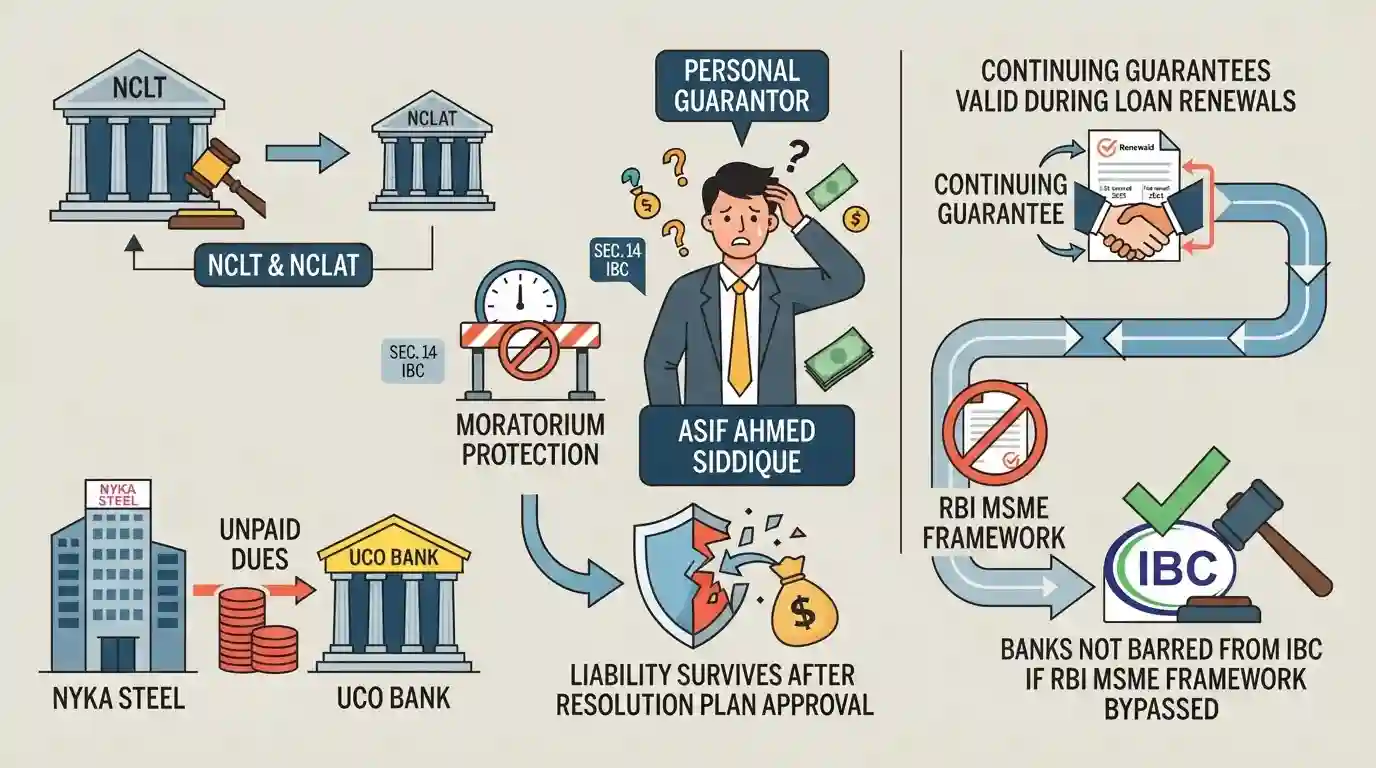
The National Company Law Appellate Tribunal (NCLAT) has upheld an NCLT order permitting insolvency proceedings against Asif Ahmed Siddique, a personal guarantor for Mumbai-based Nyka Steel, over unpaid dues to UCO Bank. The tribunal clarified that personal guarantors do not enjoy the moratorium protection afforded to corporate debtors under Section 14 of the Insolvency and Bankruptcy Code (IBC), and their liability survives even after the approval of a resolution plan. Furthermore, the NCLAT ruled that continuing guarantees remain valid during loan renewals, and banks are not barred from using the IBC just because they bypassed the RBI's MSME rehabilitation framework.
मुख्य मुद्दे
- The NCLAT upheld the initiation of insolvency proceedings against a personal guarantor under Section 95 of the Insolvency and Bankruptcy Code, even though the primary corporate debtor was already undergoing the Corporate Insolvency Resolution Process (CIRP).
- The statutory moratorium under Section 14 of the IBC, which halts legal proceedings against a corporate debtor, does not extend to shield personal guarantors, adhering to the Supreme Court's ruling in SBI vs V. Ramakrishnan.
- A guarantor's liability is not extinguished if the primary loan is renewed without a fresh guarantee deed, provided the original agreement functioned as a continuing guarantee.
- A lender's failure to first utilize the RBI's rehabilitation framework for MSMEs does not act as a bar to initiating insolvency proceedings under the IBC.
महत्त्वाच्या संज्ञा
Insolvency and Bankruptcy Code (IBC), 2016

A comprehensive legal framework consolidating Indian insolvency laws to resolve distress for corporates, individuals, and partnerships through a time-bound, creditor-in-control process.
UPSC context
GS Paper III (Indian Economy). Tests concepts of NPA resolution, debt recovery, and corporate reforms.
National Company Law Appellate Tribunal (NCLAT)
A statutory quasi-judicial body constituted under Section 410 of the Companies Act, 2013, to hear appeals against decisions made by NCLT, IBBI, CCI, and NFRA.
UPSC context
GS Paper II & III. Tests knowledge of quasi-judicial bodies and dispute resolution in corporate governance.
National Company Law Tribunal (NCLT)
A specialized quasi-judicial body established under Section 408 of the Companies Act, 2013, serving as the first-instance adjudicating authority for corporate law and insolvency disputes.
UPSC context
GS Paper II & III. Tests structural understanding of India’s corporate dispute-resolution architecture.
RBI's rehabilitation framework for MSMEs
A structured framework designed to identify early financial stress, classify loan accounts, and facilitate timely restructuring or rehabilitation of micro, small, and medium enterprises.
UPSC context
GS Paper III (Economy). Tests policy mechanisms for MSME credit revival, NPA management, and priority sector initiatives.
Reserve Bank of India (RBI)
India's central bank and regulatory body responsible for regulating monetary policy, supervising banking systems, managing foreign exchange, and maintaining overall financial stability.
UPSC context
GS Paper III (Economy). Tests monetary policy, central banking regulations, inflation control, and financial system supervision.
पूर्वपरीक्षा सापळा
The statutory moratorium under Section 14 of the IBC automatically halts recovery proceedings against both the corporate debtor and its personal guarantors.
The Supreme Court in SBI vs V. Ramakrishnan clarified that the Section 14 moratorium is strictly debtor-specific and does not shield personal guarantors from parallel recovery actions.
संबंधित स्थिर संकल्पना
How is adjudicating jurisdiction divided under the IBC, 2016?
- NCLT Jurisdiction: Handles insolvency of corporate debtors and personal guarantors associated with them, serving as the primary corporate adjudicating authority.
- DRT Jurisdiction: Adjudicates insolvency and bankruptcy cases for individuals and partnership firms not classified as personal guarantors to corporate entities.
- Appellate Route: Appeals from NCLT decisions lie with the NCLAT, whereas appeals from DRT go to the Debt Recovery Appellate Tribunal (DRAT).
What is the legal status of a Personal Guarantor?
- Co-extensive Liability: Under Contract Act Section 128, the guarantor's liability is co-extensive with the principal debtor, enabling lenders to sue either or both simultaneously.
- No Moratorium Protection: Insolvency proceedings against personal guarantors can run concurrently with the corporate debtor's CIRP, completely outside the corporate moratorium.
- Surviving Liabilities: The approval of a corporate resolution plan (including haircuts) does not discharge the personal guarantor from paying the remaining unpaid balance.
आंतर-विषय नमुने
IBC primacy over administrative frameworks
Statutory rights under the IBC override circular-based recovery processes like RBI's MSME restructuring scheme, ensuring legal remedies remain unhindered by administrative delays.
Credit culture and moral hazard
Holding promoter-guarantors financially accountable via personal assets prevents moral hazard and improves banking credit discipline, aligning with GS-3 formalization goals.

Expect multi-statement questions testing the NCLT-DRT jurisdictional split and the non-applicability of Section 14 moratorium to guarantors.
