Institutional Mechanism of NCERT Textbook Drafting Process
Source:Indian Express ↗
Why It Matters
Understanding the institutional mechanisms of curriculum drafting is crucial for UPSC aspirants, as education reform is a core component of GS Paper 2. The alignment of NCERT textbooks with NEP 2020, along with the debates on institutional autonomy and curriculum rationalization, provides critical insights into India's evolving educational governance.
Summary
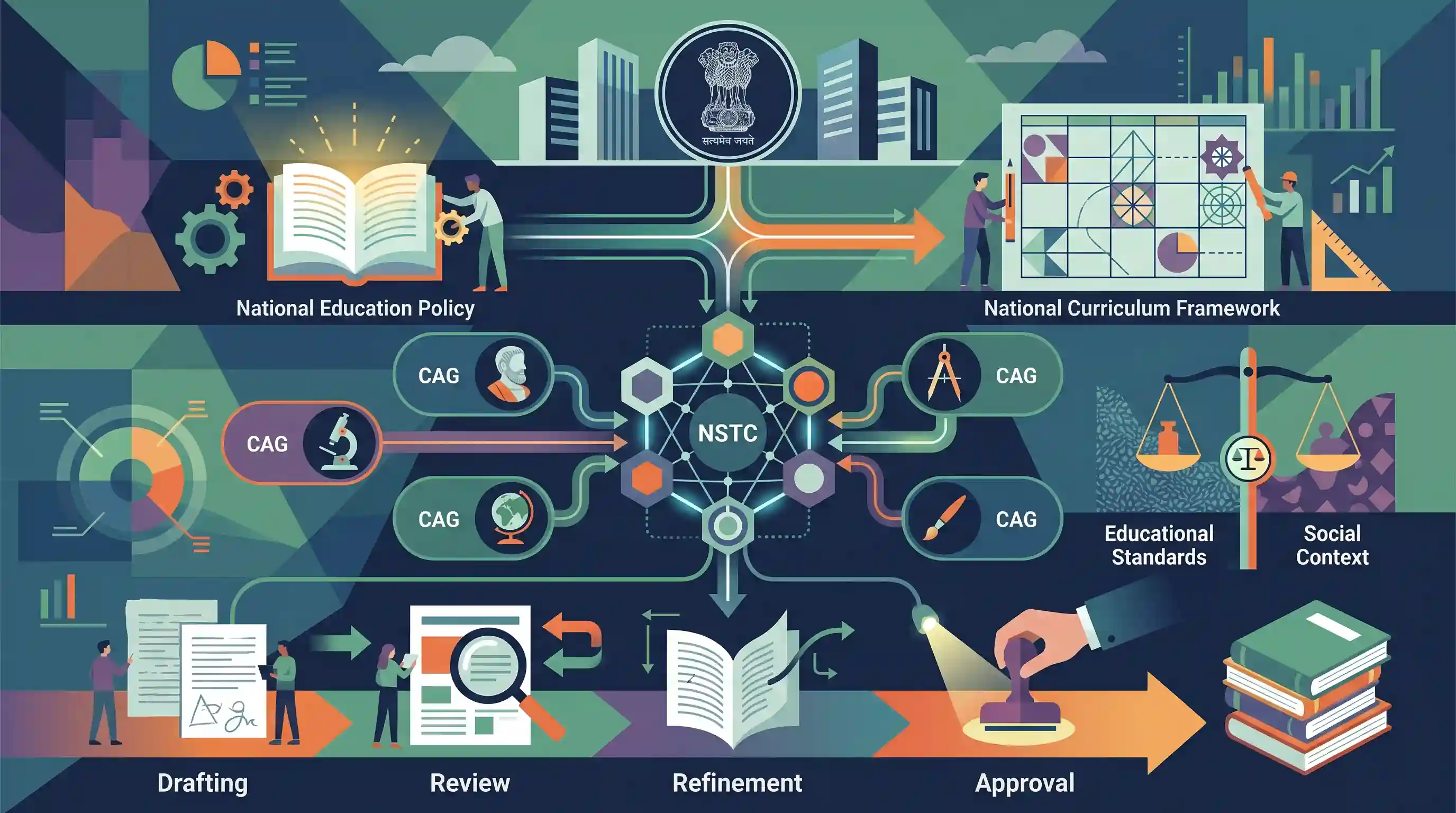
The article explains the structured process behind the drafting and approval of new NCERT textbooks, a topic brought into focus by the recent controversy over the removal of references to 'judiciary corruption' in Class 11 materials. Aligned with the National Education Policy (NEP) 2020, the textbook revision process is guided by the National Curriculum Framework (NCF) developed by the National Steering Committee. The actual syllabus and content are formulated by the National Syllabus and Teaching Learning Material Committee (NSTC) and its subject-specific Curricular Area Groups (CAGs). The explainer sheds light on the multi-tiered institutional mechanism under the Ministry of Education, balancing educational standards with political and social sensitivities.
Key Points
- The NCERT has established a structured process for drafting new textbooks aligned with the National Education Policy (NEP) 2020.
- The National Steering Committee (NSC) developed the National Curriculum Framework (NCF), which serves as the foundation for syllabus and textbook development.
- A 19-member National Syllabus and Teaching Learning Material Committee (NSTC) was formed to finalize the curriculum and create educational materials across subjects.
- The NSTC works through specialized Curricular Area Groups (CAGs) comprising subject experts who draft the actual content.
- Recent controversies, such as the modification of references to 'judiciary corruption' in Political Science textbooks, highlight the intersection of curriculum drafting, political sensitivities, and institutional autonomy.
Important Terms
National Education Policy (NEP) 2020

India’s 21st-century educational reform replacing the 1986 policy, emphasizing holistic, flexible, and multidisciplinary learning through a 5+3+3+4 school structure to transform the nation into a global knowledge superpower.
UPSC context
GS Paper 2 (Education/Governance); tests understanding of social sector reforms, human resource development, and implementation challenges of national policies.
National Curriculum Framework (NCF)
A guiding framework developed by NCERT that outlines the syllabus, pedagogy, and assessment standards for Indian schools; the latest 2023 version (NCF-SE) is specifically aligned with NEP 2020.
UPSC context
GS Paper 2 (Social Justice/Education); relevant for questions on curriculum reform, pedagogical shifts, and institutional mechanisms of educational standards.
National Council of Educational Research and Training (NCERT)
An autonomous organization established in 1961 that advises the Central and State governments on school education and is responsible for drafting national textbooks and curriculum frameworks.
UPSC context
GS Paper 2 (Statutory/Regulatory Bodies); tests knowledge of institutional frameworks in education and the balance between academic autonomy and executive oversight.
National Syllabus and Teaching Learning Material Committee (NSTC)
A 22-member high-powered committee established by NCERT in 2023 to oversee the development and finalization of school syllabi, textbooks, and teaching-learning materials for Classes 3 to 12.
UPSC context
GS Paper 2 (Governance/Education); significant for understanding the multi-tiered process of textbook drafting and the role of specialized expert committees.
National Steering Committee (NSC)
A high-level body, notably the one led by K. Kasturirangan, constituted by the government to draft the National Curriculum Frameworks in alignment with the goals of NEP 2020.
UPSC context
GS Paper 2 (Education Policy); tests awareness of expert-driven committees tasked with translating policy goals into actionable curriculum frameworks.
Ministry of Education
The central government ministry (formerly MHRD) responsible for formulating national education policies and providing administrative oversight to autonomous bodies like NCERT and UGC.
UPSC context
GS Paper 2 (Ministries & Departments); fundamental for understanding the executive structure of the social sector and national education governance.
Prelims Trap
"The NCERT is a statutory body established by an Act of Parliament to regulate school education in India."
NCERT is an autonomous body registered as a society under the Societies Registration Act, 1860. It is NOT a statutory body created by an Act of Parliament.
Static Concepts Connected
What is the legal and academic status of the NCERT?
- Legal Status: It is an autonomous organization registered under the Societies Registration Act, 1860. It is not a statutory body.
- Academic Status: It was recently granted 'Deemed to be University' status under Section 3 of the UGC Act, 1956, enabling it to independently award degrees.
- Nodal Function: Under NEP 2020, it is the designated nodal agency responsible for formulating the distinct National Curriculum Frameworks (NCFs).
What are the specific National Curriculum Frameworks (NCFs) mandated by NEP 2020?
- School Education: The NCF for School Education (NCFSE) focuses on restructuring the pedagogical framework into the new 5+3+3+4 design.
- Early Childhood: The NCF for Early Childhood Care and Education (NCFECCE) targets foundational learning, cognitive development, and care up to age 8.
- Teacher & Adult: Separate frameworks exist for Teacher Education (NCFTE) and Adult Education (NCFAE) to ensure standardized professional development and lifelong learning.
Cross-Topic Patterns
Institutional Autonomy vs Executive Control
Textbook revisions highlight the friction between the academic autonomy of bodies like NCERT or UGC and executive oversight, a recurring constitutional and governance theme for GS2 Mains.
Committee mandates in NEP 2020
UPSC frequently tests committee-to-purpose matching. Dr. K Kasturirangan's role spans both drafting the original NEP 2020 and chairing the National Steering Committee (NSC) to guide subsequent curriculum frameworks.

Expect a Prelims question confusing NCERT's 'Deemed University' and society status, or matching NEP committees (NSC, NSTC) with roles.
Linked PYQs · 3
Linked PYQs · 3
- 2020MainsGS2
National Education Policy 2020 is in conformity with the Sustainable Development Goal-4 (2030). It intends to restructure and reorient education system in India. Critically examine the statement.
- 2023MainsGS2
“Constitutionally guaranteed judicial independence is a prerequisite of democracy.” Comment.
- 2018PrelimsGS1
Consider the following statements: 1. As per the Right to Education (RTE) Act, to be eligible for appointment as a teacher in a State, a person would be required to possess the minimum qualification laid down by the concerned State Council of Teacher Education. 2. As per the RTE Act, for teaching primary classes, a candidate is required to pass a Teacher Eligibility Test conducted in accordance with the National Council of Teacher Education guidelines. 3. In India, more than 90% of teacher education institutions are directly under the State Governments. Which of the statements given above is/are correct?
