Waqf Amendment Act Challenges and Constitutional Rights Debate
Source:The Hindu ↗
Why It Matters
The controversy over the Waqf (Amendment) Act touches upon core constitutional principles, particularly the balance between state regulatory oversight and the fundamental right of religious denominations to manage their own affairs and properties (Articles 25, 26, and 300A). It is a prime example for Mains answers discussing Indian secularism, minority rights, and state intervention in religious institutions.
Summary
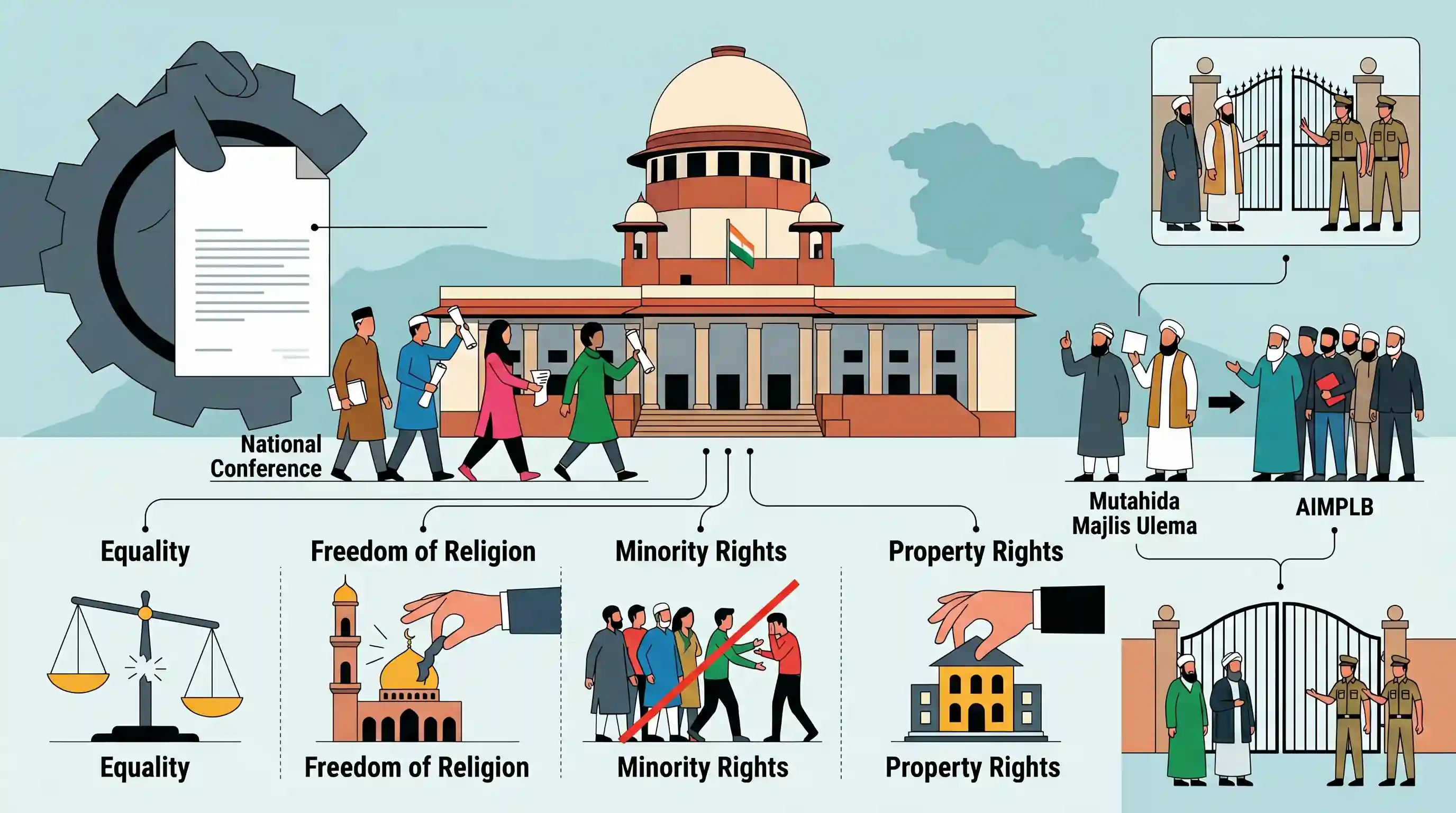
The National Conference (NC) and the Peoples Democratic Party (PDP) in Jammu and Kashmir have announced their decision to petition the Supreme Court against the recently enacted Waqf (Amendment) Act. Leaders from both parties argue that the legislation infringes upon fundamental rights, including the rights to equality (Articles 14 and 15), life and liberty (Article 21), freedom of religion (Articles 25 and 26), protection of minority interests (Article 29), and the right to property (Article 300A). They contend that the Act introduces unconstitutional state interference into the management of Muslim religious endowments and charitable properties. Concurrently, Mirwaiz Umar Farooq has aligned the Mutahida Majlis Ulema (MMU) with the All India Muslim Personal Law Board's (AIMPLB) legal challenge against the law. This came after local J&K authorities denied permission for a scheduled MMU meeting intended to strategize opposition to the Act, further escalating political tensions over religious and minority rights.
Key Points
- Jammu and Kashmir political parties National Conference (NC) and Peoples Democratic Party (PDP) plan to move the Supreme Court to challenge the newly amended Waqf Act.
- The parties argue the legislation is unconstitutional as it infringes upon fundamental rights guaranteed under Articles 14, 15, 21, 25, 26, 29, and 300A.
- Critics assert the Act unconstitutionally expands State interference into the management of Muslim religious and charitable properties, undermining the freedom to manage religious affairs.
- Mirwaiz Umar Farooq, leading the Mutahida Majlis Ulema (MMU), extended support to the All India Muslim Personal Law Board's legal challenge against the Act after J&K authorities barred a scheduled MMU meeting on the issue.
Important Terms
Waqf (Amendment) Act

A 2024 legislative proposal to reform the 1995 Act, introducing non-Muslim representation on Waqf Boards and granting District Collectors authority over property surveys and ownership disputes.
UPSC context
GS Paper II (Polity); relates to secularism, minority rights, and the extent of state interference in religious endowments.
All India Muslim Personal Law Board (AIMPLB)
Established in 1973, this non-governmental organization represents Indian Muslim interests in matters of personal law, such as marriage and inheritance, and advocates for the preservation of Shariat.
UPSC context
GS Paper I & II; significant for topics like secularism, personal laws, and the Uniform Civil Code (UCC).
Freedom of Religion (Articles 25 & 26)
Article 25 protects an individual's right to profess and practice religion; Article 26 grants religious denominations the collective right to manage their own affairs and own property.
UPSC context
GS Paper II (Polity); essential for understanding the constitutional balance between religious autonomy and state-led social reform.
Article 300A (Right to Property)
A constitutional right added by the 44th Amendment (1978) stating that no person shall be deprived of their property except by the authority of a valid law.
UPSC context
GS Paper II (Polity); tests the transition of property rights from a Fundamental Right to a Constitutional/Legal Right.
Waqf Board
A statutory body responsible for managing and protecting properties permanently dedicated by Muslims for religious or charitable purposes, such as mosques and graveyards.
UPSC context
GS Paper II (Polity); relevant to the functioning of statutory bodies and the administration of religious institutions.
Article 29 (Protection of Minority Interests)
Protects the interests of minorities by guaranteeing their right to conserve a distinct language, script, or culture, often invoked to defend the autonomy of minority-run institutions.
UPSC context
GS Paper II (Polity); key for questions on pluralism and the constitutional safeguards for marginalized or minority communities.
Prelims Trap
Religious endowments and Waqf properties fall exclusively under the Union List in the Seventh Schedule.
Religious endowments, charities, and institutions actually fall under Entry 28 of the Concurrent List, allowing both Parliament and State legislatures to enact laws.
Static Concepts Connected
How does the Constitution protect religious endowments and properties?
- Article 26: Grants religious denominations the right to establish institutions and manage affairs in religion, subject strictly to public order, morality, and health.
- Concurrent List: Entry 28 places 'charities, charitable institutions, and religious endowments' in the Concurrent List, enabling both State and Centre to legislate.
- Article 300A: Ensures no person or institution is deprived of property save by authority of law; it is a constitutional right, not a fundamental right.
What are the legal fundamentals of a Waqf in India?
- Irrevocable Dedication: It is an irrevocable and permanent dedication of property by a person professing Islam for any purpose recognized as pious, religious, or charitable.
- Non-transferability: Once created, Waqf properties are legally considered to belong to the Almighty and generally cannot be sold, gifted, exchanged, or mortgaged.
Cross-Topic Patterns
Waqf Reforms & UCC Debates
State intervention in religious property management runs parallel to Article 44 (UCC) debates, raising questions about balancing secular governance with minority protections under Articles 26 and 29.
Federalism in J&K Transition
The political mobilization by J&K parties against a Central Act highlights ongoing federal friction and the evolving role of local leadership post-Article 370 abrogation.

Expect a 2026 Prelims multi-statement question combining Article 26 limitations, Entry 28 of the Concurrent List, and Article 300A.
Linked PYQs · 4
Linked PYQs · 4
- 2021PrelimsGS1
What is the position of the Right to Property in India?
- 2005PrelimsGS1
Consider the following statements: 1. Article 301 pertains to the Right to Property. 2. Right to Property is a legal right but not a fundamental right. 3. Article 300 A was inserted in the Constitution of India by the Congress Government at the Center by the 44th Constitutional Amendment. Which of the above statements are true?
- 2024MainsGS2
Discuss India as a secular state and compare with the secular principles of the US constitution.
- 2024MainsGS2
Public charitable trusts have the potential to make India's development more inclusive as they relate to certain vital public issues. Comment.
