Wildlife board clears irrigation project in Durgavati reserve
Source:Indian Express ↗
Why It Matters
This issue offers a textbook case study for GS3 Environmental Impact questions, demonstrating the paradox of "compensatory conservation" where protected areas created to offset one project (Ken-Betwa) are compromised by another (irrigation).
Summary
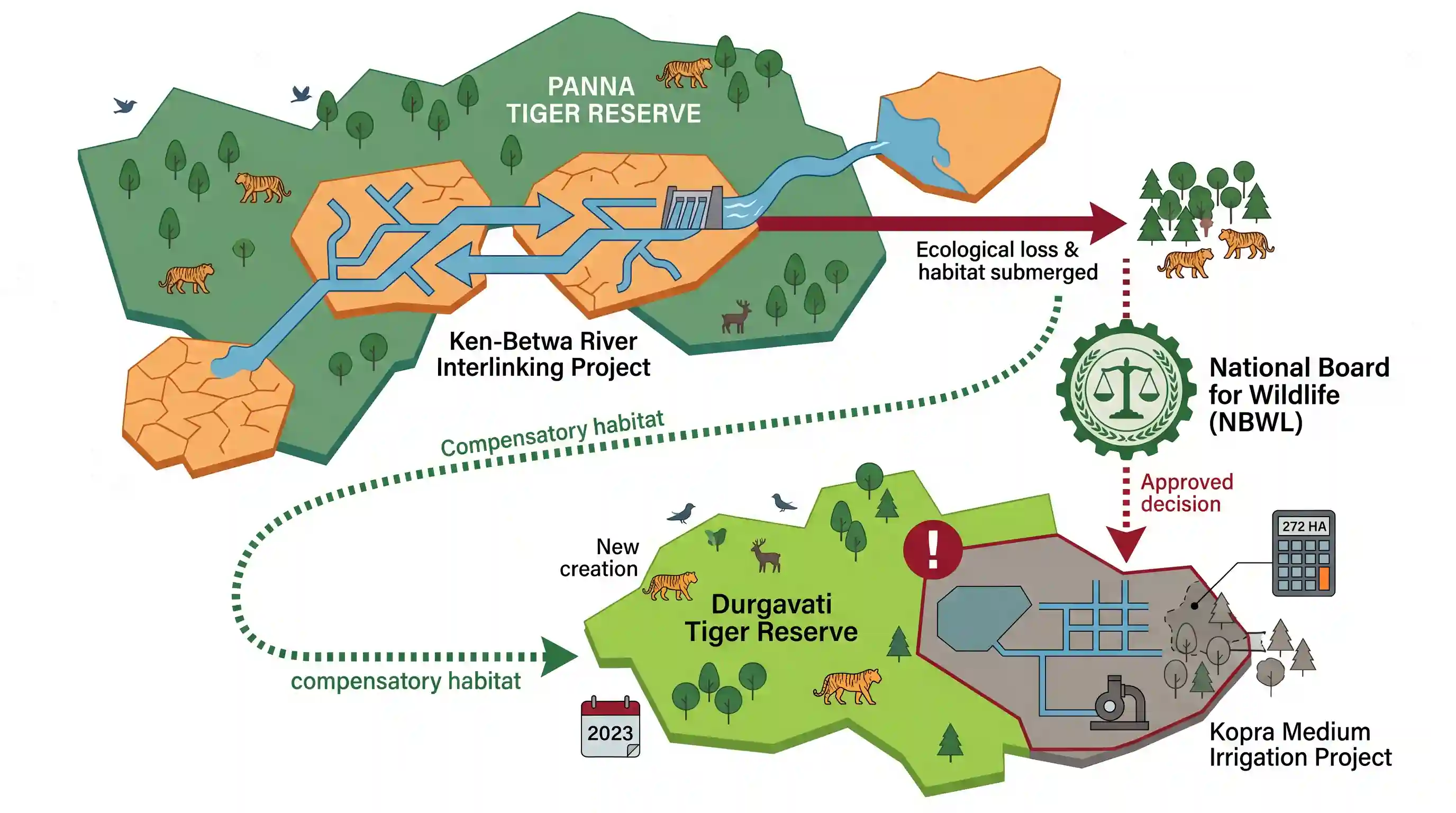
The National Board for Wildlife (NBWL) has approved a new irrigation project inside the Durgavati Tiger Reserve in Madhya Pradesh, leading to the diversion of 272 hectares of forest land. Paradoxically, the Durgavati reserve was newly created to serve as a compensatory habitat for the ecological losses suffered by the Panna Tiger Reserve due to the Ken-Betwa river interlinking project. The diversion of land in a compensatory reserve underscores the intense and cascading pressures of infrastructure and developmental projects on wildlife habitats, raising critical concerns regarding the efficacy of environmental offsets and the long-term integrity of tiger reserves.
Key Points
- The National Board for Wildlife (NBWL) has cleared an irrigation project inside the Durgavati Tiger Reserve, diverting 272 hectares of forest land.
- Ironically, Durgavati Tiger Reserve was established specifically to compensate for the habitat loss in Panna Tiger Reserve caused by the Ken-Betwa river linking project.
- The approval exposes the vulnerability of compensatory protected areas to further infrastructure development.
- It highlights the cascading ecological costs of large-scale river interlinking and irrigation projects on critical wildlife habitats.
Important Terms
National Board for Wildlife (NBWL)

Statutory body under the Wildlife (Protection) Act, 1972, chaired by the Prime Minister. It is the apex authority for wildlife-related policy and project clearances in protected areas.
UPSC context
GS Paper III (Environment/Statutory Bodies). Tests regulatory frameworks and the balance between development and conservation.
Ken-Betwa River Link Project (KBLP)
India’s first river-interlinking project, transferring surplus water from the Ken River (MP) to the Betwa River (UP) to irrigate Bundelkhand, notably submerging parts of Panna Tiger Reserve.
UPSC context
GS Papers I & III (Geography/Water Resources; Environment). Key for river-linking debates and environmental impact assessments.
Wildlife (Protection) Act, 1972
Comprehensive legislation providing the legal framework for protecting wild animals, birds, and plants. it establishes National Parks and Sanctuaries and categorizes species into schedules for varying protection.
UPSC context
GS Paper III (Environment & Ecology). Fundamental for understanding conservation laws and protected area management.
Veerangana Durgavati Tiger Reserve
Notified in 2023 in Madhya Pradesh, it serves as a compensatory habitat for tiger habitat lost in Panna due to the Ken-Betwa project; currently faces new infrastructure pressures.
UPSC context
GS Paper III (Conservation/Tiger Reserves). Relevant for current affairs on compensatory afforestation and habitat integrity.
National Tiger Conservation Authority (NTCA)
Statutory body under MoEFCC responsible for strengthening tiger conservation and overseeing 'Project Tiger'. It provides guidance on reserve management and monitors tiger populations.
UPSC context
GS Paper III (Environment/Conservation). Essential for questions on institutional mechanisms for flagship species protection.
Compensatory Habitat (Environmental Offsets)
The creation of new protected habitats to mitigate ecological losses from infrastructure projects elsewhere. It aims to maintain the net environmental integrity of a landscape.
UPSC context
GS Paper III (Environment/EIA). Tests understanding of mitigation strategies and the efficacy of ecological offsets.
Prelims Trap
"The National Board for Wildlife (NBWL) is an apex statutory body chaired by the Union Minister of Environment, Forest and Climate Change."
NBWL is a statutory body under the Wildlife (Protection) Act, 1972, but it is chaired by the Prime Minister. The Environment Minister serves only as the Vice-Chairperson.
Static Concepts Connected
What is the statutory mandate and structure of the National Board for Wildlife (NBWL)?
- Statutory Origin: Constituted under the Wildlife (Protection) Act, 1972, acting as the apex advisory body for wildlife conservation in India.
- Prime Ministerial Chair: Chaired by the Prime Minister of India, giving the board the highest level of executive backing.
- Project Clearances: Its approval is legally mandatory before altering boundaries or undertaking any development projects within protected areas.
How does the Ken-Betwa River Interlinking Project impact regional ecology?
- Basin Transfer: Transfers surplus water between Ken and Betwa, both Yamuna tributaries, to irrigate the drought-prone Bundelkhand region.
- Panna Submergence: Involves constructing the Daudhan Dam, which threatens to submerge significant critical tiger habitat within the Panna Tiger Reserve.
- Compensatory Habitat: Required the creation of the Veerangana Durgavati Tiger Reserve as a compensatory habitat to offset these massive ecological losses.
Cross-Topic Patterns
The paradox of environmental offsets
Diverting land within Durgavati—a reserve explicitly created to compensate for Panna’s losses—exposes fatal flaws in India's compensatory afforestation frameworks and environmental offset policies.
River linking vs. central wildlife corridors
The Ken-Betwa project highlights the intense tension between the National Perspective Plan for water security and the integrity of central Indian tiger corridors connecting Panna, Satpura, and Bandhavgarh.

Expect a multi-statement 2026 Prelims question linking Ken-Betwa’s impact on Panna, Durgavati's compensatory role, and NBWL's mandate.
Linked PYQs · 4
Linked PYQs · 4
- 2017MainsGS3
Not many years ago, river linking was a concept but it is becoming a reality in the country. Discuss the advantages of river linking and its possible impact on the environment.
- 2020MainsGS1
The interlinking of rivers can provide viable solutions to the multi-dimensional inter-related problems of droughts, floods and interrupted navigation. Critically examine.
- 2020PrelimsGS1
Among the following Tiger Reserves, which one has the largest area under "Critical Tiger Habitat"?
- 2017PrelimsGS1
In India, if a species of tortoise is declared protected under Schedule I of the Wildlife (Protection) Act, 1972, what does it imply?
