Indian Navy Role in Regional Security and IOR Stability
Source:Indian Express ↗
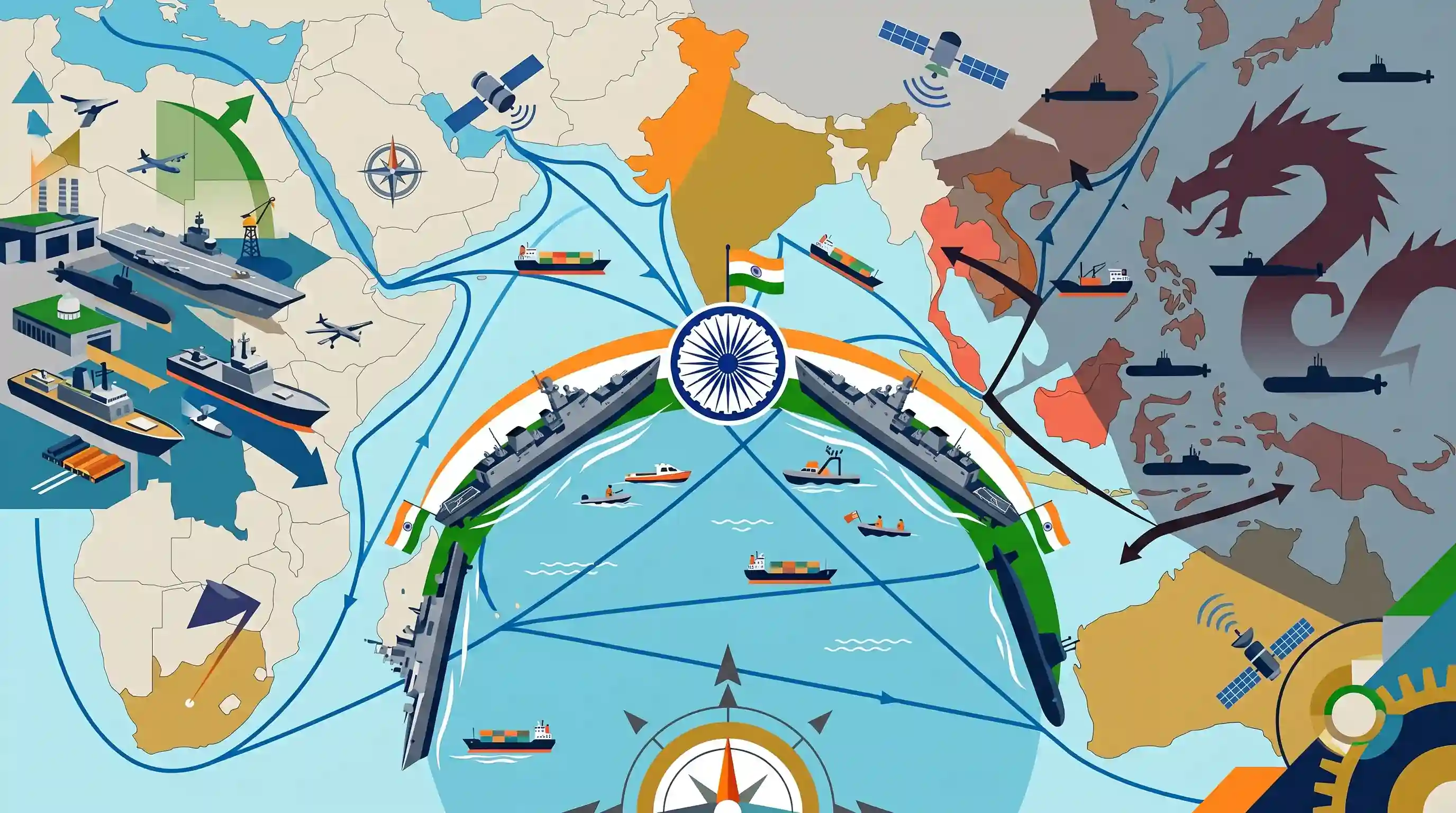
Why It Matters
The Indian Ocean Region is the lifeline of global trade and is witnessing intense geopolitical contestation. Understanding India's naval strategy and its policy as a 'net security provider' is vital for tackling GS2 International Relations questions on the Indo-Pacific, as well as GS3 questions on Maritime Security and border management.
Summary
Defence Minister Rajnath Singh highlighted the Indian Navy's pivotal role in ensuring that no single nation can dominate or suppress others in the Indian Ocean Region (IOR). Emphasizing India's responsibility as a 'net security provider', he underscored the Navy's commitment to protecting the maritime commons, securing sea lines of communication, and upholding a free, open, and rules-based Indo-Pacific. His remarks reflect India's strategic push to counter regional hegemony—implicitly pointing to China's growing maritime footprint—while pushing for indigenous naval modernization to safeguard geopolitical and economic interests.
Key Points
- Defence Minister Rajnath Singh asserted that the Indian Navy ensures no single nation can establish hegemony or suppress others in the Indian Ocean Region (IOR).
- India reaffirmed its role as a 'net security provider' in the region, committed to protecting global maritime commons and vital sea lanes of communication.
- The emphasis was placed on maintaining a free, open, and rules-based maritime order across the Indo-Pacific.
- The strategic messaging implicitly aims at countering China's growing naval footprint and its 'String of Pearls' strategy in the IOR.
- The modernization of the Indian Navy, with a focus on indigenous defense manufacturing, was highlighted as essential to sustaining regional stability.
Important Terms
Net Security Provider

A nation that proactively addresses regional security concerns beyond its borders, offering assistance through military diplomacy, capacity building, and disaster relief to ensure mutual stability in shared maritime spaces.
UPSC context
GS II (International Relations). Tests India’s strategic posture, leadership in the IOR, and contributions to regional stability.
Rules-Based Maritime Order
A global framework governing oceanic conduct based on international law (primarily UNCLOS), ensuring freedom of navigation, peaceful dispute resolution, and equitable access to maritime resources without coercion.
UPSC context
GS II (International Relations). Tests India’s stance on South China Sea disputes and opposition to unilateral regional hegemony.
Sea Lines of Communication (SLOCs)
Primary maritime trade routes between ports, essential for global commerce, energy transit, and naval logistics; their security is vital for a nation’s economic and strategic stability.
UPSC context
GS III (Security & Economy). Vital for understanding energy security, global trade chokepoints, and piracy challenges.
Indian Ocean Region (IOR)
The maritime space and littoral nations of the Indian Ocean, serving as a critical global trade highway and a focal point for geopolitical competition.
UPSC context
GS II & III. Central to India’s ‘SAGAR’ vision and countering external influence in its primary interest zone.
Indo-Pacific Strategy
A geopolitical framework treating the Indian and Pacific Oceans as a single interconnected strategic space, emphasizing a 'free, open, and inclusive' region governed by international law.
UPSC context
GS II (International Relations). Core to India's foreign policy, Quad engagement, and balancing regional power dynamics.
Maritime Commons
Ocean areas and resources outside the jurisdiction of any single state, available for international use under the principle of 'freedom of the high seas.'
UPSC context
GS II & III. Concerns global governance, freedom of navigation, and protection of international waters from hegemonies.
Prelims Trap
"The Information Fusion Centre for Indian Ocean Region (IFC-IOR) is a joint maritime security initiative of the Quad."
IFC-IOR was established by India in 2018 (hosted by the Indian Navy in Gurugram) to share white shipping data. It is an Indian initiative, not a formal Quad body.
Static Concepts Connected
What are the key maritime zones and navigation rights defined under UNCLOS?
- Territorial Sea: Extends up to 12 nautical miles from the baseline; the coastal state exercises full sovereignty over the air space, water, and seabed.
- Exclusive Economic Zone (EEZ): Extends up to 200 nautical miles; the coastal state holds sovereign rights for exploring and exploiting resources, but foreign ships enjoy freedom of navigation.
- Innocent Passage: The right of foreign ships to pass through a territorial sea continuously and expeditiously, provided it is not prejudicial to the peace or security of the coastal state.
What key doctrines and initiatives anchor India's strategic footprint in the Indian Ocean?
- SAGAR Doctrine: Security and Growth for All in the Region. India's overarching vision for maritime cooperation, emphasizing inclusive growth, capacity building, and resolving disputes via international law.
- Necklace of Diamonds: A strategic counter-alignment to China's 'String of Pearls', involving access to naval bases like Duqm (Oman), Sabang (Indonesia), and Changi (Singapore).
- Net Security Provider: India acts as a first responder to crises (e.g., HADR operations, anti-piracy) to maintain regional stability without forming formal military alliances.
Cross-Topic Patterns
Deep Sea Mining & IOR Security
India's applications to the International Seabed Authority for exploring deep-sea minerals in the Indian Ocean directly tie its naval security posture to its long-term economic and resource security.
Defense Indigenization & Project 75I
Countering China's 'String of Pearls' requires a robust blue-water navy, making GS3 indigenization topics like Project 75I (submarines) and INS Vikrant critical enablers for India's GS2 regional geopolitics.

Expect a multi-statement Prelims question mixing UNCLOS navigation provisions with the mandate of IFC-IOR and India's SAGAR doctrine.
Linked PYQs · 5
Linked PYQs · 5
- 2014MainsGS2
With respect to the South China sea, maritime territorial disputes and rising tension affirm the need for safeguarding maritime security to ensure freedom of navigation and over flight throughout the region. In this context, discuss the bilateral issues between India and China.
- 2020MainsGS2
What is the significance of Indo-US defence deals over Indo-Russian defence deals? Discuss with reference to stability in the Indo-Pacific region.
- 2022MainsGS3
What are the maritime security challenges in India ? Discuss the organisational, technical and procedural initiatives taken to improve the maritime security.
- 2025MainsGS3
Why is maritime security vital to protect India's sea trade? Discuss maritime and coastal security challenges and the way forward.
- 2015PrelimsGS1
With reference to Indian Ocean Rim Association for Regional Cooperation (IOR-ARC)', consider the following statements: 1. It was established very recently in response to incidents of piracy and accidents of oil spills. 2. It is an alliance meant for maritime security only. Which of the statements given above is/are correct?
