ISRO NavIC Satellite Launch and Technological Autonomy
Source:Indian Express ↗
हे का महत्त्वाचे आहे
NavIC represents India's strategic push for technological autonomy in satellite navigation, critical for both national security and civilian infrastructure development.
सारांश
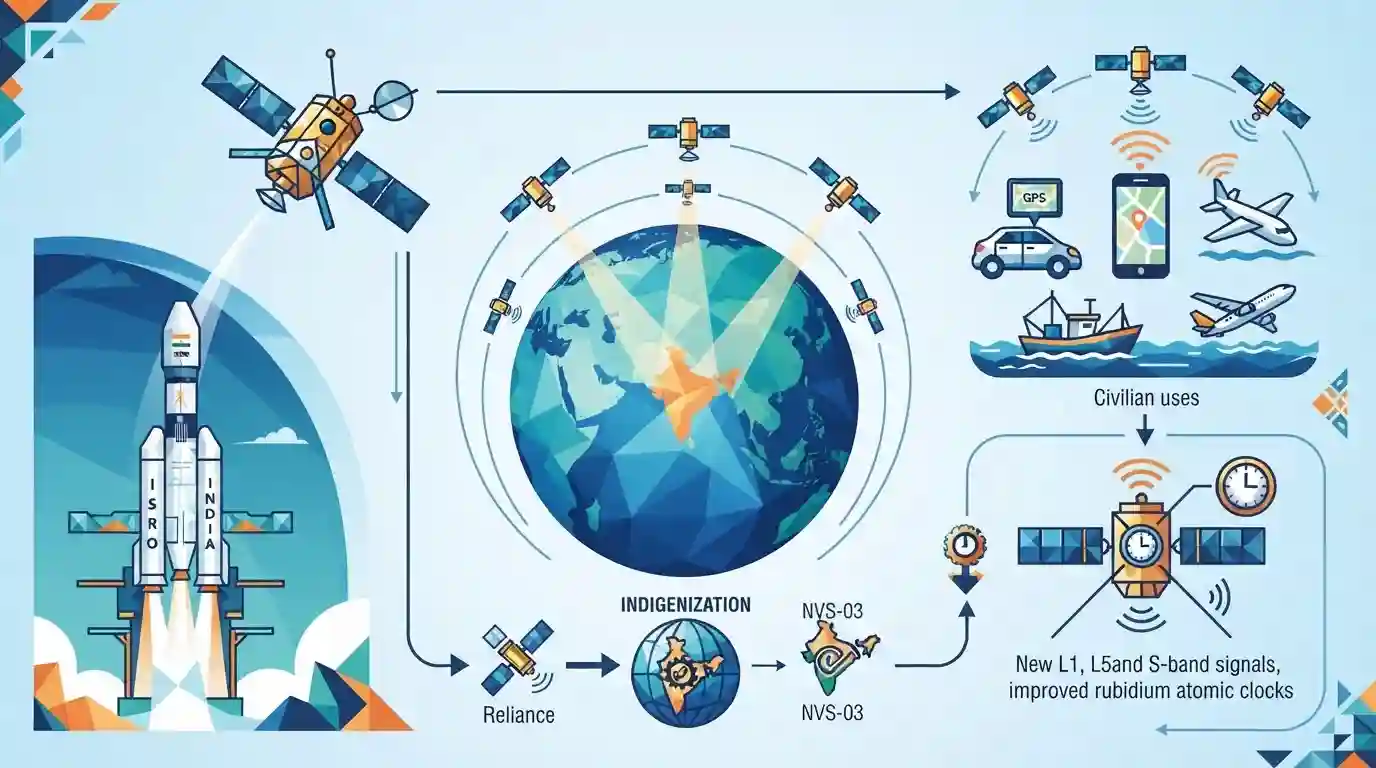
The article discusses the launch and significance of ISRO's NVS-03 navigation satellite under the NavIC (Navigation with Indian Constellation) program, highlighting technological enhancements, civilian integration, and strategic self-reliance in space-based positioning systems.
मुख्य मुद्दे
- ISRO is advancing its regional navigation satellite system, NavIC, with the upcoming launch of the NVS-03 satellite.
- NavIC (Navigation with Indian Constellation) provides accurate position information services to users in India and the region extending up to 1,500 km from its borders.
- The NVS series introduces advanced features like indigenous rubidium atomic clocks and L1 band signals for better compatibility with civilian smartphones and global navigation systems like GPS.
- Strategic and civilian applications include disaster management, vehicle tracking, precision agriculture, and military navigation.
महत्त्वाच्या संज्ञा
NavIC

India's indigenous regional satellite navigation system, formerly known as IRNSS, designed to provide accurate position information service to users in India and the region extending up to 1,500 km from its borders.
UPSC context
UPSC Mains GS Paper III (Science & Technology - Space Technology). Tests awareness of indigenous tech achievements and strategic autonomy.
NVS-03
The third second-generation navigation satellite launched by ISRO under the NavIC program, featuring indigenous rubidium atomic clocks and tri-band signals for enhanced civilian and strategic use.
UPSC context
UPSC Prelims/Mains. Tests current updates in ISRO missions, space exploration, and improvements in indigenous navigation capabilities.
IRNSS
Indian Regional Navigation Satellite System, the original operational name for the constellation of satellites forming India's regional positioning system, now branded as NavIC.
UPSC context
UPSC Prelims. Tests technical nomenclature and historical development of India's space-based navigation infrastructure.
ISRO
The national space agency of India responsible for the development, launch, and operation of space programs, launch vehicles, and satellite communication and navigation networks.
UPSC context
UPSC Prelims and Mains (GS-3). Tests institutional frameworks, major scientific achievements, and contributions to national security and development.
संबंधित स्थिर संकल्पना
What are the key technical parameters and service classifications of India's NavIC system?
- Service Area: Regional Coverage: Covers India and a primary service area extending up to 1,500 km beyond its borders.
- Dual Services: Standard Positioning Service (SPS) for civilian users and Restricted Service (RS) for authorized/strategic users.
- NVS Series Upgrades: Second-generation NVS satellites feature indigenous rubidium atomic clocks and L1 band signals for smartphone compatibility.
आंतर-विषय नमुने
Space Tech + Consumer Electronics Indigenization
NavIC's civilian L1-band integration bridges domestic satellite navigation with mass-market consumer electronics, linking high-tech space indigenization to Make in India manufacturing.
Strategic Autonomy in Critical Technology Components
Indigenous rubidium atomic clocks demonstrate critical sub-component substitution, echoing similar self-reliance drives in defense avionics and semiconductor fabrication.

Expect a statement-based prelims question comparing NavIC's regional coverage (1500 km) and L1-band integration with GPS/GLONASS.
संबंधित PYQ · 2
संबंधित PYQ · 2
- 2015MainsGS3
What do you understand by 'Standard Positioning Systems' and 'Precision Positioning Systems' in the GPS era? Discuss the advantages India perceives from its ambitious IRNSS programme employing just seven satellites.
- 2016MainsGS3
Discuss India's achievements in the field of Space Science and Technology. How the application of this technology has helped India in its socio-economic development?
