Navi Mumbai Airport Prepares for International Flight Operations
Source:The Hindu ↗
Why It Matters
Demonstrates the practical expansion of India's critical transport infrastructure and the continued role of the Public-Private Partnership (PPP) model in executing and operating large-scale aviation projects.
Summary
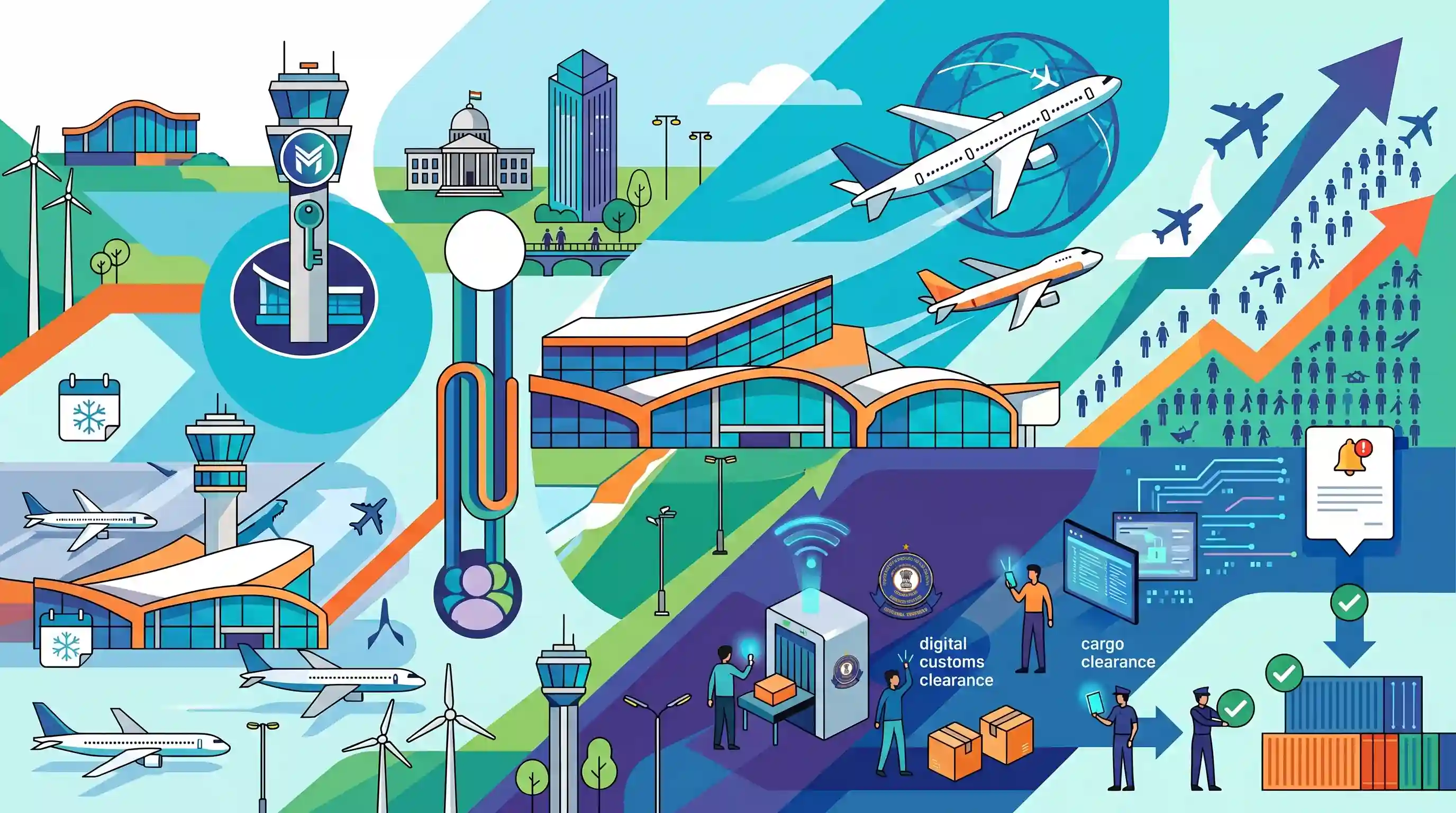
The Navi Mumbai International Airport (NMIAL), managed by the Adani Group, is preparing to launch international passenger and freighter flights on July 15. Having started domestic operations in December, the airport is projecting rapid growth, expecting to serve 50,000 daily passengers by year-end. The Central Board of Indirect Taxes and Customs (CBIC) has facilitated upcoming international operations by officially notifying it as a customs airport and initiating trials for digital customs clearance. NMIAL's expansion highlights the successful operationalization of critical transport infrastructure in India under the Public-Private Partnership (PPP) model.
Key Points
- Navi Mumbai International Airport (NMIAL) will begin international passenger and freighter operations starting July 15.
- The airport, operated by the Adani Group, had commenced domestic flights in December and currently handles roughly 20,000 passengers daily.
- Passenger volumes are expected to reach 50,000 per day by the end of the year, driven by expansions from airlines like Air India Express and IndiGo.
- The Central Board of Indirect Taxes and Customs (CBIC) recently notified NMIAL as a customs airport and authorized trials for its electronic data interchange (EDI) system.
- The airport was recognized internationally by being named among the Prix Versailles World's Most Beautiful Airports 2026.
Important Terms
Central Board of Indirect Taxes and Customs (CBIC)

A statutory body under the Ministry of Finance responsible for formulating and administering policies related to GST, Customs, and Central Excise, and supervising international trade and smuggling prevention.
UPSC context
GS Paper II/III: Relevant for statutory bodies, fiscal policy, and trade facilitation mechanisms in India.
Public-Private Partnership (PPP)
A long-term contractual arrangement between a government agency and a private entity to finance, build, and operate public infrastructure or services, sharing risks and rewards.
UPSC context
GS Paper III: Core concept under Investment Models and Infrastructure development for providing public assets.
Customs Airport
An airport officially notified by the CBIC under the Customs Act, 1962, as the only authorized site for unloading imported goods and loading export goods for clearance.
UPSC context
GS Paper III: Vital for logistics, trade infrastructure, and the movement of international passengers and cargo.
Greenfield Project
An infrastructure project, such as a new airport, constructed from scratch on previously undeveloped land, allowing for modern design without the constraints of existing facilities.
UPSC context
GS Paper III: Key distinction in infrastructure planning and economic development compared to brownfield (upgrade) projects.
Aviation Sector
A critical component of national infrastructure involving airport development and air transport services, aimed at enhancing regional connectivity and economic growth.
UPSC context
GS Paper III: Infrastructure growth and its role in decongesting urban hubs and boosting tourism and trade.
Prelims Trap
"International airports are notified for customs clearance exclusively by the Ministry of Civil Aviation or AAI."
The Central Board of Indirect Taxes and Customs (CBIC), functioning under the Ministry of Finance, officially notifies 'Customs Airports' under the Customs Act.
Static Concepts Connected
What is the DBFOT model in PPP infrastructure projects?
- Design & Build: The private entity handles the structural design and complete construction of the facility from scratch.
- Finance & Operate: The private player secures funding and manages operations/maintenance for a fixed concession period to recover its investment.
- Transfer: Asset ownership and operational control are handed back to the public authority (e.g., AAI) once the concession period ends.
What are the key features of India's Greenfield Airports Policy?
- Greenfield Nature: Refers to aviation facilities built entirely from scratch on undeveloped land, avoiding the physical and logistical constraints of upgrading existing structures.
- Two-stage Approval: Requires a strict two-stage process: 'Site Clearance' followed by 'In-Principle' approval from the Steering Committee under the Ministry of Civil Aviation.
- State Responsibility: Land acquisition, rehabilitation, and the provision of multi-modal connectivity to the airport site are the responsibility of the respective State Government.
Cross-Topic Patterns
ICEGATE and WTO Trade Facilitation
The EDI customs trials at NMIAL align with India's commitments under the WTO Trade Facilitation Agreement (TFA) to implement paperless, expedited cargo clearance via ICEGATE.
Greenfield Policy + State Finances
States are primarily responsible for land acquisition for Greenfield airports, which often strains state capital expenditure and sparks debates around land monetization and rehabilitation models.

Expect a multi-statement Prelims question contrasting Greenfield vs. Brownfield airport policies and the roles of CBIC vs. MoCA.
Linked PYQs · 3
Linked PYQs · 3
- 2017MainsGS3
Examine the development of Airports in India through joint ventures under Public-Private Partnership (PPP) model. What are the challenges faced by the authorities in this regard?
- 2022MainsGS3
Why is Public Private Partnership (PPP) required in infrastructural projects ? Examine the role of PPP model in the redevelopment of Railway Stations in India.
- 2013MainsGS3
Adoption of PPP model for infrastructure development of the country has not been free of criticism. Critically discuss pros and cons of the model.
