Industrial Safety Standards and Corporate Criminal Liability
Source:Indian Express ↗
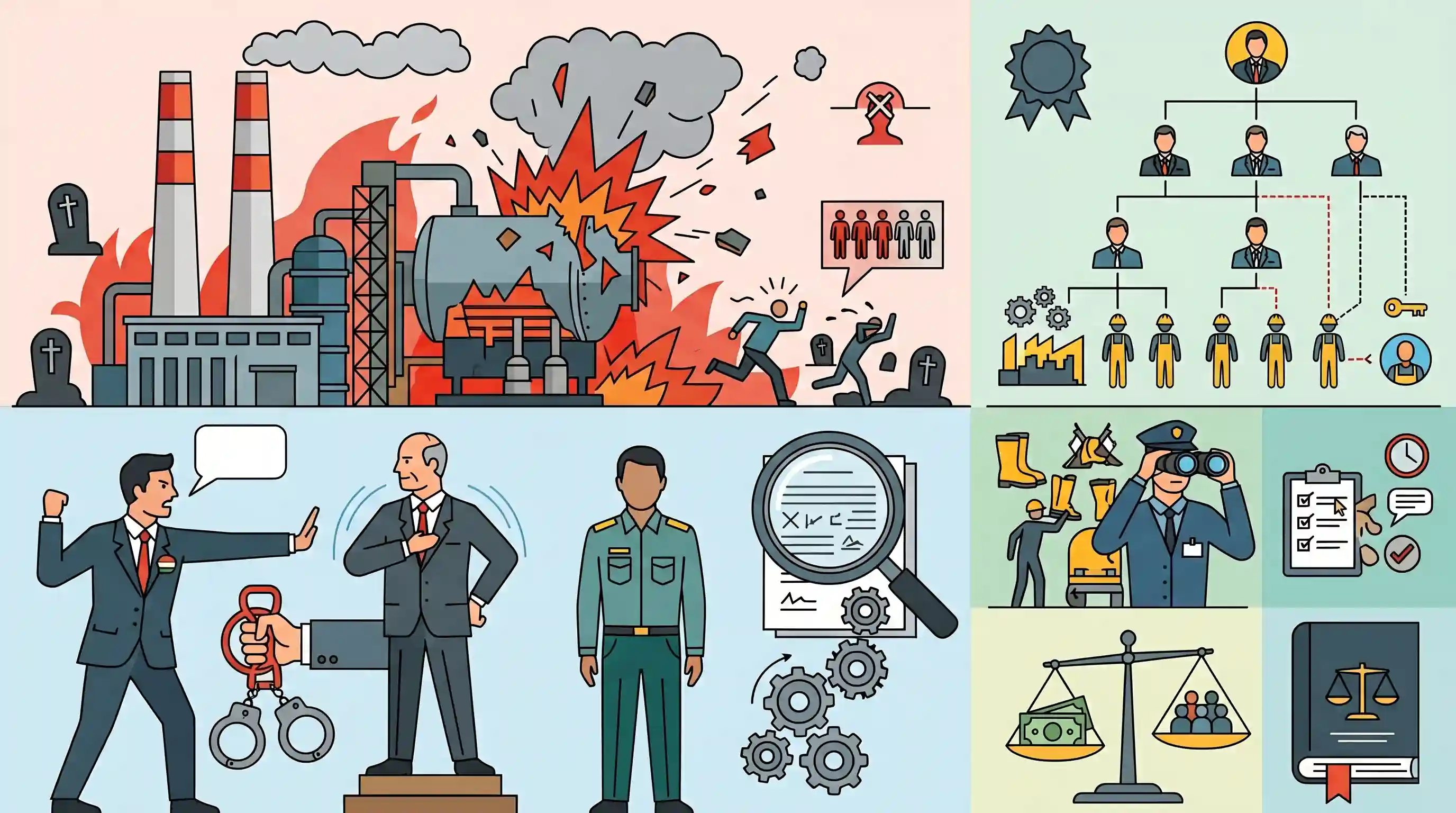
Why It Matters
The article is highly relevant for GS4 (Ethics in Corporate Governance) and GS3 (Disaster Management). It highlights the ongoing debate on the vicarious liability of top management in industrial accidents, standardizing safety protocols, and ensuring fair legal procedures without discouraging entrepreneurship.
Summary
Following a boiler explosion at a Vedanta power plant in Chhattisgarh that killed 23 people, BJP MP Naveen Jindal defended Vedanta Chairman Anil Agarwal against being named in the FIR. Jindal argued that top corporate leaders should not be reflexively criminalized before an investigation establishes direct culpability, highlighting that heads of Public Sector Undertakings (PSUs) are not treated similarly in accidents. The police have invoked Bharatiya Nyaya Sanhita (BNS) sections for death by negligence. The disaster underscores systemic challenges in industrial safety compliance, regulatory oversight, and the ethical dimensions of corporate accountability and vicarious liability.
Key Points
- The death toll from a boiler tube explosion at a Vedanta power plant in Chhattisgarh has reached 23, raising concerns over industrial safety.
- BJP MP and industrialist Naveen Jindal defended Vedanta Chairman Anil Agarwal, criticizing the immediate naming of top executives in FIRs before a thorough investigation.
- Jindal argued for parity between private sector leaders and PSU heads, pointing out that PSU chairmen are rarely named in FIRs for accidents at their plants.
- The local administration registered an FIR invoking BNS Sections 106 (death by negligence) and 288 (negligent conduct regarding machinery), prompting political demands for a judicial inquiry.
- The incident brings to light the ethical and legal debates surrounding vicarious liability, corporate governance, and occupational hazard management in India.
Important Terms
Bharatiya Nyaya Sanhita (BNS)

India's new criminal code replacing the Indian Penal Code (IPC). Section 106(1) specifically addresses 'death by negligence,' providing for imprisonment up to five years for rash or negligent acts.
UPSC context
GS Paper II: Important Legislation. Replaces colonial-era laws; tests understanding of modern criminal justice and individual vs. corporate negligence.
Vicarious Liability
A legal doctrine where a superior (employer) is held responsible for the wrongful acts of a subordinate (employee). In criminal law, it usually requires specific statutory provisions.
UPSC context
GS Paper IV: Corporate Ethics. Tests ability to analyze accountability boundaries between top leadership and ground-level operational failures.
Occupational Safety, Health and Working Conditions (OSH) Code, 2020
A 2020 law consolidating 13 central labor laws to regulate workplace health and safety. It sets standards for hazardous industries and mandates safety committees for large establishments.
UPSC context
GS Paper III: Economy/Labor Reforms. Key for questions on industrial safety, ease of doing business, and worker welfare.
Corporate Governance
The system of rules, practices, and processes by which a company is directed and controlled. It balances the interests of shareholders, management, customers, and the community.
UPSC context
GS Paper IV: Ethics. Core topic regarding transparency, accountability, and the social responsibility of business entities during crises.
Industrial Disaster Management
The framework for preventing and responding to accidents in industrial setups. Guided by the Disaster Management Act, 2005, and National Disaster Management Authority (NDMA) specific guidelines.
UPSC context
GS Paper III: Disaster Management. Focuses on man-made hazards, risk mitigation, and institutional response frameworks (NDMA/SDMA).
Public Sector Undertaking (PSU)
Government-owned corporations where the state holds a majority stake. In legal contexts, their heads may sometimes claim protection under 'public servant' clauses requiring government sanction for prosecution.
UPSC context
GS Paper II/III: Governance and Economy. Relevant for comparing legal immunities and accountability standards between public and private sector leaders.
Prelims Trap
Corporate directors are automatically held criminally liable for any industrial death under the OSH Code.
Criminal liability requires establishing direct negligence or 'mens rea'. Vicarious liability in criminal law is not automatic for directors without specific statutory mandates.
Static Concepts Connected
What is 'Absolute Liability' in Indian environmental and industrial law?
- Origin: Formulated by the Supreme Court in the M.C. Mehta (Oleum Gas Leak) case in 1986, moving beyond the older 'Strict Liability' principle.
- Core Principle: Enterprises engaged in inherently dangerous activities are absolutely liable to compensate for harm, without any defenses or exceptions.
- Criminal vs Civil: While absolute liability ensures civil compensation, criminal prosecution of directors still requires establishing direct negligence under laws like the BNS.
How does the OSH Code, 2020 govern industrial safety?
- Consolidation: It subsumes 13 legacy labor laws, including the Factories Act of 1948, to streamline occupational safety standards across industries.
- Principal Employer: Mandates that the principal employer is responsible for the safety and welfare of both direct and contractual workers on site.
- Safety Committees: Requires the formation of bipartite safety committees in hazardous factories to institutionalize risk assessment and worker participation.
Cross-Topic Patterns
Absolute Liability vs Vicarious Criminality
Links GS3 disaster management with GS2 legal frameworks, contrasting the civil 'absolute liability' of a company with the individual criminal liability of its directors.
Private vs Public sector accountability
Raises a GS4 ethics theme on administrative parity: questioning why private promoters face immediate FIRs while PSU heads are insulated by bureaucratic protections.

Expect a GS4 case study on industrial disasters contrasting civil absolute liability (Oleum Gas) with direct executive criminal negligence.
Linked PYQs · 5
Linked PYQs · 5
- 2023MainsGS4
What do you understand by 'moral integrity' and 'professional efficiency' in the context of corporate governance in India ? Illustrate with suitable examples.
- 2013MainsGS3
How important are vulnerability and risk assessment for pre-disaster management ? As an administrator, what are key areas that you would focus on in a Disaster Management System.
- 2024MainsGS4
Given below are three quotations of great thinkers. What do each of these quotations convey to you in the present context? (c) “In law, a man is guilty when he violates the rights of others. In ethics, he is guilty if he only thinks of doing so.” — Immanuel Kant
- 2017MainsGS4
Corporate social responsibility makes companies more profitable and sustainable. Analyse.
- 2020MainsGS3
Discuss the recent measures initiated in disaster management by the Government of India departing from the earlier reactive approach.
