Nature Based Solutions for Urban Climate Resilience in Coastal Cities
Source:The Hindu ↗
Why It Matters
As urban flooding and extreme weather events increasingly disrupt Indian cities, nature-based solutions (NbS) provide a sustainable, economically viable framework to enhance climate resilience. This directly aligns with UPSC syllabus themes encompassing disaster mitigation, sustainable urban planning, and environmental conservation.
Summary
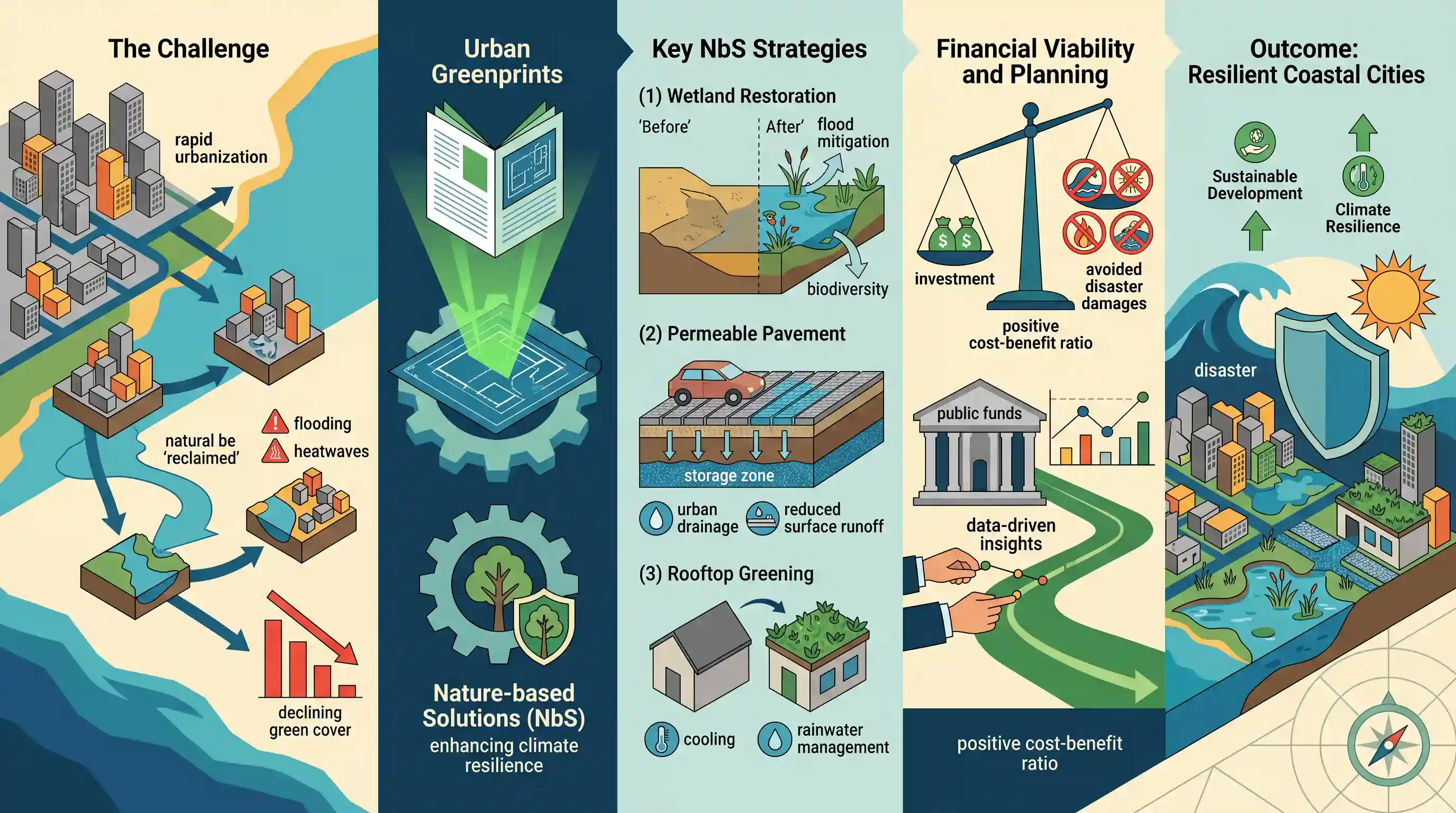
The Center for Study of Science, Technology and Policy (CSTEP) has released a report titled 'Urban Greenprints,' emphasizing Nature-based Solutions (NbS) as a crucial strategy for enhancing climate resilience in coastal cities like Mangaluru and Chennai. The report addresses escalating urban challenges such as flooding, heatwaves, and declining green cover driven by rapid urbanization and the reclamation of natural water bodies. Through strategies like wetland restoration, permeable pavements, and rooftop greening, NbS offers a financially viable approach with a positive cost-benefit ratio due to avoided disaster damages. The report advocates for mainstreaming NbS into urban planning frameworks and using data-driven insights to direct public funds toward sustainable, resilient infrastructure.
Key Points
- A new report by CSTEP titled 'Urban Greenprints' advocates for Nature-based Solutions (NbS) to combat climate vulnerabilities in coastal cities like Mangaluru and Chennai.
- Recommended NbS interventions include wetland restoration, permeable pavements, and rooftop greening to mitigate issues like urban flooding and heatwaves.
- The report highlights the economic viability of NbS, demonstrating that the cost-benefit analysis favors these interventions due to significant savings from avoided flood damages.
- Rapid urbanization has led to the degradation of green cover and encroachment upon natural water bodies, exacerbating the impact of extreme weather events.
- The study recommends integrating NbS into long-term urban planning and utilizing data-driven frameworks to effectively direct public investments toward sustainable infrastructure.
Important Terms
Nature-based Solutions (NbS)

Actions to protect, sustainably manage, and restore natural or modified ecosystems to address societal challenges (e.g., climate change, flooding) while providing human well-being and biodiversity benefits.
UPSC context
GS Paper III: Environment and Disaster Management; testing climate adaptation strategies and sustainable development goals.
Climate Resilience
The capacity of social, economic, and environmental systems to cope with a hazardous event or trend or disturbance, responding or reorganising in ways that maintain their essential function.
UPSC context
GS Paper III: Disaster Management; critical for understanding adaptive capacity and long-term climate risk mitigation.
Permeable Pavements
Surfaces made of porous materials (e.g., pervious concrete or interlocking pavers) that allow rainwater to infiltrate the ground, reducing surface runoff and urban flood risks.
UPSC context
GS Paper I: Urbanization; GS Paper III: Disaster Management (Urban Flooding); tests innovative infrastructure for sustainable cities.
Center for Study of Science, Technology and Policy (CSTEP)
A prominent Indian non-profit think tank founded in 2005 that provides science and technology-based policy recommendations to government bodies for a sustainable and inclusive society.
UPSC context
GS Paper II/III: Policy Formulation; tests the role of non-governmental think tanks in shaping India's climate and energy policies.
Urban Greenprints
A feasibility framework developed by CSTEP for systematically assessing and implementing Nature-based Solutions (NbS) in Indian coastal cities to counter rapid urbanization and climate threats.
UPSC context
GS Paper I/III: Urbanization and Environment; tests specific regional frameworks for climate-resilient urban planning.
Grey Infrastructure
Traditional human-engineered infrastructure (e.g., concrete stormwater drains, seawalls, and pipes) designed for water management, which often lacks the ecological benefits of green infrastructure.
UPSC context
GS Paper III: Environment and Disaster Management; tests the ability to contrast conventional engineering with nature-integrated solutions.
Prelims Trap
Nature-based Solutions (NbS) in urban planning rely exclusively on natural ecosystem restoration and exclude engineered setups like pavements.
NbS includes hybrid 'Blue-Green Infrastructure' like permeable pavements and green roofs alongside natural restoration, rather than being strictly limited to wild ecosystems.
Static Concepts Connected
What causes the Urban Heat Island (UHI) effect?
- Surface modifications: Concrete and asphalt absorb and retain significantly more solar radiation than natural vegetation.
- Reduced evaporation: Loss of water bodies and urban green cover reduces natural cooling achieved through evapotranspiration.
- Waste heat: Anthropogenic heat generated from dense vehicle traffic, air conditioning units, and industrial activities.
What constitutes Blue-Green Infrastructure (BGI) in urban planning?
- Blue elements: Elements linked to water management, such as restored wetlands, detention ponds, and permeable pavements for aquifer recharge.
- Green elements: Vegetative networks including urban parks, green roofs, bioswales, and vertical gardens.
- Resilience function: BGI replaces traditional 'grey' infrastructure (concrete drains) to mitigate flooding, reduce UHI, and improve urban biodiversity.
Cross-Topic Patterns
Urban Flooding & Sponge City concept
The 'sponge city' model, which aims to absorb rainwater through permeable surfaces, directly overlaps with NbS strategies to prevent urban flooding seen in cities like Chennai and Mumbai.
Disaster economics & Sendai Framework
The report's focus on "avoided disaster damages" aligns directly with the Sendai Framework's priority of investing in disaster risk reduction to build economic resilience.

GS-3 Mains 2026 will likely test 'Blue-Green Infrastructure' or 'Sponge Cities' as a primary remedy for recurrent coastal urban flooding.
Linked PYQs · 4
Linked PYQs · 4
- 2024MainsGS3
Flooding in urban areas is an emerging climate-induced disaster. Discuss the causes of this disaster. Mention the features of two such major floods in the last two decades in India. Describe the policies and frameworks in India that aim at tackling such floods.
- 2021MainsGS1
What are the environmental implications of the reclamation of water bodies into urban land use ? Explain with examples.
- 2018MainsGS1
The ideal solution of depleting ground water resources in India is water harvesting system." How can it be made effective in urban areas?
- 2022MainsGS3
Explain the causes and effects of coastal erosion in India. What are the available coastal management techniques for combating the hazard?
