Natural farming prospects and challenges in Uttarakhand agriculture
Source:garhwal-post ↗
Why It Matters
Details traditional farming practices (like Barahnaja) and geographical constraints unique to Uttarakhand. It is highly relevant for state-specific questions on the agricultural economy, organic farming schemes, and rural socio-economic issues (like out-migration) in the UKPSC PCS Prelims.
Summary
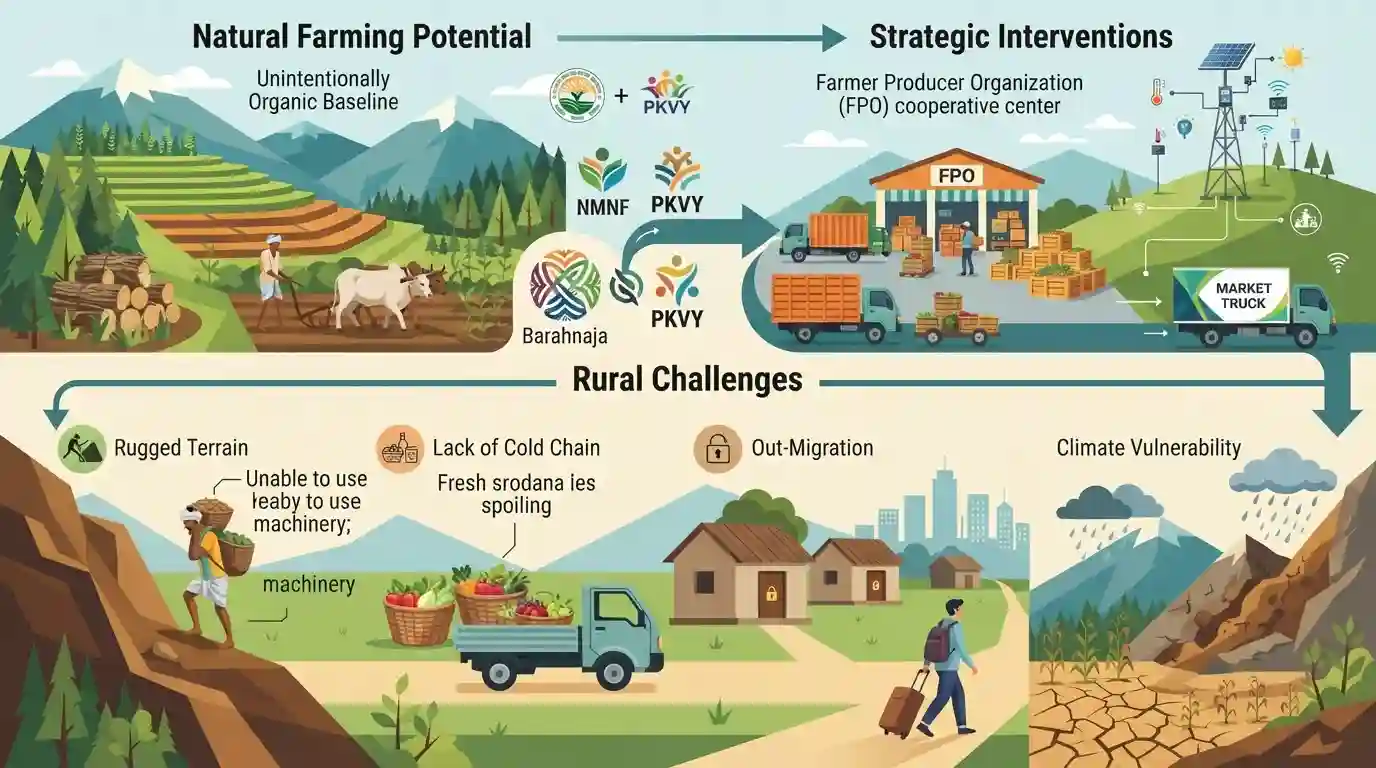
The article examines the prospects and challenges of natural farming in Uttarakhand. Benefiting from an "unintentionally organic" baseline, substantial forest cover for biomass, and traditional systems like 'Barahnaja', the state has strong potential for chemical-free farming, supported by central schemes like NMNF and PKVY. However, rugged terrains restricting mechanisation, a lack of cold-chain logistics, rural out-migration, and extreme climate vulnerabilities pose significant barriers. Scaling up FPOs and utilizing micro-weather infrastructure are proposed as strategic interventions to boost farm returns.
Key Points
- Over 80% of agriculture in Uttarakhand's hilly regions is rain-fed, relying minimally on synthetic fertilizers, making it "unintentionally organic" and suitable for Zero Budget Natural Farming (ZBNF).
- The traditional 'Barahnaja' system (intercropping 12 distinct crops) provides natural pest resistance, improves soil health, and insulates farmers from climate risks.
- Government backing is strong through initiatives like the National Mission on Natural Farming (NMNF) and Paramparagat Krishi Vikas Yojana (PKVY), which finance cluster formations and certifications.
- Major challenges to agricultural scalability include rugged mountain topography restricting mechanisation, severe climate vulnerabilities (cloudbursts, topsoil erosion), and long-term out-migration leading to deserted step farms.
- Recommended solutions include setting up micro-weather stations (as seen in Tipli, Tehri Garhwal) to guide sowing schedules, scaling up FPOs, and promoting localized bio-inputs like Jeevamrit and Neemastra.
Important Terms
National Mission on Natural Farming (NMNF)

A Centrally Sponsored Scheme to promote chemical-free, climate-resilient agriculture. It operationalizes agro-ecological farming by integrating livestock, diversifying crops, and using traditional knowledge to restore soil health without synthetic inputs.
UPSC context
GS Paper 3 (Agriculture/Environment). Tests knowledge of sustainable agriculture, government schemes for soil health, and strategies for reducing farm input costs.
Paramparagat Krishi Vikas Yojana (PKVY)
An extended component of the National Mission on Sustainable Agriculture (NMSA). It promotes traditional, chemical-free organic farming through an organic village cluster approach and participatory certification, aiming to double farmer incomes.
UPSC context
GS Paper 3. Relevant for evaluating Central schemes on sustainable agricultural practices, organic farming transition, and related rural subsidies.
Participatory Guarantee System (PGS)
A decentralized, low-cost organic certification system where local farmers assess, inspect, and verify each other's production practices. It operates outside third-party frameworks, relying on mutual trust and peer appraisals to ensure integrity.
UPSC context
GS Paper 3 (Agriculture). Tests understanding of organic certification mechanisms, quality assurance in farming, and decentralized models for smallholders.
Barahnaja
A traditional multi-cropping system from Uttarakhand involving the simultaneous cultivation of up to twelve diverse crops. It enhances ecological resilience, stabilizes food security, and enriches soil nutrients via complementary cycles.
UPSC context
GS Paper 1 (Geography) & GS 3 (Agriculture). Crucial for topics on traditional agricultural knowledge, crop diversification, and climate resilience.
Farmer Producer Organisations (FPOs)
Collectives of primary producers, particularly small and marginal farmers, formed to leverage economies of scale in procurement, processing, and marketing. They empower farmers with better bargaining power and direct market linkages.
UPSC context
GS Paper 2 & 3. Important for rural development, agricultural marketing reforms, farmer collectivization policies, and bypassing exploitative intermediaries.
Common Facility Centres (CFCs)
Shared infrastructural hubs providing essential services like processing, sorting, grading, packaging, and cold-chain storage. They assist small-scale farmers and FPOs in adding value to their produce without heavy individual capital investments.
UPSC context
GS Paper 3 (Infrastructure & Agriculture). Key to addressing post-harvest losses, agricultural supply chain logistics, and rural economic empowerment.
Prelims Trap
"Natural farming involves replacing synthetic chemicals with organic fertilizers like vermicompost."
Natural farming (ZBNF) uses NO external fertilizers, not even organic ones. It relies purely on on-farm biostimulants (Jeevamrit) to activate soil microbes. Organic farming uses external composts.
Static Concepts Connected
What is the difference between Organic Farming and Natural Farming?
- Input source: Organic farming uses external organic inputs (manure, vermicompost). ZBNF uses zero external inputs, relying entirely on on-farm biostimulants like Jeevamrit.
- Soil manipulation: Organic farming involves basic tillage. ZBNF promotes minimal to no-tillage, relying instead on biological soil aeration by earthworms and mulching (Acchadana).
- Input costs: ZBNF aims to be "zero budget" (no credit/cash required), whereas organic farming can be expensive initially due to bulk compost needs and certification.
What are the key features of Paramparagat Krishi Vikas Yojana (PKVY)?
- Cluster approach: Farmers form groups of 20 or more, covering at least 20 hectares in a contiguous area to transition to organic farming.
- Peer Certification: Promotes the Participatory Guarantee System (PGS-India), a localized peer-review certification process that is cheaper and faster than third-party checks.
- Financial support: Provides financial assistance of Rs 50,000 per hectare over three years for organic inputs, capacity building, certification, and marketing.
Cross-Topic Patterns
Border Security & Ghost Villages
Out-migration from Uttarakhand's hill districts due to agrarian distress creates unpopulated 'ghost villages', linking the rural agricultural economy directly to international border vulnerability and security management.
Traditional intercropping & Climate
The 'Barahnaja' mixed-cropping system acts as a hedge against climate extremes, showing how indigenous knowledge systems map onto climate adaptation strategies.

Expect a multi-statement question contrasting ZBNF vs Organic Farming, or matching traditional systems like Barahnaja to their home states.
Linked PYQs · 3
Linked PYQs · 3
- 2025UKPSC_PRELIMSGS1
Consider the following statements with reference to animal husbandry in Uttarakhand. Select the correct answer from the codes given below : 1. Animal husbandry is a supplementary occupation of agriculture. 2. Sheep rearing in the mountainous areas has been affected by environmental degradation.
- 2025UKPSC_PRELIMSGS1
Which of the following districts of Uttarakhand has the highest agricultural land ?
- 2016UKPSC_PRELIMSGS1
'HARELA' festival of Uttarakhand is related to:
