NATO defense spending hike and transatlantic security architecture
Source:The Hindu ↗
Why It Matters
The significant increase in NATO defense spending reflects a paradigm shift in trans-Atlantic security architecture and burden-sharing dynamics. For UPSC aspirants, understanding these changes is crucial for analyzing the evolving geopolitical landscape, the US-Europe strategic partnership, and its indirect implications for India's foreign policy and global stability.
Summary
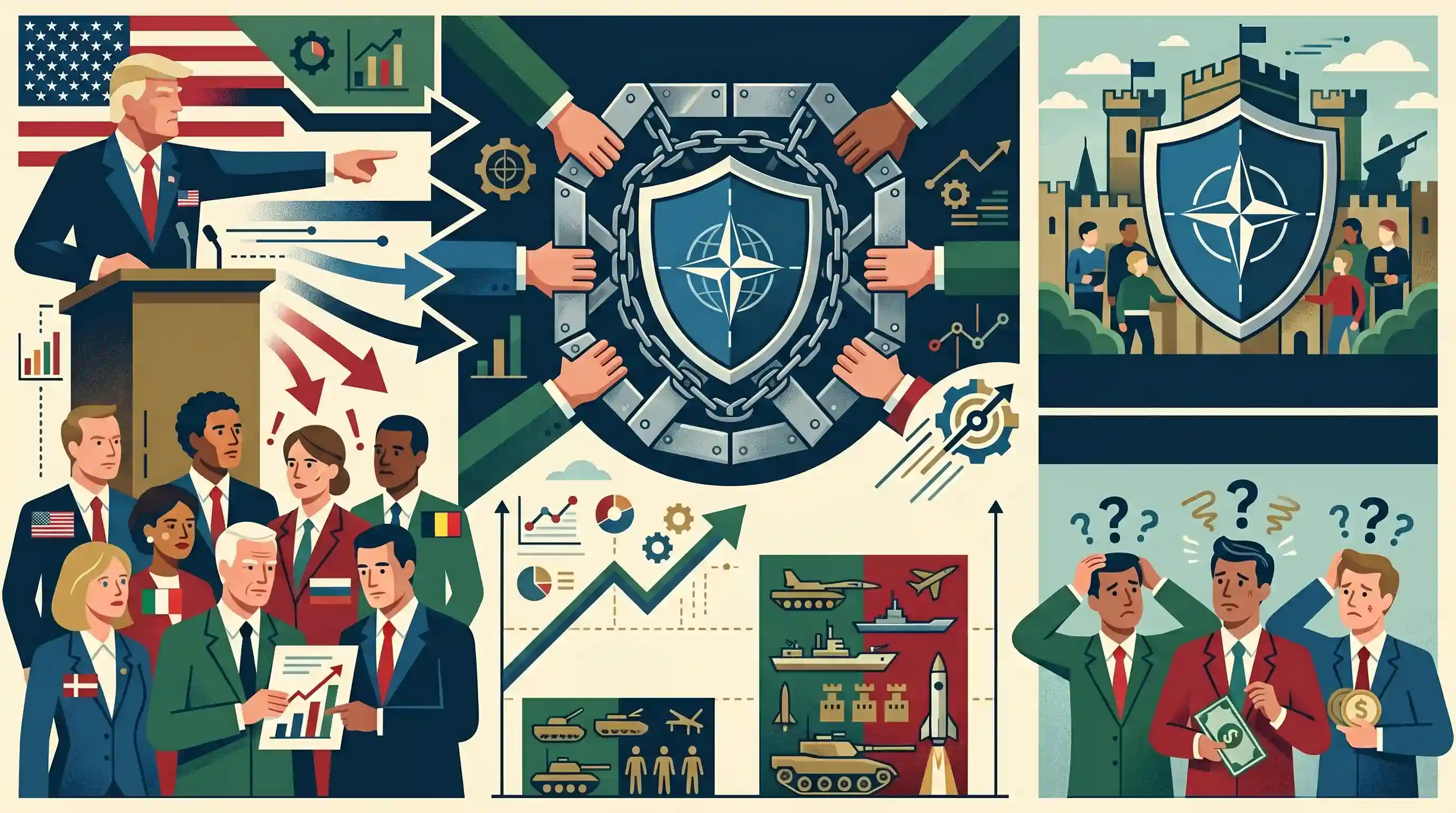
Under pressure from US President Donald Trump, NATO leaders have agreed to a substantial increase in military spending. They committed to invest 5% of GDP annually on core defense and security-related spending by 2035, significantly up from the previous 2% goal. The leaders also reaffirmed their "ironclad commitment" to the alliance's collective security guarantee. While the move addresses US demands for greater European burden-sharing, it has drawn reservations from some member states concerned about the steep financial targets.
Key Points
- NATO leaders agreed to increase their defense and security-related spending target to 5% of their GDP by 2035.
- The new target is split into 3.5% for core defense requirements and 1.5% for broader defense-related spending.
- The alliance reaffirmed its 'ironclad commitment' to collective defense, reiterating that an attack on one member is an attack on all.
- The drastic hike in spending targets was heavily driven by pressure from US President Donald Trump regarding equitable burden-sharing.
- While major European powers committed to the targets, countries like Spain and Belgium voiced reservations about the financial feasibility.
Important Terms
NATO

An intergovernmental military alliance of 32 North American and European countries, established in 1949 by the Washington Treaty to provide mutual security against external threats.
UPSC context
GS II: International Relations/Global Groupings. Tests understanding of major security alliances and their role in global geopolitics.
Collective Defence
A foundational NATO principle (Article 5) stipulating that an armed attack against one member is an attack against all, requiring a collective response.
UPSC context
GS II: International Relations. Core concept in international security treaties, deterrence, and treaty-based military obligations.
Burden-sharing
The distribution of financial and military responsibilities among NATO members, frequently centered on U.S. demands for European allies to increase defense spending.
UPSC context
GS II: International Relations. Analyzes fiscal tensions, internal alliance dynamics, and evolving U.S.-Europe security relations.
The Hague Defense Commitment
A 2025 agreement requiring NATO members to spend 5% of GDP on defense and security by 2035, significantly exceeding the previous 2% target.
UPSC context
GS II: Current Affairs/International Relations. Highlights recent shifts in global defense spending and heightened European security commitments.
Article 4 (North Atlantic Treaty)
A provision in the North Atlantic Treaty allowing members to consult whenever their territorial integrity, political independence, or security is deemed under threat.
UPSC context
GS II: International Relations. Mechanism for preventative diplomacy and security consultation before full-scale military activation.
Prelims Trap
NATO member states are now required to contribute 5% of their annual GDP to the alliance's central budget.
The 5% GDP target refers to a member state's own domestic military expenditure, not a central financial contribution or membership fee paid to NATO itself.
Static Concepts Connected
What is NATO's Article 5 and how does its collective defence operate geographically?
- Collective Defence: An armed attack against one member is considered an attack against all, requiring members to assist the attacked party with necessary action, including armed force.
- Geographic Limitations: It applies strictly to attacks occurring in Europe, North America, or island territories in the North Atlantic area north of the Tropic of Cancer.
- Sole Invocation: Article 5 has been invoked only once in the alliance's history, following the September 11, 2001, terrorist attacks on the United States.
How is NATO funded and what constitutes the burden-sharing framework?
- Direct Funding: Member states pay into common civil, military, and security investment budgets based on an agreed cost-share formula derived from Gross National Income (GNI).
- Indirect Funding (Burden-Sharing): This constitutes the 5% GDP target. It is a commitment regarding a member's domestic defense budget to ensure national militaries are adequately resourced, not direct NATO payments.
Cross-Topic Patterns
NATO Burden-Sharing & Indo-Pacific Pivot
As Europe increases defense spending to secure itself, the US can pivot more military resources toward the Indo-Pacific, indirectly supporting the Quad and India's counter-China strategy.
Defense Supply Chain Restructuring
Hiking European defense targets to 5% by 2035 will heavily strain Western manufacturing, potentially creating export or joint-venture opportunities for emerging defense industrial bases, including India.

Prelims 2026 will likely test the distinction between NATO's direct common budget funding and the domestic 5% GDP expenditure targets.
Linked PYQs · 2
Linked PYQs · 2
- 2023MainsGS2
‘The expansion and strengthening of NATO and a stronger US-Europe strategic partnership works well for India.’ What is your opinion about this statement ? Give reasons and examples to support your answer.
- 2025PrelimsGS1
Consider the following countries : I. Austria II. Bulgaria III. Croatia IV. Serbia V. Sweden VI. North Macedonia How many of the above are members of the North Atlantic Treaty Organization?
