NATO Enters Strategic Transformation and Collective Defense Era
Source:The Hindu ↗
Why It Matters
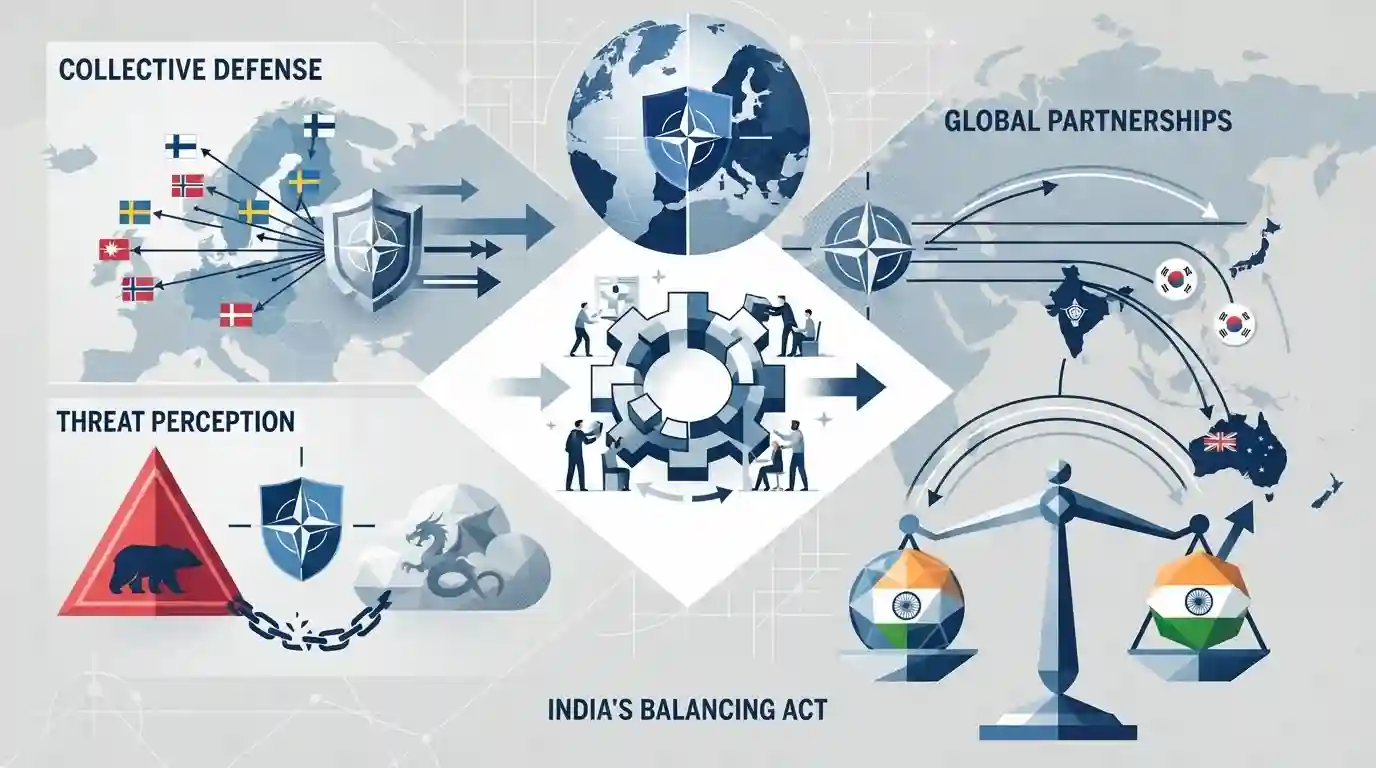
The article highlights NATO's structural transformation and its implications for global geopolitics, regional security, and India's strategic balancing act between the Western alliance and Russia.
Summary
The article outlines the North Atlantic Treaty Organization's (NATO) strategic evolution into a new era characterized by collective defense, structural transformation, and global partnerships. Driven by the Russia-Ukraine war, NATO has transitioned back to its founding mission of deterrence, absorbing formerly neutral nations like Finland and Sweden, and officially categorizing Russia as a direct threat while identifying China as a systemic challenge. Additionally, NATO is expanding its security umbrella by strengthening ties with Indo-Pacific partners, presenting both strategic opportunities and balancing challenges for India's foreign policy.
Key Points
- Strategic Reset: NATO has shifted its focus from out-of-area crisis management back to its core Cold War-era mission of deterrence and collective territorial defense in Europe.
- Expansion in Northern Europe: The accession of Finland (2023) and Sweden (2024) represents a major geopolitical shift, effectively transforming the Baltic Sea into a 'NATO lake' and adding substantial military depth in Northern Europe.
- Broadened Threat Assessment: NATO's modern strategic outlook explicitly defines Russia as the most direct threat to Euro-Atlantic peace, while for the first time designating China's coercive policies as a systemic challenge to its security interests.
- Defense Spending and Preparedness: The alliance has revitalized its force posture, requiring members to commit a minimum of 2% of GDP to defense, leading to enhanced readiness and command structure modernization.
- Global Indo-Pacific Pivot: Recognising that Euro-Atlantic and Indo-Pacific security are deeply intertwined, NATO is institutionalizing ties with its IP4 partners (Japan, South Korea, Australia, New Zealand).
- Implications for India: While a stronger Western security framework offers strategic leverage against Chinese assertiveness, NATO's aggressive positioning against Russia tests India’s traditional multi-alignment strategy and defense reliance on Moscow.
Important Terms
North Atlantic Treaty Organization (NATO)

An intergovernmental military alliance established in 1949 by the Washington Treaty. Comprising 32 North American and European nations, it is committed to collective defense under Article 5.
UPSC context
GS Paper II (Global Groupings); tests understanding of global security architecture, transatlantic relations, and contemporary geopolitical conflicts.
Madrid Strategic Concept
A key policy blueprint adopted at NATO's 2022 summit. It outlines strategic priorities for the next decade, designating Russia as a direct threat and China as a systemic challenge.
UPSC context
GS Paper II (International Relations); tests understanding of evolving global threat perceptions, shifting alliance priorities, and security dynamics.
North Atlantic Treaty
Also known as the Washington Treaty (1949), it is the founding legal document of NATO that establishes the core principle of collective defense.
UPSC context
GS Paper II (International Relations); essential for understanding the origins of Cold War-era military pacts and international treaty frameworks.
European Union (EU)
A unique political and economic union of 27 European member states established in 1993, operating as a single market with a standardized system of laws.
UPSC context
GS Paper II (Global Groupings); relevant for studying multilateral trade, India-EU ties, and regional integration models.
Prelims Trap
NATO’s Article 5 collective defense obligation applies automatically to member state military assets or territories globally, including the Indo-Pacific.
Article 6 of the North Atlantic Treaty geographically limits Article 5 to Europe, North America, and islands/vessels north of the Tropic of Cancer, excluding territories like Hawaii.
Static Concepts Connected
What is NATO's Article 5 and how is collective defense geographically constrained?
- Collective Defense: An attack on one is an attack on all, requiring allies to assist, though the nature of military response remains an individual sovereign decision.
- Consensus Principle: All NATO decisions require consensus among all member states, giving every single member an effective veto over operations and expansions.
- Geographic Limits: Article 6 restricts Article 5 to member territories, forces, or vessels in Europe, North America, and the Atlantic Ocean north of the Tropic of Cancer.
What is the Suwalki Gap and its strategic significance?
- Geographic Corridor: A narrow 100-kilometer land corridor connecting Poland and Lithuania, bordered by Belarus and the highly militarized Russian exclave of Kaliningrad.
- Chokepoint Risk: In any direct conflict, Russian control of this gap would completely isolate the Baltic states from their continental NATO allies.
Cross-Topic Patterns
NATO IP4 + Quad Maritime Synergy
The institutionalization of NATO's IP4 ties overlaps with the Quad’s maritime security agenda, compelling India to balance western alignment with continental Eurasian realities.
Arctic Geopolitics + NATO Expansion
Finland and Sweden’s accession brings almost all Arctic Council states (except Russia) under the NATO umbrella, accelerating the militarization of northern shipping lanes.

UPSC 2026 may test NATO's geographic Treaty limits (Article 6) alongside the geopolitical implications of Sweden/Finland accession.
Linked PYQs · 2
Linked PYQs · 2
- 2023MainsGS2
‘The expansion and strengthening of NATO and a stronger US-Europe strategic partnership works well for India.’ What is your opinion about this statement ? Give reasons and examples to support your answer.
- 2025PrelimsGS1
Consider the following countries : I. Austria II. Bulgaria III. Croatia IV. Serbia V. Sweden VI. North Macedonia How many of the above are members of the North Atlantic Treaty Organization?
