US Secondary Sanctions: NATO Warnings on India Russia Trade
Source:The Hindu ↗
Why It Matters
The threat of secondary sanctions by the US significantly challenges India's strategic autonomy and its balancing act between Western powers and Russia, particularly affecting its energy security and defense procurement.
Summary
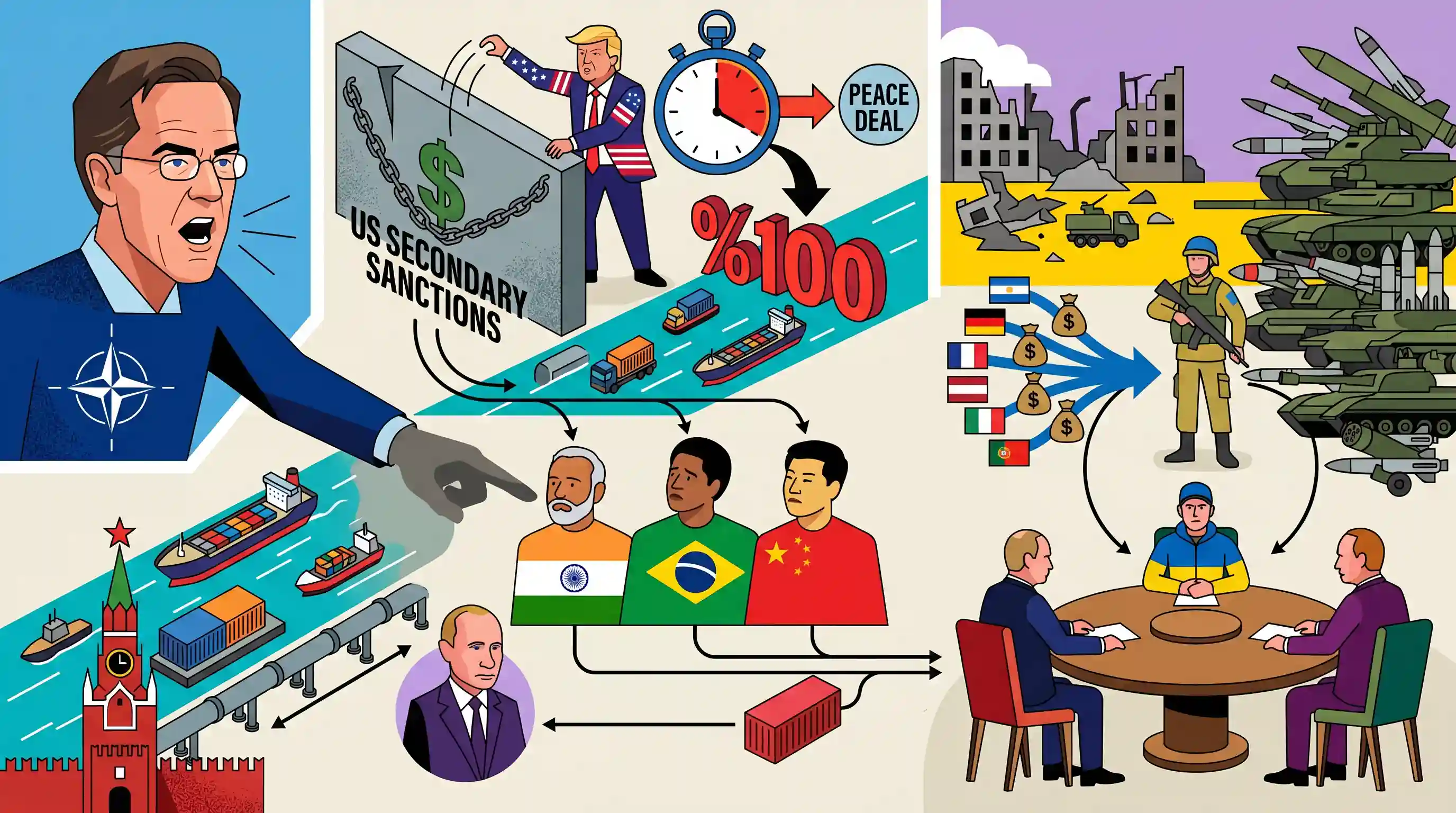
NATO Secretary General Mark Rutte has warned India, Brazil, and China that they could face devastating secondary sanctions from the US if they continue trading with Russia. This comes after US President Donald Trump announced a 50-day deadline for a peace deal in the Russia-Ukraine war, threatening to impose 100% tariffs on any country purchasing Russian exports. Rutte urged these nations to leverage their influence to push Russian President Vladimir Putin toward peace talks. Meanwhile, European nations have agreed to fund a massive supply of US weapons to Ukraine to ensure it holds a strong position in upcoming negotiations.
Key Points
- NATO Secretary General Mark Rutte warned that Brazil, China, and India could face severe secondary sanctions if they continue business with Russia.
- The warning follows US President Donald Trump's threat to impose 100% tariffs on buyers of Russian exports unless a peace agreement is reached in Ukraine within 50 days.
- Rutte urged the leaders of India, China, and Brazil to pressure Russian President Vladimir Putin to engage seriously in peace talks.
- Under a new US-Europe agreement, European nations will finance massive US weapons supplies to Ukraine, potentially including long-range missiles, to strengthen Kyiv's negotiating position.
Important Terms
NATO

A 32-member intergovernmental military alliance between North American and European countries, established by the Washington Treaty (1949) for collective defense against security threats, primarily focused on Euro-Atlantic stability.
UPSC context
GS Paper II (International Relations). Crucial for understanding global security architecture and India's 'multi-aligned' foreign policy amidst West-Russia tensions.
Secondary Sanctions
Punitive economic measures targeting third-party countries or entities (like India) that continue trading with a sanctioned nation (Russia), effectively forcing them to choose between US markets and the sanctioned party.
UPSC context
GS Paper II & III. Tests knowledge of 'extraterritoriality' in international law and its impact on India's trade and energy security.
Strategic Autonomy
The ability of a state to pursue its own national interests and preferred foreign policy without being constrained by other states, a cornerstone of India's non-aligned and multi-aligned stance.
UPSC context
GS Paper II (Foreign Policy). A recurring theme in questions regarding India's balancing act between the US and Russia.
CAATSA
A 2017 US federal law that mandates sanctions on countries engaging in significant transactions with Russian, Iranian, or North Korean defense or intelligence sectors, notably impacting India's S-400 deal.
UPSC context
GS Paper II. Vital for analyzing India-US bilateral friction points and the legal mechanisms behind US secondary sanctions.
US Congress
The legislative branch of the US government, consisting of the Senate and House of Representatives, which plays a key role in authorizing sanctions and funding foreign military aid.
UPSC context
GS Paper II (International Relations). Tests understanding of how domestic political institutions of developed nations influence global geopolitics and Indian interests.
Pentagon
The headquarters of the US Department of Defense, responsible for managing the country's military forces, weapon supplies to allies (like Ukraine), and executing national security strategies.
UPSC context
GS Paper II & III (Security). Relevant for India-US defense cooperation, technology transfers, and global military logistics.
Prelims Trap
"India legally recognizes and complies with US secondary sanctions to avoid being cut off from the global financial system."
India strictly maintains that it only recognizes multilateral sanctions imposed by the UN Security Council. It officially rejects unilateral or extraterritorial sanctions by the US as a violation of sovereignty.
Static Concepts Connected
What is the difference between primary and secondary economic sanctions?
- Primary Sanctions: Prohibits citizens and domestic companies of the sanctioning country from engaging in trade or financial transactions with the targeted nation.
- Secondary Sanctions: Targets third-party nations and foreign entities, threatening to cut them off from the sanctioning country's markets if they do business with the sanctioned target.
- India's Stance: India adheres strictly to UN Security Council resolutions and does not recognize unilateral extraterritorial sanctions under international law.
What is the CAATSA framework in United States foreign policy?
- CAATSA defined: Countering America's Adversaries Through Sanctions Act (2017) is a US federal law aimed at penalizing countries trading with Russia, Iran, and North Korea.
- The S-400 Friction: India's acquisition of the Russian S-400 missile defense system risked triggering CAATSA sanctions, heavily testing the boundaries of US-India bilateral ties and India's strategic autonomy.
Cross-Topic Patterns
BRICS alignment vs Dollar hegemony
The targeted nations—India, China, Brazil—form the core of BRICS. This geopolitical friction accelerates their push for de-dollarization and alternative payment systems to shield against extraterritorial Western sanctions.
Energy Security vs Macroeconomic Stability
Threatened 100% tariffs on Russian exports risk India's access to discounted crude oil, linking geopolitical sanctions directly to India's macroeconomic stability, domestic inflation, and Current Account Deficit management.

Expect a multi-statement IR question testing the legal difference between UNSC sanctions and extraterritorial US secondary sanctions.
Linked PYQs · 3
Linked PYQs · 3
- 2012MainsGS2
How have the US sanctions against Iran affected India's bilateral relations with Iran?
- 2023MainsGS2
‘The expansion and strengthening of NATO and a stronger US-Europe strategic partnership works well for India.’ What is your opinion about this statement ? Give reasons and examples to support your answer.
- 2020MainsGS2
What is the significance of Indo-US defence deals over Indo-Russian defence deals? Discuss with reference to stability in the Indo-Pacific region.
