Electricity Employees Plan Nationwide Strike Against Privatisation
Source:Indian Express ↗
Why It Matters
The article highlights the friction between government-led economic reforms (privatization of discoms, implementation of four new labour codes) and labor unions' concerns regarding job security, affordability of public goods, and social security. This directly ties into the GS-3 syllabus on infrastructure (energy), effects of liberalization on the economy, and changes in industrial policy and their effects on industrial growth.
Summary
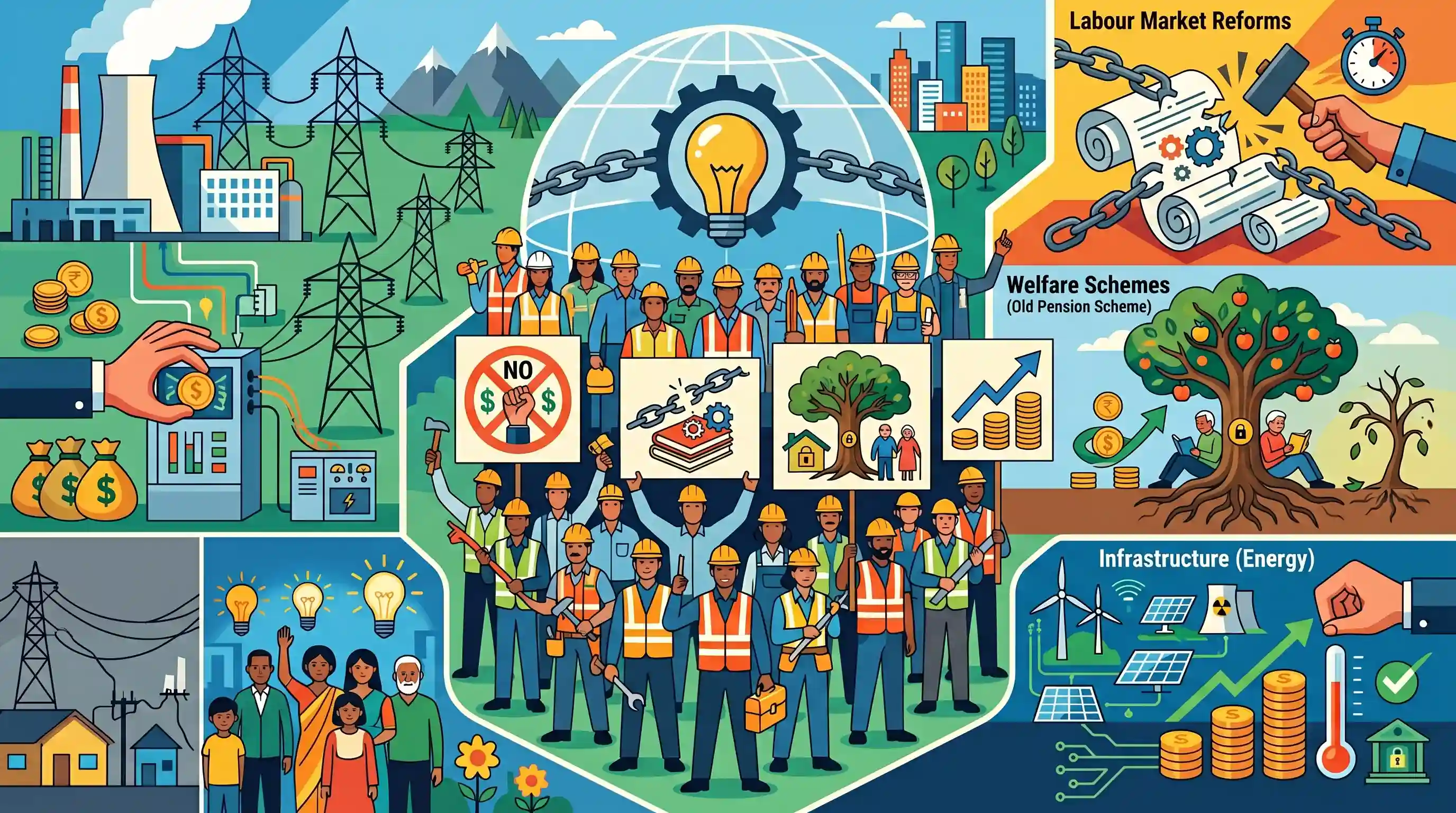
Electricity sector employees and engineers, under the umbrella of the National Coordination Committee of Electricity Employees and Engineers (NCCOEE), have scheduled a nationwide strike for July 9. The primary objective is to resist the central government's move to privatize electricity distribution companies (discoms), which workers argue will turn an essential public service into a profit-driven enterprise out of reach for marginalized sections. Beyond privatization, the protesting staffers are demanding the repeal of the four new labour codes, the restoration of the Old Pension Scheme (OPS), and the implementation of the Eighth Pay Commission.
Key Points
- The NCCOEE has called a nationwide strike on July 9 to protest against the central government's push for the privatization of electricity distribution.
- Protesters condemned the proposed privatization of the Purvanchal and Dakshinchal discoms in Uttar Pradesh, arguing that privatization makes electricity unaffordable for farmers and the poor.
- In addition to halting privatization, the electricity workers demand the restoration of the Old Pension Scheme, the notification of the Eighth Pay Commission, and the regularisation of contract workers.
- The staffers are also voicing stiff opposition to the four new central labour codes (Wages, Industrial Relations, Social Security, and OSH), describing them as detrimental to workers' rights.
Important Terms
Old Pension Scheme (OPS)

A 'Defined Benefit' system providing 50% of the last drawn salary as pension to government employees without salary deductions. Replaced by the market-linked National Pension System (NPS) in 2004.
UPSC context
GS-2 (Welfare Schemes) and GS-3 (Fiscal Policy); tests understanding of unfunded liabilities vs. sustainable pension reforms.
Eighth Pay Commission
A central panel constituted (November 2025) to review and recommend revisions to the pay scales, allowances, and pensions of over one crore central government employees and retirees.
UPSC context
GS-3 (Indian Economy); relates to government expenditure management and the decadal cycle of administrative wage revisions.
Code on Wages, 2019
A legislative consolidation of four laws (e.g., Minimum Wages Act) that establishes a statutory 'National Floor Wage' to ensure minimum living standards across all sectors.
UPSC context
GS-3 (Labour Reforms); tests knowledge of wage universalization and the transition from multiplicity of laws to simplified codes.
Industrial Relations Code, 2020
A consolidation of laws (e.g., Industrial Disputes Act) aimed at modernizing trade union rules, dispute resolution, and balancing worker welfare with industrial flexibility for employers.
UPSC context
GS-3 (Economy/Employment); critical for understanding the ease of doing business vs. collective bargaining rights.
Code on Social Security, 2020
A unified framework extending social security benefits (insurance, maternity, etc.) to all workers, including for the first time those in the unorganized, gig, and platform sectors.
UPSC context
GS-2 (Vulnerable Sections) and GS-3 (Formalization of Economy); focuses on universalizing safety nets.
Occupational Safety, Health and Working Conditions (OSH) Code, 2020
Legislation merging 13 laws to set uniform standards for safety, health, and working conditions, including mandatory health check-ups and allowing women to work night shifts.
UPSC context
GS-2 (Governance/Health); tests regulatory aspects of workplace safety and gender-neutral labor opportunities.
National Coordination Committee of Electricity Employees and Engineers (NCCOEE)
The primary umbrella organization representing major federations of power sector workers and engineers; it coordinates national resistance against the privatization of electricity distribution companies.
UPSC context
GS-2 (Pressure Groups); relevant for analyzing the influence of professional associations on infrastructure and energy policy.
Prelims Trap
"Labour welfare is an exclusive State subject, giving states sole authority to implement or reject labour codes."
'Labour' is actually in the Concurrent List (Entries 22-24). Both Centre and States can legislate on trade unions, disputes, and welfare, though Central laws prevail in conflicts.
Static Concepts Connected
What are AT&C losses in the power sector?
- Technical losses: Energy lost during transmission and distribution due to grid inefficiencies, transformer issues, and outdated equipment.
- Commercial losses: Revenue lost to power theft, unmetered agricultural/domestic supply, and defective metering.
- Collection shortfall: The financial gap occurring when billed amounts are not fully recovered from consumers by Discoms.
How do the four new Labour Codes restructure existing laws?
- Code on Wages: Universalizes minimum wages and timely payment for all workers, including the unorganized sector.
- Industrial Relations: Raises the threshold for factories requiring prior government permission for retrenchment from 100 to 300 workers.
- Social Security: Extends provident fund, insurance, and maternity benefits to gig, platform, and unorganized workers.
Cross-Topic Patterns
Discoms + PM Surya Ghar
Rooftop solar targets depend on net-metering. Financially weak Discoms often resist this, fearing the loss of high-paying, cross-subsidizing commercial consumers.
OPS + Fiscal Federalism
Reverting to the unfunded Old Pension Scheme restricts state capital expenditure, directly conflicting with FRBM Act fiscal deficit targets and RBI's warnings.

Expect a multi-statement Prelims question testing the Concurrent List jurisdiction of both 'Labour' and 'Electricity' against state powers.
Linked PYQs · 1
Linked PYQs · 1
- 2024MainsGS3
Discuss the merits and demerits of the four 'Labour Codes' in the context of labour market reforms in India. What has been the progress so far in this regard?
