UN Climate Summit and Challenges to 1.5°C Warming Target
Source:The Hindu ↗
Why It Matters
Directly relates to international climate negotiations, global governance, and India's commitments under the Paris Agreement and UNFCCC COPs.
Summary
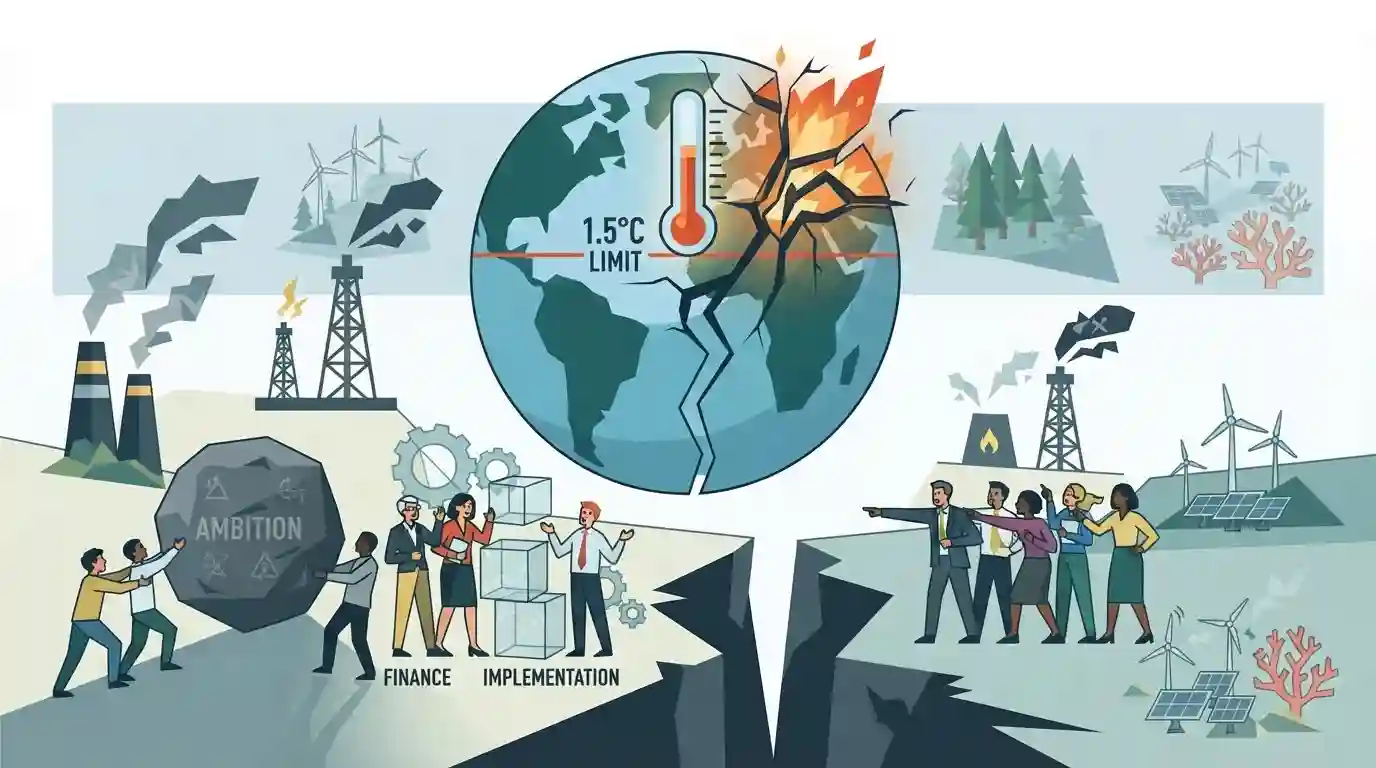
Delegates and nations at the UN climate summit are struggling with the viability and loss of the crucial 1.5°C global warming target, reflecting deep divisions over climate ambition, finance, and implementation under international climate frameworks.
Key Points
- Nations are grappling with challenges related to maintaining the 1.5 degrees Celsius global warming limit at UN climate talks.
- Uncertainty surrounds climate commitments, mitigation ambitions, and implementation mechanisms under international climate frameworks.
- Developing and developed nations face persistent friction over financial support, equity, and responsibility in climate action.
Important Terms
Paris Agreement

A legally binding international treaty adopted in 2015 at COP21, aiming to limit global warming to well below 2°C, with efforts to pursue a 1.5°C limit above pre-industrial levels.
UPSC context
GS Paper III (Environment, Conservation, and Climate Change). Tests knowledge of international treaties, emission targets, and global climate governance frameworks.
UN Climate Summit
The annual Conference of the Parties (COP) held under the UNFCCC to negotiate global climate action, mitigation strategies, and climate finance commitments.
UPSC context
GS Paper III (Environmental Pollution and Degradation). Tests understanding of multilateral climate diplomacy, state negotiation stances, and outcomes of COP meetings.
UNFCCC
The United Nations Framework Convention on Climate Change, an international environmental treaty established to stabilize greenhouse gas concentrations and prevent dangerous anthropogenic climate interference.
UPSC context
GS Paper III (Environment and Conservation). Tests foundational knowledge of international environmental law, institutional frameworks, and climate convention bodies.
Static Concepts Connected
What is the distinction between CBDR-RC and UNFCCC Annex parties?
- Annex II Obligations: Developed countries listed under Annex II must provide financial resources to assist developing countries.
- CBDR-RC Basis: Principle acknowledging that all countries must address global warming, but developed nations bear primary responsibility historically.
- Evolving Equity: Developing countries have no mandatory mitigation targets under initial UNFCCC text, shifting under Paris via NDCs.
Cross-Topic Patterns
1.5°C Breach + International Climate Justice
Climate target viability discussions feed directly into international law debates on state responsibility, loss and damage compensation, and the evolving interpretation of CBDR-RC under UNFCCC.

Expect statement questions combining IPCC emissions pathways, Paris Agreement legal nature, and CBDR-RC mechanics.
Linked PYQs · 2
Linked PYQs · 2
- 2025MainsGS3
Write a review on India's climate commitments under the Paris Agreement (2015) and mention how these have been further strengthened in COP26 (2021). In this direction, how has the first Nationally Determined Contribution intended by India been updated in 2022?
- 2021MainsGS3
Describe the major outcomes of the 26th session of the Conference of the Parties (COP) to the United Nations Framework Convention on Climate Change (UNFCCC). What are the commitments made by India in this conference?
