Uttar Pradesh targets deep tech capital status on Technology Day
Source:The Hindu ↗
Why It Matters
This article connects historical achievements (National Technology Day, Pokhran-II) with contemporary governance models (DBT, e-governance) and state-level economic strategies focusing on emerging technologies (Deep Tech, AI, Drones). It is highly relevant for GS-3 answers on indigenisation of technology, the application of emerging tech in regional development, and GS-2 answers on e-governance improving transparency.
Summary
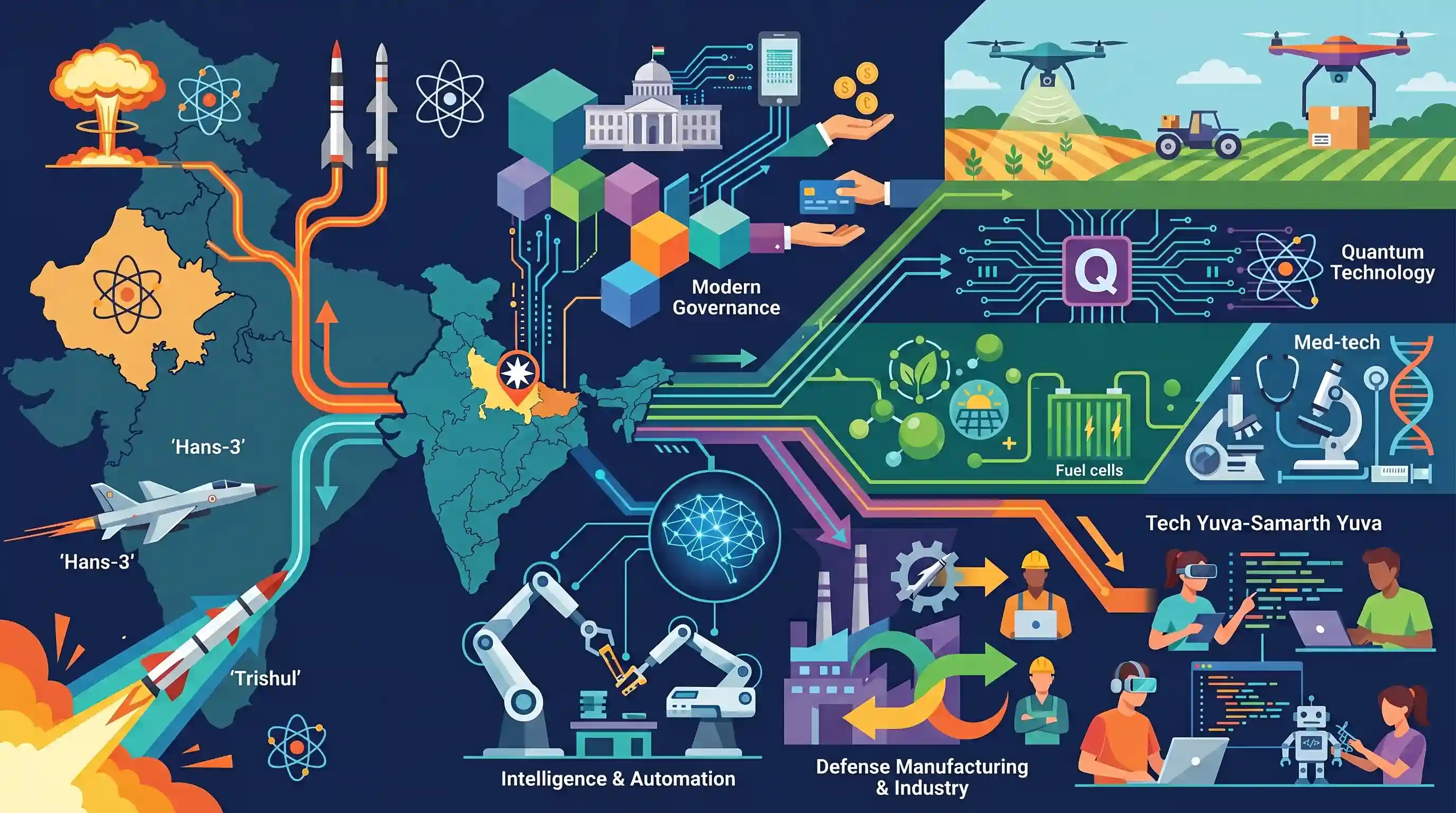
On National Technology Day, Uttar Pradesh Chief Minister Yogi Adityanath announced a commitment to making the state India's 'Deep Tech Capital'. Commemorating historical milestones like the 1998 Pokhran nuclear tests ('Operation Shakti'), the indigenous 'Hans-3' aircraft, and the 'Trishul' missile, the Chief Minister emphasized the role of science and technology in modern governance. He highlighted the state's push towards technological integration, citing the use of Direct Benefit Transfer (DBT) for transparent governance. Furthermore, Uttar Pradesh is focusing on emerging sectors like drones, quantum technology, green hydrogen, and med-tech through initiatives such as the 'Tech Yuva-Samarth Yuva' scheme and a dedicated Robotics and AI Mission, while also actively participating in defence indigenisation through the manufacturing of BrahMos missiles.
Key Points
- Chief Minister Yogi Adityanath pledged to transform Uttar Pradesh into India’s ‘Deep Tech Capital’ on the occasion of National Technology Day.
- National Technology Day (May 11) commemorates the 1998 Pokhran nuclear tests (Operation Shakti), the flight of the indigenous aircraft Hans-3, and the test firing of the Trishul missile.
- The UP government is promoting deep tech through initiatives like the State Robotics and AI Mission, data centre clusters, and the ‘Tech Yuva-Samarth Yuva’ scheme.
- Technology is being leveraged to improve governance via Direct Benefit Transfer (DBT) and digital enumeration, ensuring welfare reaches the grassroots.
- Uttar Pradesh is contributing to indigenous defence manufacturing, notably through the local production of BrahMos missiles.
Important Terms
National Technology Day

Observed annually on May 11 to commemorate India's 1998 Pokhran nuclear tests, the successful flight of the Hansa-3 aircraft, and the test-firing of the Trishul missile.
UPSC context
Relevant for GS Paper III (Science & Technology); focuses on celebrating indigenous achievements and the spirit of scientific innovation.
Operation Shakti
The code name for India's second series of five underground nuclear tests conducted in May 1998 at the Pokhran range, establishing India as a nuclear-armed state.
UPSC context
GS Paper III and GS Paper II; crucial for understanding India's nuclear policy, strategic deterrence, and post-independence history.
Deep Tech
Technologies based on substantial scientific or engineering breakthroughs, characterized by high technical risk, long gestation periods, and the potential for radical societal impact (e.g., Quantum, AI, Biotech).
UPSC context
GS Paper III (Economy/S&T); essential for discussions on the National Deep Tech Startup Policy and future innovation ecosystems.
State Robotics and AI Mission
A flagship mission by the Uttar Pradesh government (supported by budgetary allocations) to establish the state, particularly the Noida-Greater Noida region, as a global hub for robotics and AI.
UPSC context
GS Paper III; relates to regional development, industrial automation, and state-led missions for emerging technologies.
Tech Yuva-Samarth Yuva scheme
An initiative by the Uttar Pradesh government to train millions of youth in advanced technologies like AI, AR, and VR to enhance employability and digital skills.
UPSC context
GS Paper II (Social Justice/Education) and GS Paper III; tests knowledge of human capital development and digital empowerment schemes.
Direct Benefit Transfer (DBT)
A government mechanism to transfer subsidies and benefits directly into the bank accounts of beneficiaries, aimed at reducing leakages and ensuring transparent governance.
UPSC context
GS Paper II (Governance) and GS Paper III (Economy); core component of e-governance and welfare delivery reforms.
Prelims Trap
"National Technology Day is celebrated on May 11 to commemorate the discovery of the Raman Effect."
National Science Day (Feb 28) celebrates the Raman Effect. National Technology Day (May 11) marks the 1998 Pokhran-II tests, Hans-3 flight, and Trishul missile test firing.
Static Concepts Connected
What distinguishes 'Deep Tech' from conventional digital startups?
- Fundamental R&D: Based on substantial scientific advances and high-tech engineering (e.g., quantum computing, genomics, robotics) rather than just business model innovation.
- High risk, long gestation: Requires significant early-stage capital and long development cycles before commercial viability compared to standard software apps.
- Impact Scale: Aims to solve large-scale, complex global challenges like climate change, energy storage, or chronic diseases.
What are the key features of the Trishul missile under the IGMDP?
- Missile Type: A short-range, quick-reaction surface-to-air missile (SRSAM) designed for the Indian armed forces by DRDO.
- IGMDP Roster: Part of the original 5 missiles under the Integrated Guided Missile Development Programme (Prithvi, Agni, Trishul, Nag, Akash).
- Project Status: The project was officially closed in 2008, with its technologies serving as demonstrators for subsequent surface-to-air systems.
Cross-Topic Patterns
Defence Corridors + Industrial Location
UP's push for BrahMos manufacturing integrates GS-3 Defence Indigenisation with GS-1 Industrial Location. The UP Defence Industrial Corridor leverages regional manufacturing hubs to reduce import reliance.
Deep Tech + E-Governance Delivery
The application of 'Deep Tech' (like AI/data analytics) to Direct Benefit Transfers (DBT) builds upon the JAM Trinity to detect leakages and minimize exclusion errors in welfare schemes.

Expect a 2026 prelims question distinguishing 'Deep Tech' from generic IT, coupled with the IGMDP historical roster (Trishul/Akash).
Linked PYQs · 5
Linked PYQs · 5
- 2023MainsGS3
Introduce the concept of Artificial Intelligence (AI). How does Al help clinical diagnosis? Do you perceive any threat to privacy of the individual in the use of Al in healthcare?
- 2023MainsGS3
The use of unmanned aerial vehicles (UAVs) by our adversaries across the borders to ferry arms/ammunitions, drugs, etc., is a serious threat to the internal security. Comment on the measures being taken to tackle this threat.
- 2024MainsGS2
e-governance is not just about the routine application of digital technology in service delivery process. It is as much about multifarious interactions for ensuring transparency and accountability. In this context evaluate the role of the 'Interactive Service Model' of e-governance.
- 2025MainsGS2
e-governance projects have a built-in bias towards technology and back-end integration than user-centric designs. Examine.
- 2023MainsGS2
e-governance, as a critical tool of governance, has ushered in effectiveness, transparency and accountability in governments. What inadequacies hamper the enhancement of these features ?
