National Stock Exchange ruled as public authority under RTI Act
Source:The Hindu ↗
Why It Matters
This judgment significantly expands the interpretation of 'public authority' under the RTI Act, holding highly regulated, critical market infrastructure institutions accountable to the public. It sets a legal precedent on how government control or substantial financing is evaluated, ensuring greater transparency in India's capital markets.
Summary
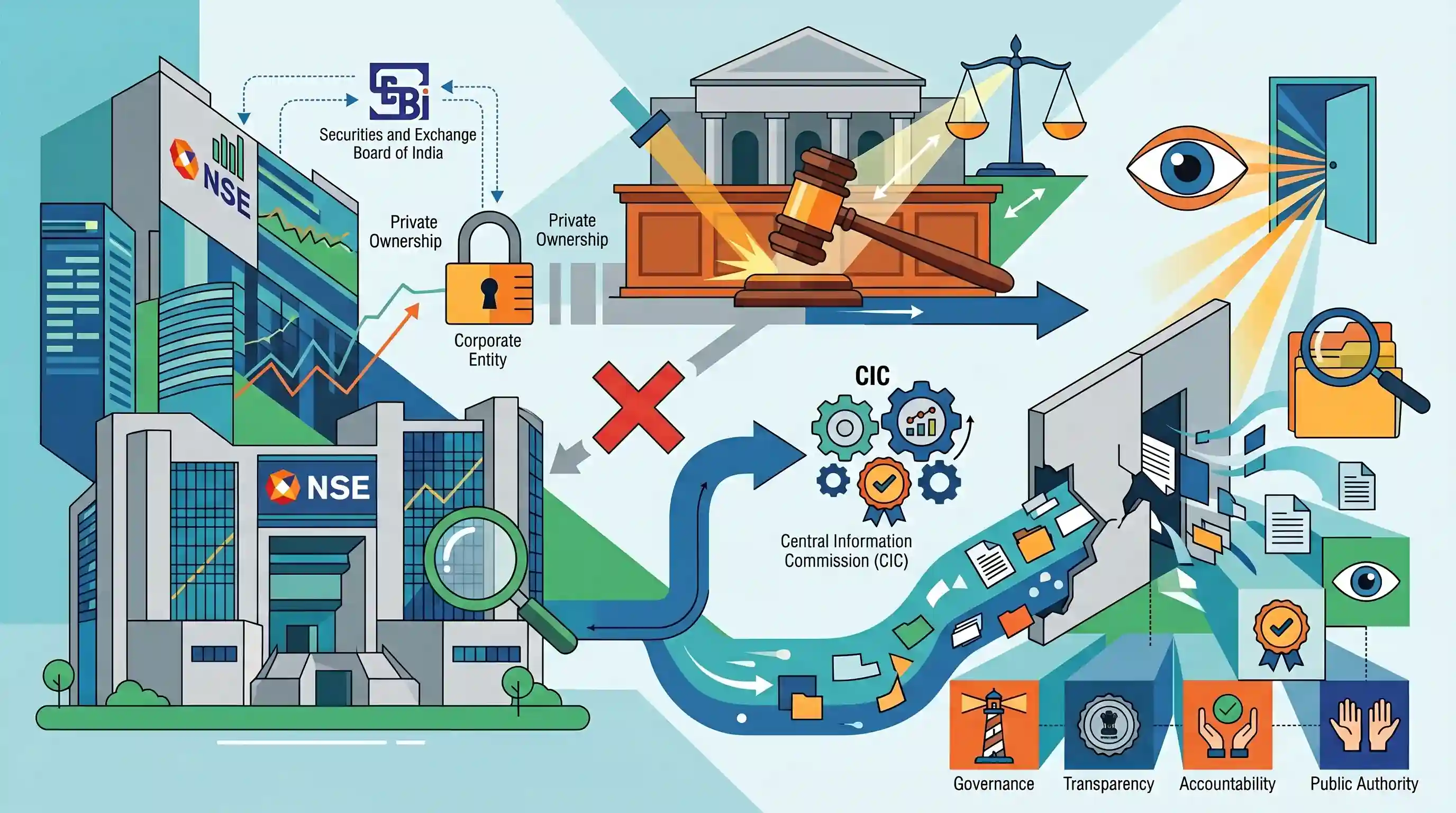
The Delhi High Court has ruled that the National Stock Exchange of India (NSE) is a 'public authority' under Section 2(h) of the Right to Information (RTI) Act, dismissing the NSE's appeal against a previous single-judge order. The NSE had argued that it was a privately owned corporate entity merely regulated by the Securities and Exchange Board of India (SEBI), and thus did not meet the criteria of being "owned, controlled, or substantially financed" by the government. However, the court upheld the Central Information Commission's (CIC) earlier determination, cementing the NSE's obligation to comply with transparency requirements under the RTI framework.
Key Points
- The Delhi High Court affirmed a single-judge ruling that the National Stock Exchange of India (NSE) is a 'public authority' under Section 2(h) of the Right to Information (RTI) Act.
- Section 2(h) of the RTI Act applies to bodies that are owned, controlled, or substantially financed by the government, either directly or indirectly.
- The NSE argued it was merely a recognized corporate entity regulated by SEBI under the Securities Contracts (Regulation) Act, and not controlled or substantially financed by the government.
- The court rejected NSE's argument, enforcing the Central Information Commission's (CIC) decision, thereby mandating the stock exchange to respond to RTI queries and ensure transparency.
Important Terms
Right to Information (RTI) Act

A 2005 legislation empowering citizens to access information from public authorities, fostering transparency and accountability in governance. It defines 'public authority' as bodies owned, controlled, or substantially financed by the government.
UPSC context
GS Paper 2: Governance and Transparency. Tests understanding of citizen empowerment tools and accountability mechanisms in Indian democracy.
Securities and Exchange Board of India (SEBI)
A statutory body established under the SEBI Act, 1992, to regulate the Indian securities market, protect investor interests, and promote market development through quasi-legislative and quasi-judicial powers.
UPSC context
GS Paper 3: Indian Economy and Regulatory Bodies. Tests knowledge of financial market oversight and investor protection frameworks.
National Stock Exchange of India (NSE)
India's leading stock exchange, established in 1992. The Delhi High Court recently classified it as a 'public authority' due to the deep regulatory control exercised by the government and SEBI.
UPSC context
GS Paper 3/2: Economics and Governance. Relevant for topics on financial infrastructure and the legal expansion of transparency laws.
Central Information Commission (CIC)
The apex statutory appellate body established under the RTI Act, 2005, to address complaints and appeals regarding information requests from central public authorities.
UPSC context
GS Paper 2: Statutory and Quasi-judicial Bodies. Tests knowledge of grievance redressal mechanisms and the institutional framework for transparency.
Securities Contracts (Regulation) Act, 1956
A 1956 law providing the legal framework for regulating stock exchanges and securities transactions in India, including the process for government recognition of exchanges.
UPSC context
GS Paper 3: Economics. Crucial for understanding the historical and legal evolution of capital market regulation in India.
Delhi High Court
The principal judicial body for the National Capital Territory of Delhi; its division bench delivered the landmark ruling confirming NSE's status as a public authority.
UPSC context
GS Paper 2: Judiciary. Relevant for judicial interpretation of statutes and the 'public authority' doctrine under administrative law.
Prelims Trap
Privately owned entities with no direct government shareholding cannot be classified as 'public authorities' under the RTI Act.
Aspirants assume strict financial ownership is required. 'Substantial financing' can be indirect (e.g., subsidized land), and pervasive statutory/regulatory control alone can trigger public authority status.
Static Concepts Connected
What defines a 'Public Authority' under Section 2(h) of the RTI Act?
- Statutory/Constitutional: Bodies established by the Constitution, Parliament, or State Legislatures.
- Government Order: Bodies constituted by notification or order made by the appropriate Government.
- Substantial Financing: Includes any body or NGO owned, controlled, or substantially financed (directly or indirectly) by the government.
What is the definition of 'State' under Article 12?
- Core Government: The Executive and Legislature of the Union and the States.
- Local Authorities: Municipalities, Panchayats, Port Trusts, and Improvement Trusts within Indian territory.
- Other Authorities: Entities exercising statutory powers or performing public functions under pervasive government control (e.g., LIC, ONGC).
Cross-Topic Patterns
Article 12 vs RTI Public Authority
The expansive interpretation of Section 2(h) of the RTI Act borrows heavily from Article 12 "State" jurisprudence, focusing on "pervasive statutory control" rather than mere ownership.
Private Monopolies & Public Functions
This mirrors the longstanding transparency debates surrounding the BCCI. Both are private entities discharging critical public/regulatory functions that resist RTI inclusion by citing corporate autonomy.

Expect a 2026 Prelims question linking RTI's 'public authority' definition with Article 12 'State' jurisprudence and indirect financing.
Linked PYQs · 3
Linked PYQs · 3
- 2020MainsGS2
Recent amendments to the Right to Information Act will have profound impact on the autonomy and independence of the Information Commission". Discuss.
- 2023PrelimsGS1
Consider the following markets: 1. Government Bond Market 2. Call Money Market 3. Treasury Bill Market 4. Stock Market How many of the above are included in capital markets?
- 2024PrelimsGS1
Consider the following statements : 1. In India, Non-Banking Financial Companies can access the Liquidity Adjustment Facility window of the Reserve Bank of India. 2. In India, Foreign Institutional Investors can hold the Government Securities (G-Secs). 3. In India, Stock Exchanges can offer separate trading platforms for debts. Which of the statements given above is/are correct?
