National Space Day Event Highlights Socioeconomic Benefits of Tech
Source:The Hindu ↗
Why It Matters
Highlights the practical, socio-economic applications of India's space program, directly addressing GS3 themes on how space technology aids national development, disaster management, and agriculture.
Summary
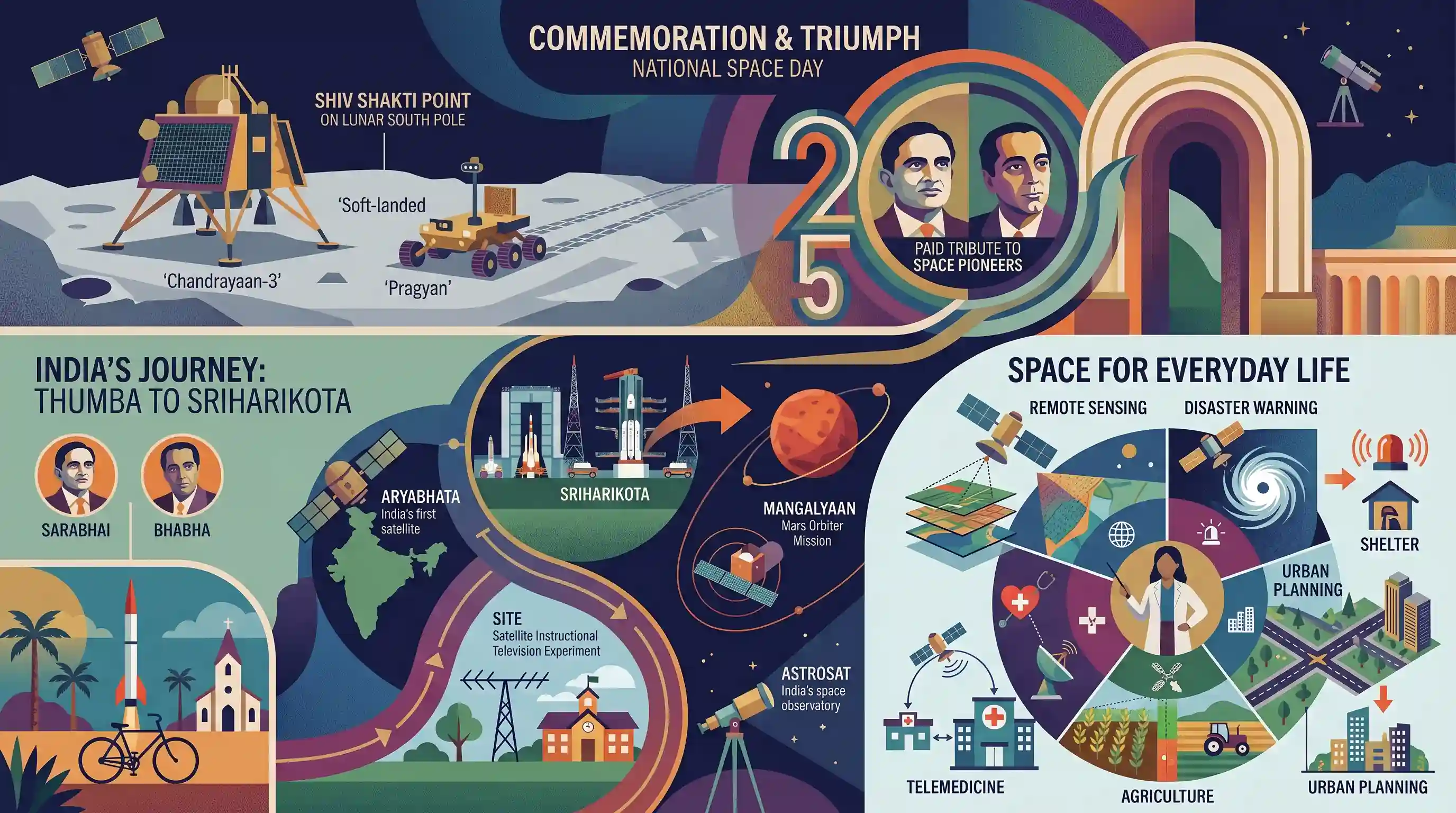
A National Space Day 2025 event at the University of Mysore highlighted the socio-economic benefits of space science and technology. Former ISRO official S. Seetha emphasized the utility of space tech in everyday life, spanning remote sensing, disaster warning, urban planning, and agriculture. The celebration commemorated the Chandrayaan-3 lunar landing and paid tribute to space pioneers Vikram Sarabhai and Homi J. Bhabha, tracing India's journey from early sounding rockets at Thumba to advanced missions like Mangalyaan and AstroSat launched from Sriharikota.
Key Points
- National Space Day is celebrated on August 23 to mark the historic soft landing of Chandrayaan-3 on the moon's southern polar region in 2023.
- Space technology provides tangible socio-economic benefits in daily life, significantly aiding in remote sensing for disaster warning, agricultural planning, urban development, and meteorology.
- India's space journey has evolved remarkably from launching sounding rockets from Thumba to deploying heavy-launch vehicles from Sriharikota.
- Pioneers like Dr. Vikram Sarabhai and Dr. Homi J. Bhabha laid the foundational vision for India's space and scientific programs, leading to missions like AstroSat and Mangalyaan.
Important Terms
National Space Day

Observed on August 23 to commemorate the successful soft landing of Chandrayaan-3 on the Moon's South Pole in 2023.
UPSC context
GS III (Science & Technology); tests awareness of national milestones and their scientific significance.
Chandrayaan-3
India's third lunar mission that made it the first country to land near the Moon’s South Pole (Shiva Shakti Point).
UPSC context
GS III (S&T); essential for 'Achievements of Indians in S&T' and 'Indigenization of Technology.'
Indian Space Research Organisation (ISRO)
India's premier space agency (est. 1969), mandated to harness space technology for national development and scientific research.
UPSC context
GS III (S&T); tests knowledge of institutional frameworks and socio-economic applications of technology.
Mangalyaan (Mars Orbiter Mission)
India's first interplanetary mission (2013), making India the first nation to reach Martian orbit on its maiden attempt.
UPSC context
GS III (S&T); reflects India's global standing and cost-effective indigenous space capabilities.
AstroSat
India's first dedicated multi-wavelength space observatory (2015) for studying celestial objects across X-ray, optical, and UV bands simultaneously.
UPSC context
GS III (S&T); relates to space technology and indigenous astronomical research capabilities.
Prelims Trap
August 23 is designated as National Space Day to commemorate the establishment of ISRO.
August 23 was designated as National Space Day specifically to mark the successful soft landing of Chandrayaan-3 on the Moon in 2023, not ISRO's founding (which is August 15).
Static Concepts Connected
What is the difference between Remote Sensing and Communication satellites?
- Remote Sensing (EO): Placed mostly in Sun-Synchronous Polar Orbits (LEO); used for agriculture, disaster management, and resource mapping (e.g., Cartosat).
- Communication: Placed in Geosynchronous/Geostationary Orbits (GEO); used for telecommunication, DTH, and navigation (e.g., GSAT, INSAT).
What makes AstroSat unique in India's space program?
- Multi-wavelength: It is India's first dedicated multi-wavelength space astronomy observatory.
- Simultaneous Coverage: Enables the simultaneous observation of celestial sources across X-ray, optical, and ultraviolet (UV) spectral bands.
Cross-Topic Patterns
Space Tech + Precision Agriculture
ISRO's remote sensing (e.g., RISAT, Cartosat) directly feeds into GS3 agriculture topics via the FASAL scheme for crop forecasting and NADAMS for drought assessment.
Historical S&T Institutional Building
Tracing India's journey from TERLS (1963) to deep space exploration highlights the GS3 theme of indigenization of technology and self-reliance amidst historical technology denial regimes.

Expect a 2026 multi-statement question mixing National Space Day's origin, AstroSat's capabilities, and LEO/GEO socio-economic applications.
Linked PYQs · 5
Linked PYQs · 5
- 2016MainsGS3
Discuss India's achievements in the field of Space Science and Technology. How the application of this technology has helped India in its socio-economic development?
- 2023MainsGS3
What is the main task of India's third moon mission which could not be achieved in its earlier mission? List the countries that have achieved this task. Introduce the subsystems in the spacecraft launched and explain the role of the Virtual Launch Control Centre' at the Vikram Sarabhai Space Centre which contributed to the successful launch from Sriharikota.
- 2017MainsGS3
India has achieved remarkable successes in unmanned space missions including the Chandrayaan and Mars Orbitter Mission, but has not ventured into manned space missions. What are the main obstacles to launching a manned space mission, both in terms of technology and logistics? Examine critically.
- 2019PrelimsGS1
For the measurement/estimation of which of the following are satellite images/remote sensing data used? 1. Chlorophyll content in the vegetation of a specific location 2. Greenhouse gas emissions from rice paddies of a specific location 3. Land surface temperatures of a specific location Select the correct answer using the code given below.
- 2016PrelimsGS1
Consider the following statements: The Mangalyaan launched by ISRO 1. is also called the Mars Orbiter Mission 2. made India the second country to have a spacecraft orbit the Mars after USA 3. made India the only country to be successful in making its spacecraft orbit the Mars in its very first attempt Which of the statements given above is/are correct?
