Public Health Intelligence System for Proactive Pandemic Defense
Source:Indian Express ↗
Why It Matters
The COVID-19 pandemic highlighted the catastrophic impact of delayed response to health crises. Incorporating intelligence frameworks into public health governance is vital for future pandemic preparedness and integrating health security into the broader national security paradigm.
Summary
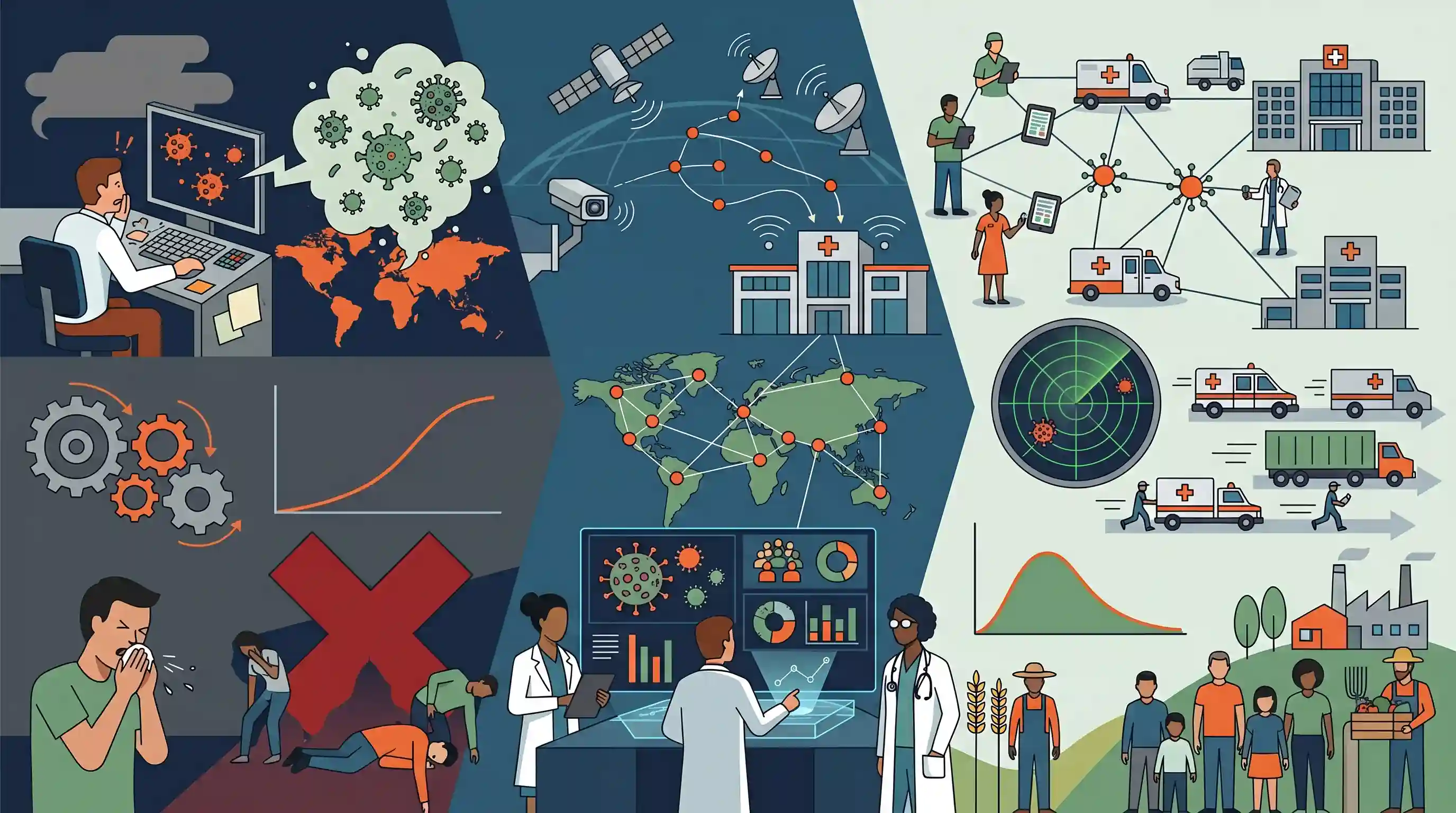
The article argues that just as nations invest heavily in intelligence systems for national security, they must develop a robust 'Public Health Intelligence System'. Traditional public health models are largely reactive, but modern threats like pandemics require a proactive approach characterized by continuous bio-surveillance, real-time epidemiological data analysis, and strong community health networks. By treating public health crises as national security imperatives, the government can leverage data-driven intelligence to detect early warning signs, mobilize resources rapidly, and prevent localized outbreaks from causing widespread socio-economic devastation.
Key Points
- The article advocates for the creation of a 'Public Health Intelligence System' to proactively monitor, detect, and mitigate health crises before they escalate into full-blown pandemics.
- Public health threats should be treated with the same urgency and strategic foresight as traditional national security threats, given their potential for massive socio-economic disruption.
- A robust health intelligence system requires real-time data integration, advanced analytics, and strengthening grassroots community health surveillance.
- Transitioning from a reactive healthcare model to an intelligence-driven, proactive bio-surveillance model is essential for future pandemic preparedness.
Important Terms
Public Health Intelligence

The process of gathering and analyzing data on health threats—including outbreaks, climate patterns, and pathogens—to enable early detection, predictive modeling, and proactive public health responses.
UPSC context
GS Paper 2 (Health Governance) & GS Paper 3 (Security); tests the integration of technology and intelligence into national security frameworks.
Integrated Health Information Platform (IHIP)
India's advanced, web-enabled digital surveillance system that provides near real-time, geospatial data on 33 epidemic-prone diseases to facilitate evidence-based policymaking and rapid outbreak response.
UPSC context
GS Paper 2 (Health/E-Governance); highlights India's leadership in digital health infrastructure and real-time disease monitoring.
Integrated Disease Surveillance Programme (IDSP)
A decentralized, state-based surveillance initiative launched in 2004 to strengthen laboratory-based tracking of epidemic-prone diseases through a network of District and State Surveillance Units.
UPSC context
GS Paper 2 (Health Infrastructure); foundational to understanding India's primary mechanism for pandemic preparedness and grassroots disease tracking.
One Health Approach
A collaborative, multisectoral framework that recognizes the interconnectedness of human, animal, and environmental health, primarily used to manage zoonotic diseases and antimicrobial resistance.
UPSC context
GS Paper 3 (Environment/S&T); essential for disaster management and addressing the biological roots of 75% of emerging infectious diseases.
National Centre for Disease Control (NCDC)
India's nodal agency under the Ministry of Health and Family Welfare responsible for national disease surveillance, outbreak investigation, and specialized training in public health.
UPSC context
GS Paper 2 (Institutions/Health); focuses on the administrative and technical leadership required for managing national public health crises.
World Health Organization (WHO)
The United Nations' specialized agency for global health that sets international standards, coordinates pandemic responses, and monitors compliance with the International Health Regulations (IHR).
UPSC context
GS Paper 2 (International Relations/Global Governance); tests knowledge of international health protocols and cooperation during global emergencies.
Prelims Trap
IHIP completely replaces the IDSP and actively tracks all communicable and non-communicable diseases nationwide.
IHIP is a digital upgrade of IDSP, specifically expanding coverage to 33+ epidemic-prone diseases (mostly communicable), not all diseases universally.
Static Concepts Connected
What is the Integrated Health Information Platform (IHIP)?
- Digital Upgrade: It is a web-enabled, near-real-time electronic information system serving as a digital upgrade to the Integrated Disease Surveillance Programme (IDSP).
- Disease Coverage: Expanded tracking from 18 to 33+ epidemic-prone diseases, utilizing GIS-enabled spatial tracking for hotspot mapping.
- Data Analytics: Integrates data from grassroots healthcare workers upward, enabling predictive analytics and early warning signals for outbreaks.
How are Biological Disasters managed under India's legal framework?
- Nodal Agency: The Ministry of Health and Family Welfare (MoHFW) is the designated nodal ministry for handling biological disasters and epidemics.
- Legal Backing: Responses are legally backed by the colonial-era Epidemic Diseases Act, 1897, and the overarching Disaster Management Act, 2005.
- NDMA Guidelines: The NDMA provides dedicated guidelines for Biological Disasters, emphasizing bio-safety, robust epidemiological surveillance, and rapid response networks.
Cross-Topic Patterns
Bio-surveillance vs. Right to Privacy
Aggressive GIS-tagging of patients for public health intelligence intersects with Article 21 privacy rights, testing the DPDP Act 2023's public health exemptions.
Non-Traditional Security Threats (GS3)
Moving beyond border security, pandemics are now classified alongside cyber-attacks and climate change as major non-traditional internal security threats requiring civil-military fusion.

Prelims 2026 may test IHIP's GIS-tagging and 33-disease tracking alongside 'One Health' concepts in a tricky multi-statement question.
Linked PYQs · 3
Linked PYQs · 3
- 2021MainsGS2
“Besides being a moral imperative of a Welfare State, primary health structure is a necessary precondition for sustainable development.” Analyze.
- 2024MainsGS2
In a crucial domain like the public healthcare system the Indian State should play a vital role to contain the adverse impact of marketisation of the system. Suggest some measures through which the State can enhance the reach of public healthcare at the grassroots level.
- 2020MainsGS3
Discuss the recent measures initiated in disaster management by the Government of India departing from the earlier reactive approach.
