NMC Revised Disability Guidelines for MBBS Admissions
Source:Indian Express ↗
हे का महत्त्वाचे आहे
It directly connects to GS2 syllabus components covering governance, the rights and inclusion of vulnerable sections (Persons with Disabilities), and the regulatory framework governing medical education and healthcare access in India.
सारांश
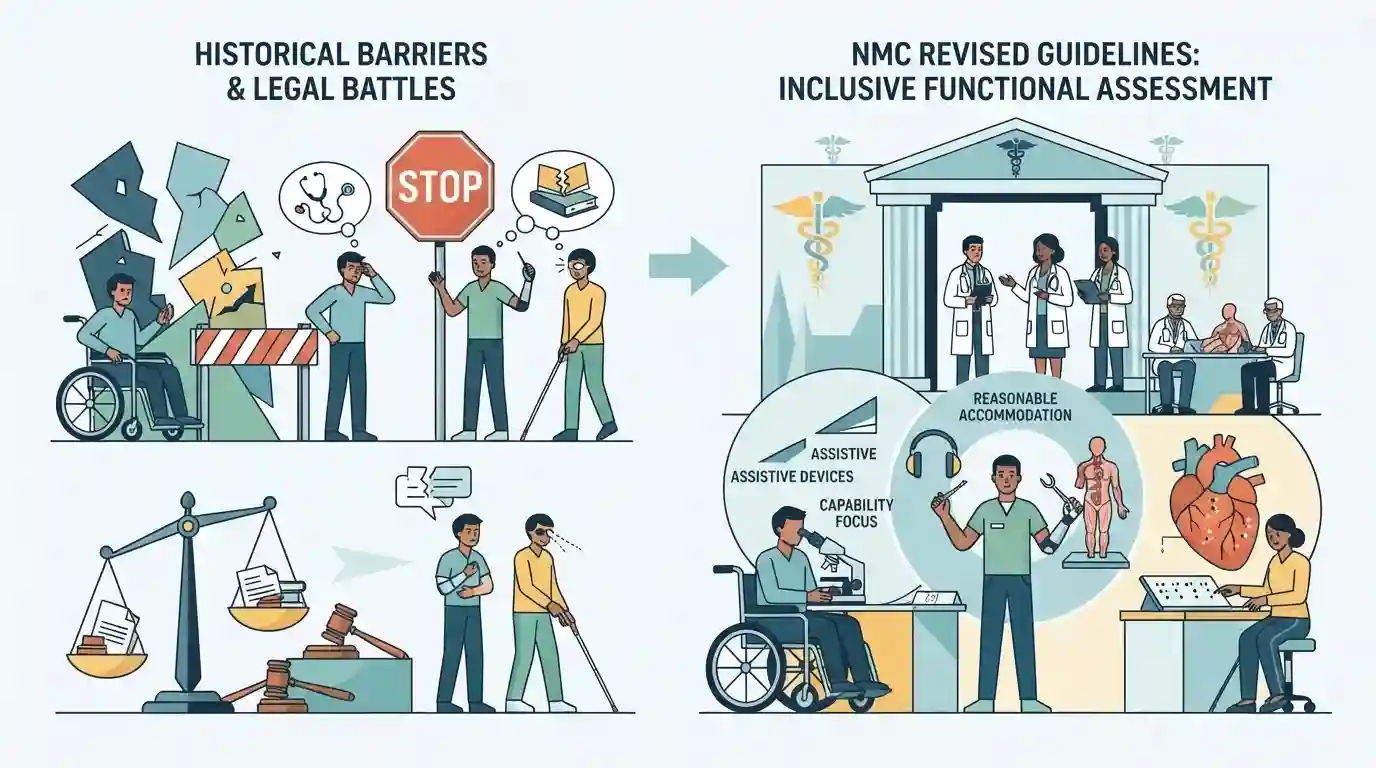
The article discusses the National Medical Commission's (NMC) revised guidelines on disability criteria for MBBS admissions. It highlights the shift towards a more inclusive, functional assessment approach for students with benchmark disabilities, addressing historical barriers and legal battles regarding medical education access.
मुख्य मुद्दे
- The National Medical Commission (NMC) revised its guidelines regarding the admission of persons with benchmark disabilities to MBBS courses, following judicial interventions.
- The earlier guidelines imposed rigid percentage caps and categorical exclusions, which restricted students with certain disabilities from pursuing medical education.
- The revised guidelines emphasize a more inclusive, competency-based assessment approach rather than blanket bans based on specific medical conditions.
- The editorial underscores the tension between clinical safety standards and the fundamental right to equality and non-discrimination for disabled aspirants.
महत्त्वाच्या संज्ञा
Rights of Persons with Disabilities (RPWD) Act, 2016

A comprehensive legislation that replaced the 1995 Act, expanding benchmark disabilities from 7 to 21, guaranteeing rights, non-discrimination, and accessibility for persons with disabilities in India.
UPSC context
GS Paper II (Social Justice - Vulnerable Sections, Government Policies & Legislation). Tests understanding of legal rights and welfare frameworks for disabled individuals.
National Medical Commission (NMC)
A statutory regulatory body established in 2020 (replacing the Medical Council of India) to determine standards of medical education, medical institutions, and medical professionals in India.
UPSC context
GS Paper II (Health & Statutory Bodies). Evaluates the governance and regulatory framework of medical education and health sector policies.
Supreme Court of India
The apex judicial authority in India and guarantor of the Constitution, responsible for judicial review, protecting fundamental rights, and interpreting statutes like the RPwD Act.
UPSC context
GS Paper II (Polity - Judiciary). Important for questions on judicial review, public interest litigation, and rights enforcement for marginalized groups.
संबंधित स्थिर संकल्पना
What are the key statutory bodies regulating medical education and disability rights in India?
- NMC Mandate: Established under the National Medical Commission Act, 2019, replacing the Medical Council of India to regulate medical education and practice.
- RPWD Act 2016: Enacted to give effect to the UNCRPD, reserving 4% of government jobs and higher education seats for persons with benchmark disabilities (40% or more disability).
- Assessment Boards: Specialized bodies authorized under RPWD rules to evaluate functional capacity and issue eligibility certificates rather than blanket exclusions.
आंतर-विषय नमुने
Disability Rights + Administrative Law (NMC vs Courts)
The evolution from categorical exclusions to functional competency mirrors the RPWD Act's shift from a medical model of disability to a social and human rights model.

Expect a statement-based Prelims question on whether a PwBD candidate can be barred solely by UDID percentage or needs a functional assessment.
संबंधित PYQ · 1
संबंधित PYQ · 1
- 2017MainsGS2
Does the Rights of Persons with Disabilities Act, 2016 ensure effective mechanism for empowerment and inclusion of the intended beneficiaries in the society? Discuss.
