National Medical Commission: Revised Disability Guidelines for MBBS
Source:Indian Express ↗
Why It Matters
It directly relates to GS2 syllabus coverage on welfare schemes for vulnerable sections, rights of persons with disabilities, and inclusive education/healthcare policy administration in India.
Summary
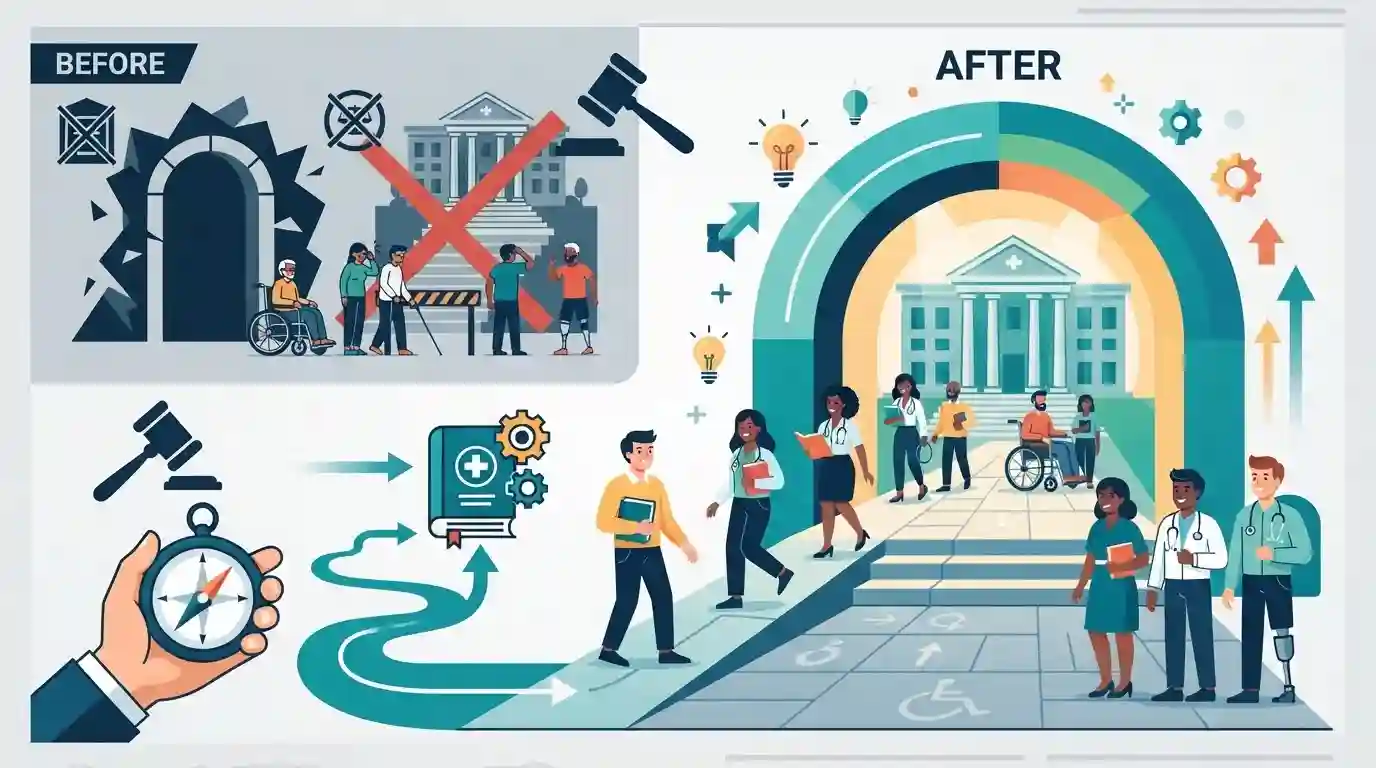
An analysis of the National Medical Commission's (NMC) revised guidelines on disability criteria for MBBS admissions. The editorial highlights the progressive shift towards greater inclusivity, moving away from past restrictive norms in compliance with judicial oversight and the Rights of Persons with Disabilities Act.
Key Points
- The National Medical Commission (NMC) has revised its guidelines regarding medical admissions for students with disabilities, expanding inclusivity for MBBS aspirants.
- Previous guidelines faced judicial scrutiny and criticism for being overly restrictive, prompting a re-evaluation aligned with modern rights frameworks and Supreme Court directives.
- The policy shift underscores the balance between reasonable accommodation in higher education and maintaining clinical competence standards.
- Emphasizes the need for institutions to adopt a proactive, barrier-free ecosystem rather than exclusion based on rigid criteria.
Important Terms
Rights of Persons with Disabilities (RPWD) Act, 2016

A comprehensive legislation enacted to give effect to the United Nations Convention on the Rights of Persons with Disabilities (UNCRPD), ensuring equality, non-discrimination, and full inclusion for individuals with diverse disabilities.
UPSC context
UPSC GS Paper II (Social Justice - Vulnerable Sections): Tests legal frameworks, rights-based approaches, and welfare measures for persons with disabilities.
National Medical Commission (NMC)
The statutory regulatory body established under the National Medical Commission Act, 2019, responsible for framing policies, setting standards for medical education, and regulating medical professionals in India.
UPSC context
UPSC GS Paper II (Governance / Health Policies): Evaluates the role of statutory bodies in regulating medical education and healthcare standards.
Supreme Court of India
The highest judicial tribunal of India under the Constitution, empowered with original, appellate, and writ jurisdictions, ensuring the protection of fundamental rights and constitutional interpretation.
UPSC context
UPSC GS Paper II (Polity - Judiciary): Tests judicial activism, judicial review, and interventions protecting the rights of marginalized groups.
Static Concepts Connected
What are the constitutional and statutory frameworks for Persons with Disabilities (PwD) in India?
- Directive Principles: Article 41, Directs the State to secure right to work, to education, and to public assistance in cases of unemployment, old age, sickness and disablement.
- Statutory Rights: RPWD Act 2016, Replaces the 1995 Act, increases benchmark disabilities from 7 to 21, and provides for reservation in higher education (not less than 5%) and government jobs (not less than 4%).
- Judicial Mandate: Supreme Court Rulings, Consistently upholds reasonable accommodation as a facet of equality under Article 14 and dignity under Article 21.
Cross-Topic Patterns
NMC Guidelines & Civil Services Disability Rules
Medical education standards governed by the NMC interact with federal reservations and civil service fitness rules for PwBD candidates under Article 32.
Social Model of Disability in Professional Education
The shift to functional competency assessment mirrors global transitions in disability rights from the medical model to the human rights/social model.

Expect UPSC Prelims statement questions on whether disability percentage alone or functional assessment determines PwBD eligibility in professional courses.
Linked PYQs · 2
Linked PYQs · 2
- 2017MainsGS2
Does the Rights of Persons with Disabilities Act, 2016 ensure effective mechanism for empowerment and inclusion of the intended beneficiaries in the society? Discuss.
- 2019MainsGS2
Performance of welfare schemes that are implemented for vulnerable sections is not so effective due to absence of their awareness and active involvement at all stages of policy process. Discuss.
