National Mathematics Day honors Srinivasa Ramanujan legacy
Source:Indian Express ↗
Why It Matters
UPSC frequently asks questions about India's historical contributions to science and mathematics, as well as notable personalities. Understanding the foundational works of ancient scholars like Aryabhatta and Brahmagupta, as well as modern geniuses like Ramanujan, is highly relevant for GS1 Art and Culture and Prelims History sections.
Summary
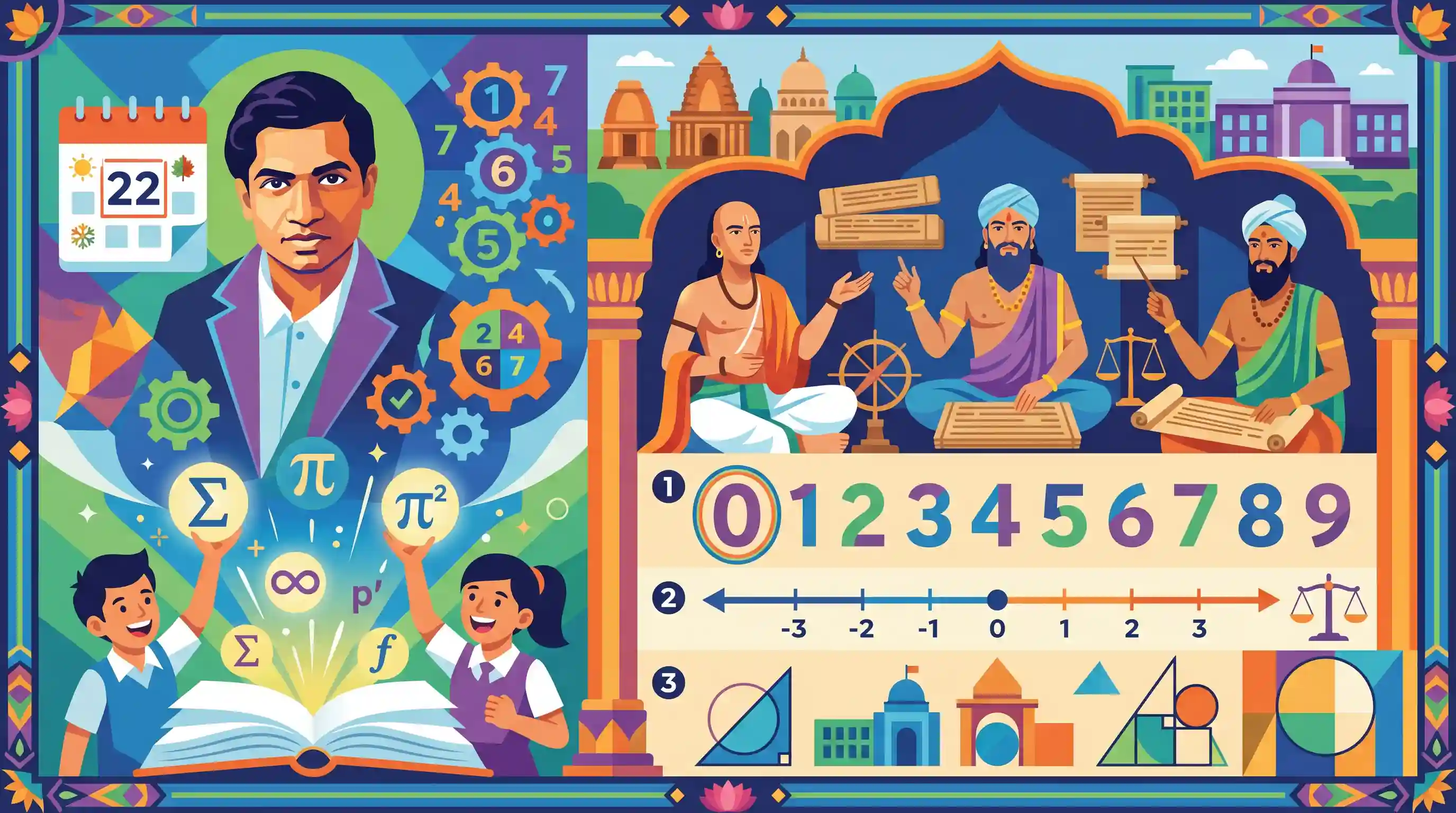
National Mathematics Day is observed in India on December 22 to honor the birth anniversary of Srinivasa Ramanujan, acknowledging his extraordinary, self-taught contributions to fields like infinite series and number theory. Declared in 2012, the day serves to promote mathematical awareness and inspire youth. Beyond Ramanujan's legacy, the occasion reflects upon India's rich, centuries-old tradition in mathematics. Ancient Indian scholars such as Aryabhatta, Brahmagupta, and Bhaskara II laid the groundwork for modern mathematics by developing the decimal number system, formalizing the concept of zero, and introducing rules for negative numbers.
Key Points
- National Mathematics Day is celebrated annually on December 22 to mark the birth anniversary of mathematical genius Srinivasa Ramanujan, initiated in 2012.
- Despite no formal training, Ramanujan independently compiled nearly 3,900 results, making groundbreaking contributions to infinite series, number theory, and continued fractions.
- His collaboration with British mathematician G.H. Hardy at Cambridge led to international acclaim, and he became one of the youngest Fellows of the Royal Society.
- The observance also highlights India's ancient mathematical legacy, tracing back to scholars like Aryabhatta, Varahamihira, Brahmagupta, and Bhaskara II.
- Foundational mathematical concepts, including the decimal system, the usage of zero as a number, and the rules for negative numbers, originated in ancient India.
Important Terms
Srinivasa Ramanujan

A self-taught mathematical genius (1887–1920) renowned for his groundbreaking work in number theory, infinite series, and mock theta functions without formal training.
UPSC context
GS Paper I (Modern Personalities) and GS III (S&T); tests knowledge of India's scientific pioneers and their global impact.
National Mathematics Day
Observed annually on December 22 since 2012 to honor Srinivasa Ramanujan's birth anniversary and promote mathematical awareness across the country.
UPSC context
GS Paper I (Modern History); tests familiarity with national days commemorating significant Indian figures and scientific legacy.
Aryabhatta
A 5th-century mathematician-astronomer and author of 'Aryabhatiya' who approximated Pi, explained eclipses scientifically, and pioneered the place value system.
UPSC context
GS Paper I (Ancient India S&T); tests understanding of foundational Indian contributions to astronomy and arithmetic.
Brahmagupta
A 7th-century mathematician who authored 'Brahmasphutasiddhanta', famously formalizing the rules for computing with zero and negative numbers.
UPSC context
GS Paper I (Ancient India Culture); tests knowledge of early Indian advancements in algebra and number systems.
Bhaskara II
A 12th-century scholar and author of 'Siddhanta Shiromani' whose work in algebra and calculus pre-dated similar European developments by centuries.
UPSC context
GS Paper I (Medieval India Culture); tests awareness of the continuity of scientific excellence in pre-colonial India.
Royal Society
The UK's national academy of sciences; Ramanujan was elected a Fellow (FRS) in 1918, marking a significant milestone for Indian scholars during the colonial era.
UPSC context
GS Paper I (Modern History); tests understanding of institutional recognition of Indian intellectuals in international academic circles.
Prelims Trap
"Aryabhatta formalized the arithmetic rules for operations involving zero and negative numbers."
Aryabhatta used zero as a placeholder in the decimal system, but Brahmagupta formalized the actual arithmetic operations for zero and negative numbers.
Static Concepts Connected
What are the foundational texts of ancient Indian mathematicians?
- Aryabhatta: Authored the Aryabhatiya; proposed the decimal place-value system, approximated Pi, and gave scientific explanations for eclipses.
- Brahmagupta: Authored the Brahmasphutasiddhanta; formalized rules for zero and negative numbers, and early concepts of gravity.
- Varahamihira: Synthesized older astronomical treatises (including Greek and Roman knowledge) in Panchasiddhantika and authored Brihat Samhita.
- Bhaskara II: Authored the 12th-century Siddhanta Shiromani (comprising Lilavati and Bijaganita) and made pioneering contributions to differential calculus.
How did Hellenistic and Greek knowledge influence ancient Indian astronomy?
- Panchasiddhantika synthesis: Varahamihira's Panchasiddhantika synthesizes five older astronomical schools, explicitly including the Romaka Siddhanta (Roman) and Paulisa Siddhanta (Greek/Alexandrian).
- Trade and ideas: This cross-cultural integration reflects a vibrant intellectual exchange along Silk Road and Indian Ocean trade routes during the Gupta and post-Gupta periods.
Cross-Topic Patterns
NEP 2020 & Indian Knowledge Systems
The integration of ancient mathematical texts like Lilavati into modern pedagogy aligns with the National Education Policy (NEP) 2020 mandate to formalize Indian Knowledge Systems (IKS) in education.
SASTRA Ramanujan Prize & R&D Deficit
Awards like the SASTRA Ramanujan Prize highlight India's modern push to revive foundational STEM research and correct the current GDP-to-R&D investment deficit (GS3 Science & Tech).

Expect a Match-the-Following question linking ancient scholars (Bhaskara II, Brahmagupta) to their specific treatises or theorems in 2026.
Linked PYQs · 1
Linked PYQs · 1
- 2016PrelimsGS1
A recent movie titled 'The Man Who Knew Infinity' is based on the biography of
