National Lok Adalat and Alternative Dispute Resolution
Source:The Hindu ↗
Why It Matters
Understanding ADR mechanisms like Lok Adalats is essential for GS2 Polity and Governance, as they represent a primary solution to India's crippling judicial pendency. It touches upon statutory provisions, NALSA's role, and the constitutional directive of equal justice and free legal aid.
Summary
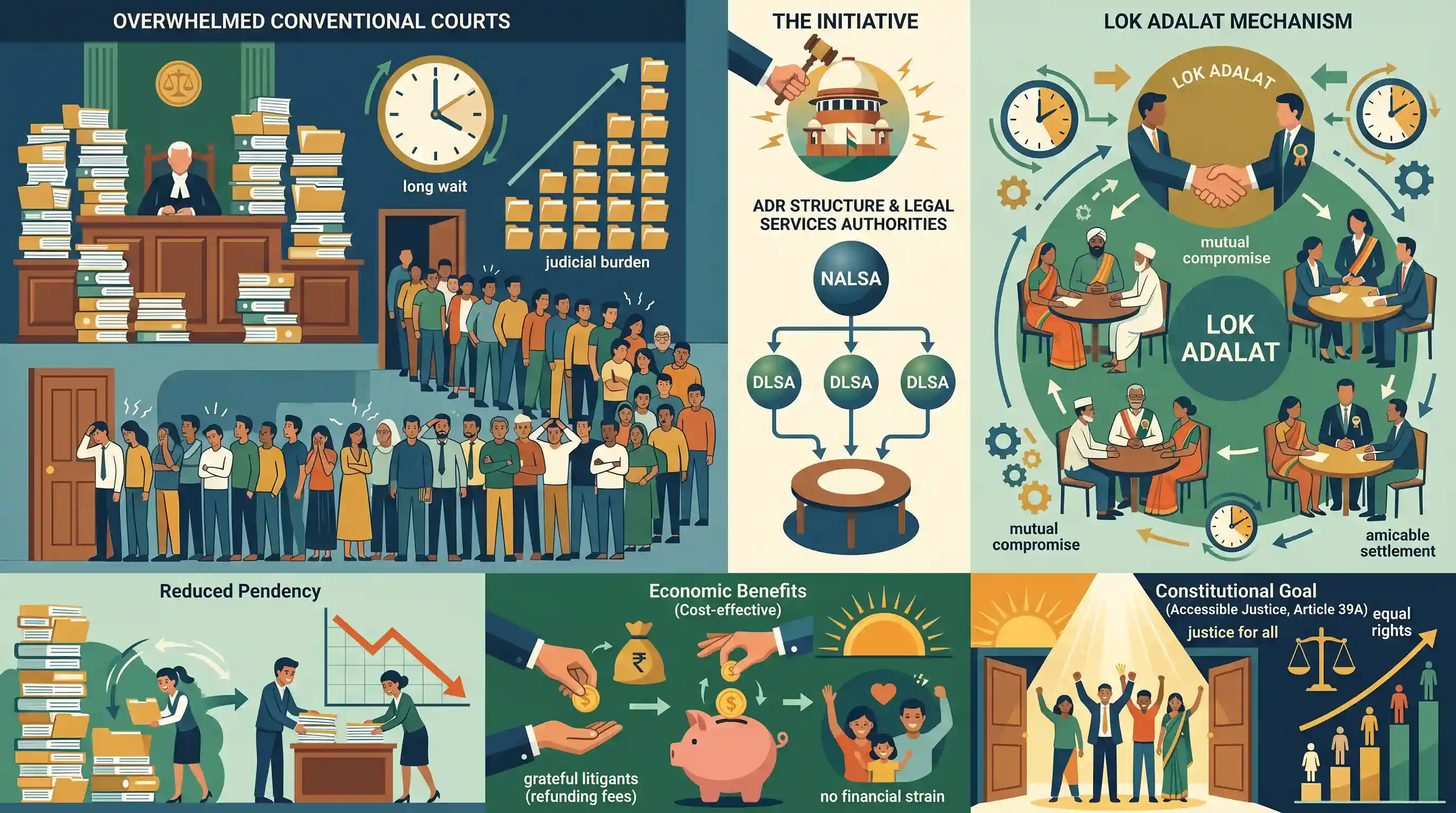
The National Lok Adalat continues to act as a crucial Alternative Dispute Resolution (ADR) mechanism in India, focusing on the speedy, amicable, and cost-effective settlement of cases. A recent campaign initiated by the Supreme Court demonstrated its efficacy at the grassroots level, with the District Legal Services Authority (DLSA) in Ballari settling thousands of pending cases through trained mediators. By facilitating mutual compromises, Lok Adalats not only reduce the massive pendency burden on conventional courts but also save litigants from financial strain by refunding court fees, aligning with the constitutional goal of accessible justice under Article 39A.
Key Points
- A special National Lok Adalat campaign was initiated by the Supreme Court from July 11 to October 7 to expedite case resolutions.
- In Ballari district, 11,931 out of 19,784 eligible pending cases were settled through mutual compromise.
- Lok Adalats offer major benefits like saving time, preventing lengthy litigation, and providing a full refund of the court fee.
- Trained mediators are deployed by the District Legal Services Authority (DLSA) to facilitate amicable settlements.
Important Terms
Lok Adalat

An informal statutory forum ("People’s Court") that settles pending or pre-litigation disputes through conciliation; its awards are binding and final, carrying the weight of a civil court decree with no appeal.
UPSC context
GS Paper 2 (Polity/Judiciary); tests understanding of judicial efficiency and the Alternative Dispute Resolution (ADR) framework.
National Legal Services Authority (NALSA)
The apex statutory body established under the 1987 Act to monitor legal aid programs and ensure uniform implementation of legal services; the Chief Justice of India serves as Patron-in-Chief.
UPSC context
GS Paper 2 (Polity/Social Justice); tests knowledge of institutional frameworks for protecting the rights of weaker sections.
Legal Services Authorities Act, 1987
The landmark central legislation that provides statutory status to Lok Adalats and creates a multi-tiered institutional structure (NALSA, SLSA, DLSA) to provide free legal services to eligible citizens.
UPSC context
GS Paper 2 (Statutory Bodies); tests the legal and institutional foundation of India's legal aid system.
Article 39A
A Directive Principle (DPSP) added by the 42nd Amendment (1976) mandating the State to provide free legal aid and ensure equal access to justice regardless of economic or social disability.
UPSC context
GS Paper 2 (Constitution/DPSP); tests the constitutional philosophy and mandates driving legal empowerment in India.
District Legal Services Authority (DLSA)
The district-level statutory body, chaired by the District Judge, responsible for grassroots implementation of legal aid, organizing local Lok Adalats, and promoting legal literacy.
UPSC context
GS Paper 2 (Governance/Judiciary); tests understanding of decentralized justice delivery and the implementation of social justice at the district level.
Alternative Dispute Resolution (ADR)
A broad category of dispute settlement mechanisms—including mediation, conciliation, and arbitration—that resolve conflicts outside formal litigation to reduce costs and judicial pendency.
UPSC context
GS Paper 2 (Dispute Redressal); tests understanding of judicial reforms and non-adversarial methods for resolving case backlogs.
Prelims Trap
"Awards passed by Lok Adalats can be appealed before the High Court if a party is unsatisfied."
Lok Adalat awards are final, binding, and have NO provision for appeal. An unsatisfied party cannot appeal; they must initiate fresh litigation.
Static Concepts Connected
What are the powers and jurisdiction of Lok Adalats under the 1987 Act?
- Statutory Status: Granted statutory status under the Legal Services Authorities Act, 1987.
- Civil Decree: Every award is deemed a decree of a civil court and is final and binding on all parties.
- Subject Matter: Can settle both civil cases and compoundable criminal offenses, but strictly barred from non-compoundable criminal cases.
- Fee Exemption: There is no court fee. If a pending court case is settled here, the original fee is refunded.
How does Article 39A mandate free legal aid in India?
- DPSP Mandate: Directs the State to secure equal justice and provide free legal aid, ensuring justice is not denied due to economic disabilities.
- 42nd Amendment: Added to the Constitution by the 42nd Amendment Act in 1976 to strengthen welfare state principles.
- Institutional Framework: Operationalized through NALSA, State (SLSA), and District (DLSA) authorities to conduct Lok Adalats and spread legal awareness.
Cross-Topic Patterns
ADR and Ease of Doing Business
The expansion of Lok Adalats and specialized ADR channels reduces contract enforcement timelines, acting as a direct catalyst for improving India's Ease of Doing Business rankings.
NALSA, DLSAs, and Undertrial Reforms
DLSAs play a pivotal role beyond Lok Adalats by providing legal representation to undertrials, linking the Article 39A mandate to broader criminal justice and prison overcrowding reforms.

Expect a multi-statement question in 2026 contrasting Lok Adalat awards (no appeal) with Arbitration or Gram Nyayalaya jurisdictions.
Linked PYQs · 5
Linked PYQs · 5
- 2010PrelimsGS1
With reference to Lok Adalats, which of the following statements is correct?
- 2024MainsGS2
Explain and distinguish between Lok Adalats and Arbitration Tribunals. Whether they entertain civil as well as criminal cases ?
- 2023MainsGS2
Who are entitled to receive free legal aid? Assess the role of the National Legal Services Authority (NALSA) in rendering free legal aid in India.
- 2020PrelimsGS1
In India, Legal Services Authorities provide free legal services to which of the following type of citizens? 1. Person with an annual income of less than ₹ 1,00,000 2. Transgender with an annual income of less than ₹ 2,00,000 3. Member of Other Backward Classes (OBC) with an annual income of less than ₹ 3,00,000 4. All Senior Citizens Select the correct answer using the code given below:
- 2013PrelimsGS1
With reference to National Legal Services Authority, consider the following statements : 1. Its objective is to provide free and competent legal services to the weaker sections of the society on the basis of equal opportunity. 2. It issues guidelines for the State Legal Services Authorities to implement the legal programmes and schemes throughout the country. Which of the statements given above is/are correct?
