Oman Mediation Efforts in US Iran Hostilities and Maritime Security
Source:Indian Express ↗
Why It Matters
The stability of West Asia is critically linked to India's energy security, as the region is a primary source of oil imports. The Strait of Hormuz is a vital maritime chokepoint, and disruptions there can severely impact India's economy and trade. Understanding regional dynamics, the role of mediators like Oman, and the impact of US-Iran-Israel tensions is essential for analyzing India's foreign policy strategies.
Summary
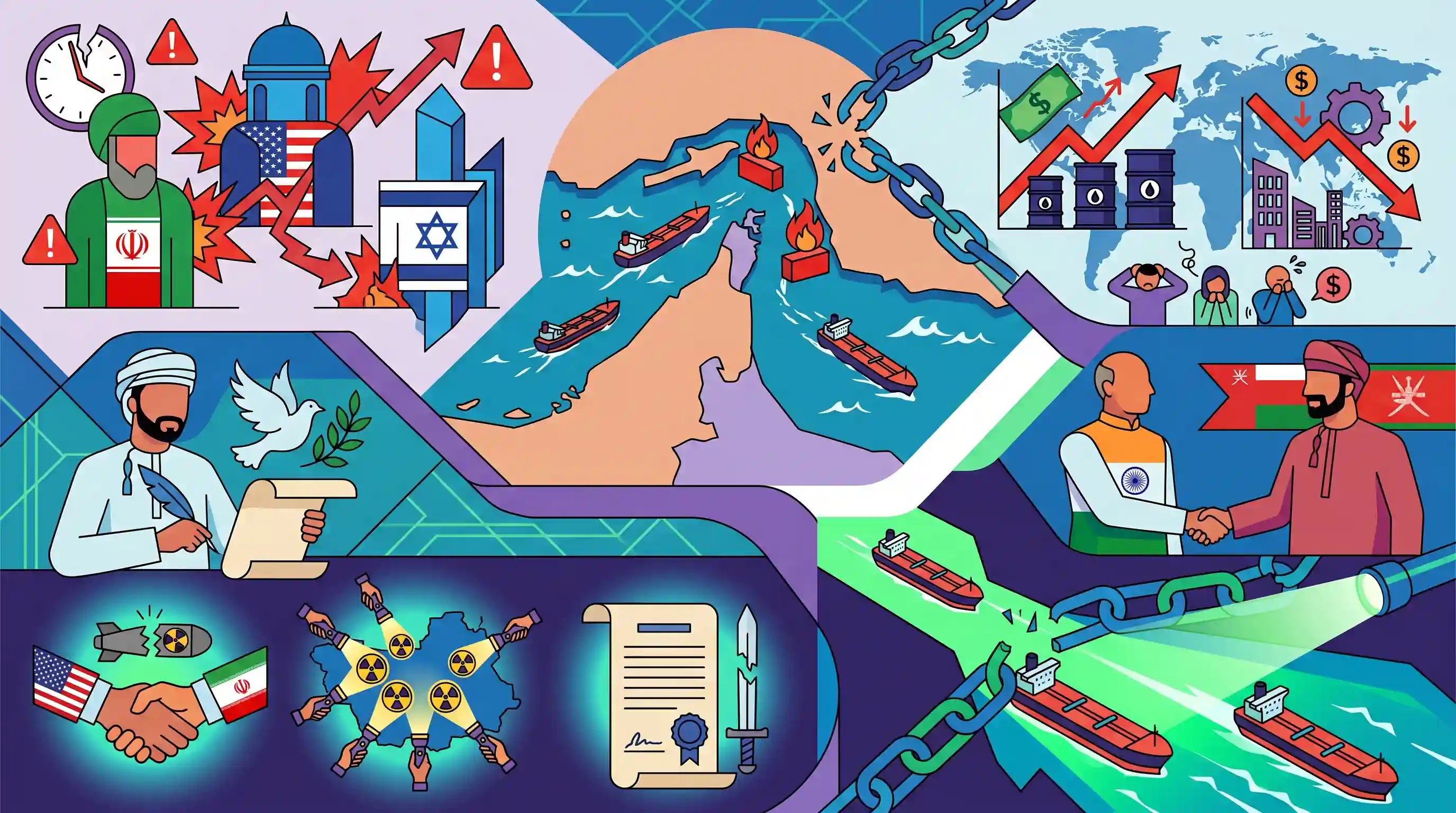
Oman's Foreign Minister Badr Albusaidi, writing in *The Economist*, has called for an immediate end to hostilities between Iran, the US, and Israel, emphasizing that their national interests lie in dialogue rather than military escalation. Condemning recent strikes and retaliations, he warned that continued conflict could disrupt maritime traffic through the Strait of Hormuz, driving up global energy prices and risking a deep economic recession. Albusaidi noted that the US and Iran were close to a nuclear deal prior to the escalation and proposed a return to bilateral negotiations, a regional framework for nuclear transparency, and a non-aggression treaty. Aligning with this approach, India's Prime Minister Narendra Modi has also advocated for diplomacy and de-escalation in talks with Oman's Sultan Haitham bin Tariq, underscoring the necessity of safe and free navigation in the Strait of Hormuz for global energy security.
Key Points
- Oman's Foreign Minister Badr Albusaidi advocates for diplomacy and an end to military hostilities between Iran, the US, and Israel, serving Oman's traditional role as a regional mediator.
- Escalation of conflict threatens the Strait of Hormuz, a critical global maritime chokepoint, risking severe disruptions to energy supplies and a potential global economic recession.
- Oman proposed three steps for regional stability: resuming US-Iran bilateral negotiations, establishing a framework for regional nuclear transparency, and developing a non-aggression treaty.
- India shares Oman's stance on de-escalation; PM Modi emphasized the importance of dialogue, diplomacy, and maintaining safe and free navigation in the Strait of Hormuz, which is vital for India's energy security.
Important Terms
Strait of Hormuz

A strategically vital narrow waterway between Iran and Oman connecting the Persian Gulf to the Gulf of Oman; it handles approximately 20-30% of global seaborne oil trade.
UPSC context
GS Paper 1 (Geography) and Paper 2 (IR); tests knowledge of maritime chokepoints and India's energy supply vulnerabilities.
Joint Comprehensive Plan of Action (JCPOA)
The 2015 agreement between Iran and world powers (P5+1) to limit Iran's nuclear program in exchange for lifting international economic sanctions.
UPSC context
GS Paper 2 (International Relations); critical for understanding West Asian geopolitics and India’s strategic assets like Chabahar Port.
Energy Security
A state’s ability to ensure an uninterrupted and affordable supply of energy, crucial for economic stability, especially for import-dependent nations like India.
UPSC context
GS Paper 3 (Economy/Security); tests awareness of India’s 80%+ oil import dependency and strategic reserves.
Niche Diplomacy
A diplomatic strategy where states (often middle powers) concentrate resources on specific areas, like mediation or peacebuilding, to enhance their international influence and reputation.
UPSC context
GS Paper 2 (IR); relevant to discussing Oman’s unique role as a neutral mediator in West Asia.
Link West Policy
India’s strategic framework aimed at strengthening political, economic, and security engagement with the nations of West Asia, including the Gulf countries, Iran, and Israel.
UPSC context
GS Paper 2 (IR); core topic for India's foreign policy and regional balancing between rival powers.
Non-Aggression Treaty
A formal agreement between two or more states pledging to abstain from military action against each other and resolve disputes through peaceful negotiation.
UPSC context
GS Paper 2 (IR); relevant for studying conflict resolution frameworks and regional stability in the Middle East.
Prelims Trap
"The Strait of Hormuz is a maritime chokepoint located between Iran and the United Arab Emirates."
The Strait is flanked by Iran to the north and Oman (specifically the Musandam Peninsula exclave) to the south. The UAE does not border the actual chokepoint.
Static Concepts Connected
What are the key maritime chokepoints surrounding the Arabian Peninsula?
- Strait of Hormuz: Connects the Persian Gulf to the Gulf of Oman and Arabian Sea; flanked by Iran and Oman. Essential for global oil transit.
- Bab el-Mandeb: Connects the Red Sea to the Gulf of Aden; flanked by Yemen on the Arabian Peninsula, and Djibouti and Eritrea in Africa.
- Suez Canal: An artificial sea-level waterway in Egypt connecting the Red Sea to the Mediterranean, acting as the primary Europe-Asia shipping route.
What are the strategic pillars of the India-Oman bilateral relationship?
- Defense Cooperation: Oman is the only Gulf nation with which India conducts regular tri-services military exercises (Al Najah, Eastern Bridge, Naseem Al Bahr).
- Port of Duqm: India secured strategic access to the Port of Duqm in 2018 for naval logistics and maintenance, countering China's Indian Ocean presence.
- Institutional Gateway: Oman's moderate foreign policy makes it India's key diplomatic bridge into vital regional groupings like the GCC, Arab League, and IORA.
Cross-Topic Patterns
Ibadi neutrality & regional mediation
Oman's distinct Ibadi Islamic tradition underpins its non-aligned foreign policy, allowing it to historically act as the primary backchannel for US-Iran nuclear talks amidst broader regional rivalries.
Energy security vs. maritime chokepoints
Nearly 50% of India's crude imports rely on Hormuz. Geopolitical flare-ups here directly inflate India's import bill, linking West Asian maritime security to India's macroeconomic stability and CAD.

Map-based Prelims questions pairing West Asian straits (Hormuz) with bordering nations (Oman/Iran) and naval bases are highly likely.
Linked PYQs · 3
Linked PYQs · 3
- 2025MainsGS2
"Energy security constitutes the dominant kingpin of India's foreign policy, and is linked with India's overarching influence in Middle Eastern countries.” How would you integrate energy security with India's foreign policy trajectories in the coming years?
- 2017MainsGS2
The question of India's Energy Security constitutes the most important part of India's economic progress. Analyze India's energy policy cooperation with West Asian countries.
- 2016PrelimsGS1
Which of the following is not a member of 'Gulf Cooperation Council'?
