National Conference on E-Governance Highlights Digital Reforms
Source:digitalindia ↗
Why It Matters
Crucial for RPSC RAS aspirants to understand national and state-level e-governance initiatives, digital transformation policies, and administrative transparency frameworks.
Summary
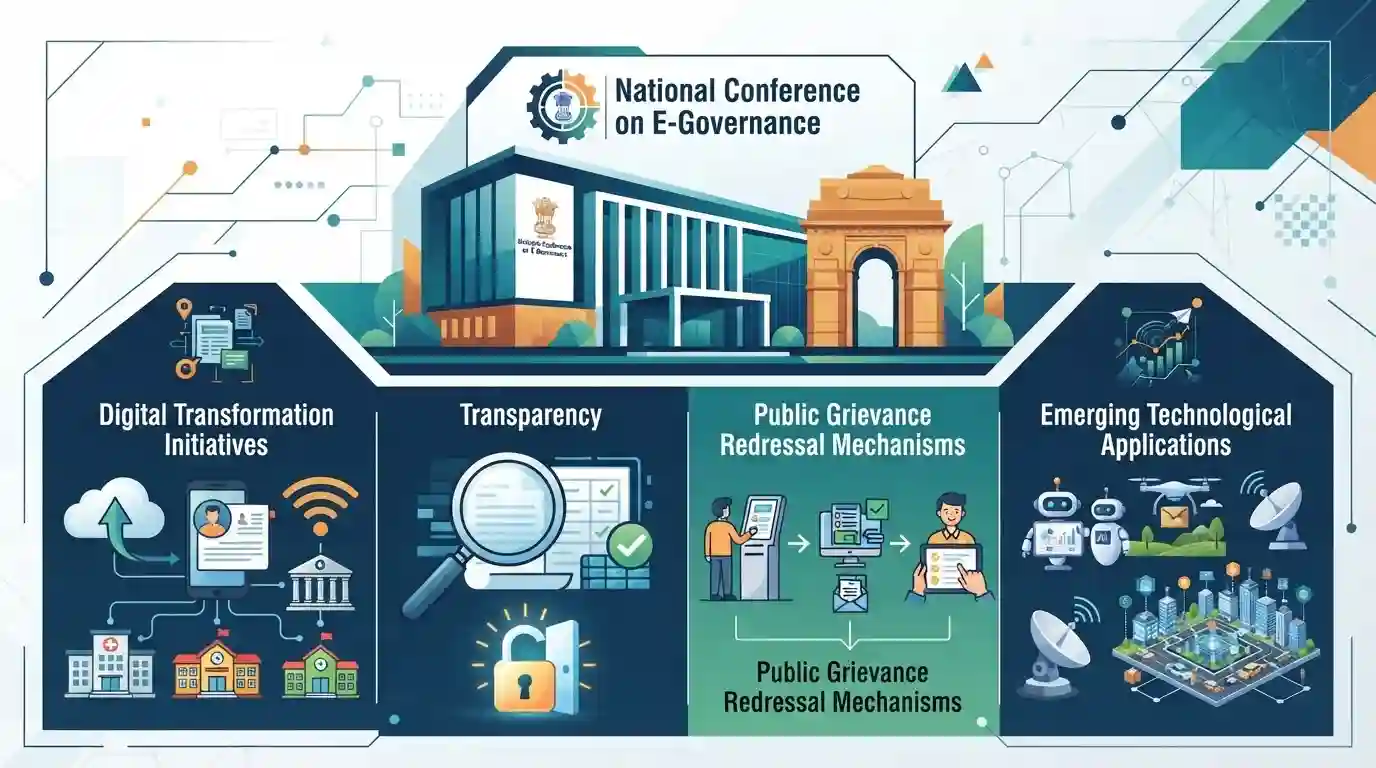
The National Conference on E-Governance hosted in Rajasthan highlights digital transformation initiatives, transparency, public grievance redressal mechanisms, and emerging technological applications in public administration.
Key Points
- The National Conference on E-Governance serves as a platform for sharing best practices, technological advancements, and innovative solutions in governance.
- Focuses on leveraging emerging technologies like AI, blockchain, and data analytics to improve public service delivery and citizen-centric governance in India and Rajasthan.
- Highlights the digital initiatives, e-services, and administrative reforms implemented within Rajasthan.
Important Terms
National Conference on E-Governance

An annual national platform bringing together policymakers, administrators, and domain experts to discuss innovations, share best practices, and set roadmaps for digital public administration across India.
UPSC context
Important for RPSC Mains (Paper II/III: Public Administration & E-Governance applications). Tests knowledge of administrative reforms, transparency, and digital initiatives.
Digital India
A flagship program of the Government of India launched to transform the country into a digitally empowered society and knowledge economy through enhanced digital infrastructure and service delivery.
UPSC context
Important for RPSC Mains (Paper II/III - E-governance applications, government policies, and technological interventions for socioeconomic development).
Government of Rajasthan
The apex executive body governing the state of Rajasthan, responsible for framing state policies, executing administrative programs, and implementing citizen-centric e-governance solutions.
UPSC context
Core for RPSC RAS exams (Rajasthan Polity and Governance), testing administrative machinery, state-level digital initiatives, and public welfare schemes.
Prelims Trap
Jan Aadhaar serves as a central government scheme for biometric authentication.
Aspirants often confuse Jan Aadhaar with the central Aadhaar card; Jan Aadhaar is a unique family-based identification and DBT platform exclusive to Rajasthan.
Static Concepts Connected
What are the key pillars of Rajasthan's e-governance and direct benefit transfer infrastructure?
- e-Mitra Network: e-Mitra platform delivers over 600 government and business services via 70,000+ kiosks across the state.
- Jan Aadhaar Scheme: Jan Aadhaar platform acts as a unified digital empowerment and direct benefit transfer backbone for over two crore families.
- NESDA Recognition: NESDA rankings validate Rajasthan's state portal and e-services for exceptional digital service delivery.
Cross-Topic Patterns
Jan Aadhaar + Direct Benefit Transfer Schemes
Rajasthan's Jan Aadhaar platform bridges e-governance welfare delivery with socio-economic database compilation, directly linking to direct benefit transfers and targeted beneficiary identification under RPSC social schemes.
Emerging Tech in Public Administration
The integration of AI, blockchain, and data analytics in public administration connects technology applications with administrative reforms and state capacity-building for good governance.

RPSC frequently asks specific portal names like e-Mitra or Jan Aadhaar; match their exact service counts and utility functions.
Linked PYQs · 3
Linked PYQs · 3
- 2025RPSC_PRELIMSGS1
Recently, Jaipur Municipal Corporation, Heritage, has launched which app to report civic issues and for the government to analyze, track, manage and resolve them?
- 2016RPSC_PRELIMSGS1
Which of the following Acts has Rajasthan been the first state to implement for resolving public grievances?
- 2025RPSC_PRELIMSGS1
Which of the following statements regarding the Raj Nivesh Portal of Rajasthan is incorrect?
