National Conference on E-Governance focuses on digital administration
Source:digitalindia ↗
Why It Matters
The event highlights national initiatives and state-level adoption of e-governance framework, which is a core component of GS2 Governance syllabus and RPSC RAS exam regarding digital administration.
Summary
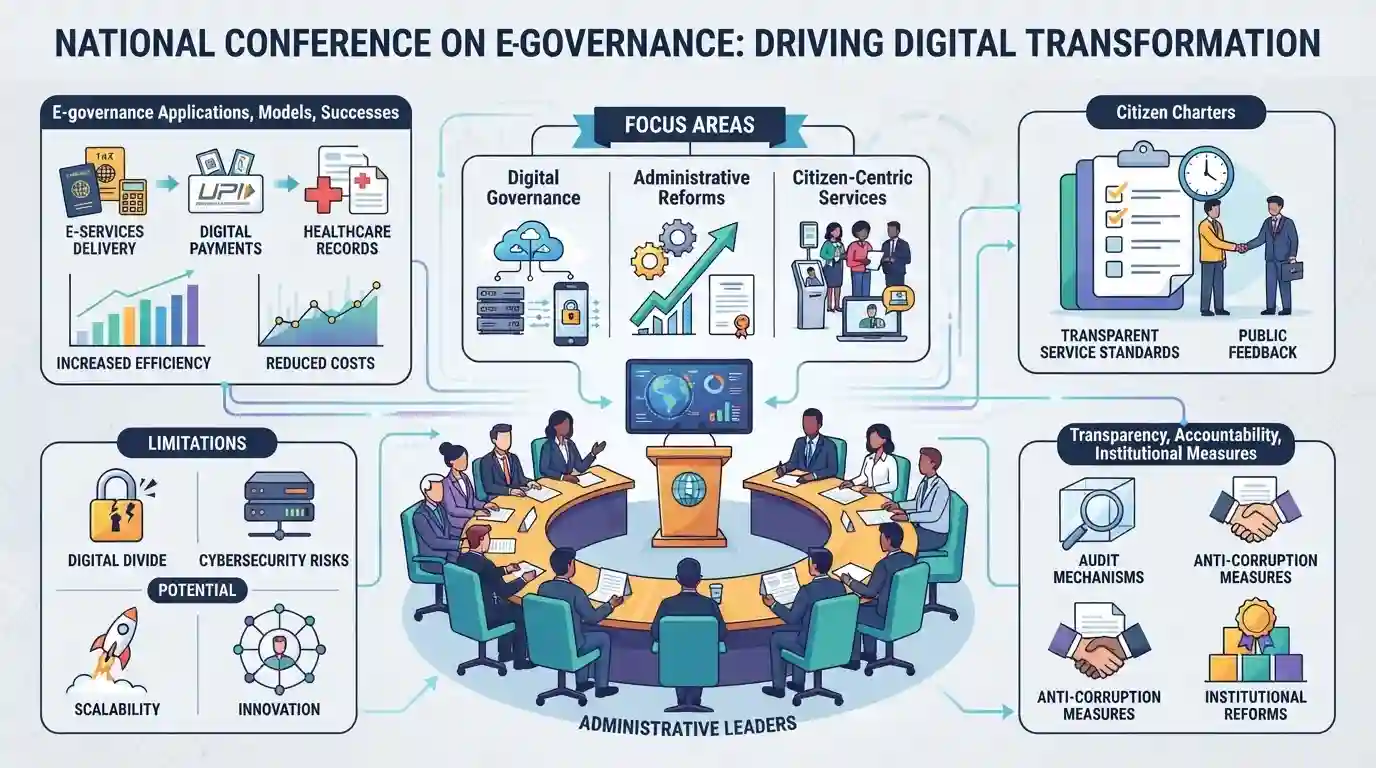
The National Conference on e-Governance focuses on promoting digital governance, administrative reforms, and citizen-centric service delivery mechanisms through emerging technologies, bringing together national and state administrative leaders.
Key Points
- The National Conference on e-Governance serves as a crucial national platform for discussing emerging technologies, digital transformation, and e-governance solutions.
- Focuses on enhancing public service delivery, transparency, and accountability in governance through digital innovations.
- Brings together policymakers, industry leaders, and administrative experts to deliberate on futuristic e-governance strategies.
Important Terms
Department of Administrative Reforms and Public Grievances (DARPG)

A central nodal agency under the Ministry of Personnel, Public Grievances and Pensions responsible for formulating public policy on administrative reforms and redressing citizen grievances across India.
UPSC context
Important for RPSC Mains (GS Paper/Public Administration & Governance), testing administrative reforms, grievance redressal mechanisms, and e-governance policies.
Ministry of Electronics and Information Technology (MeitY)
The Union government ministry responsible for policy formulation, promotion, and coordination in electronics, information technology, and the internet, driving digital governance and Digital Public Infrastructure in India.
UPSC context
Relevant for RPSC Mains (Science & Tech and Governance), assessing digital infrastructure, cyber security, and e-governance initiatives.
Government of Rajasthan
The sub-national executive authority of Rajasthan, responsible for state administration, policy implementation, and citizen-centric service delivery within the state.
UPSC context
Crucial for RPSC RAS exams, testing state-specific administration, regional e-governance projects, and local governance frameworks.
Static Concepts Connected
What are the key institutional pillars of citizen-centric e-governance and transparency in Rajasthan administration?
- Grievance Redressal: Rajasthan Sampark Portal serves as the centralized grievance redressal mechanism for citizens across all state departments.
- Proactive Transparency: Jan Soochna Portal is India's first public information platform providing proactive, department-wise scheme details to citizens.
- Digital Secretariat: Rajkaj is an enterprise e-office and digital secretariat application ensuring paperless file movement and administrative accountability.
- Single-Window Service: e-Mitra is a unified single-window platform delivering hundreds of G2C and B2C services digitally through urban and rural kiosks.
Cross-Topic Patterns
E-governance + Right to Information Act
Rajasthan's Jan Soochna Portal operationalizes the constitutional mandate of Right to Information by proactively publishing beneficiary and scheme data online, merging e-governance with statutory transparency frameworks.
AI-Enabled Governance + Digital Infrastructure Policy
The integration of AI and data-driven administration in state portals connects directly to Rajasthan's ambitious iCET and digital infrastructure policies under economic development.

Expect a matching or statement-based question linking Rajasthan's home-grown portals (Jan Soochna, Rajkaj) with their core utility.
Linked PYQs · 2
Linked PYQs · 2
- 2024RPSC_PRELIMSGS1
The size of citizen's character is not –
- 2025RPSC_PRELIMSGS1
What has been formed in place of the Chief Minister Rajasthan Economic Reforms Advisory Council (CMRETAC)?
