National Child Survey and Mission Vatsalya Data Framework
Source:Indian Express ↗
কেন এটি গুরুত্বপূর্ণ
This development highlights the critical shift towards evidence-based policy formulation in India. The lack of disaggregated, real-time data severely limits the effectiveness and monitoring of flagship welfare programs like Mission Vatsalya. Understanding the structural steps to survey child labour, street children, and out-of-school cohorts is vital for addressing GS2 questions on child protection, rights, human resource development, and governance.
সারসংক্ষেপ
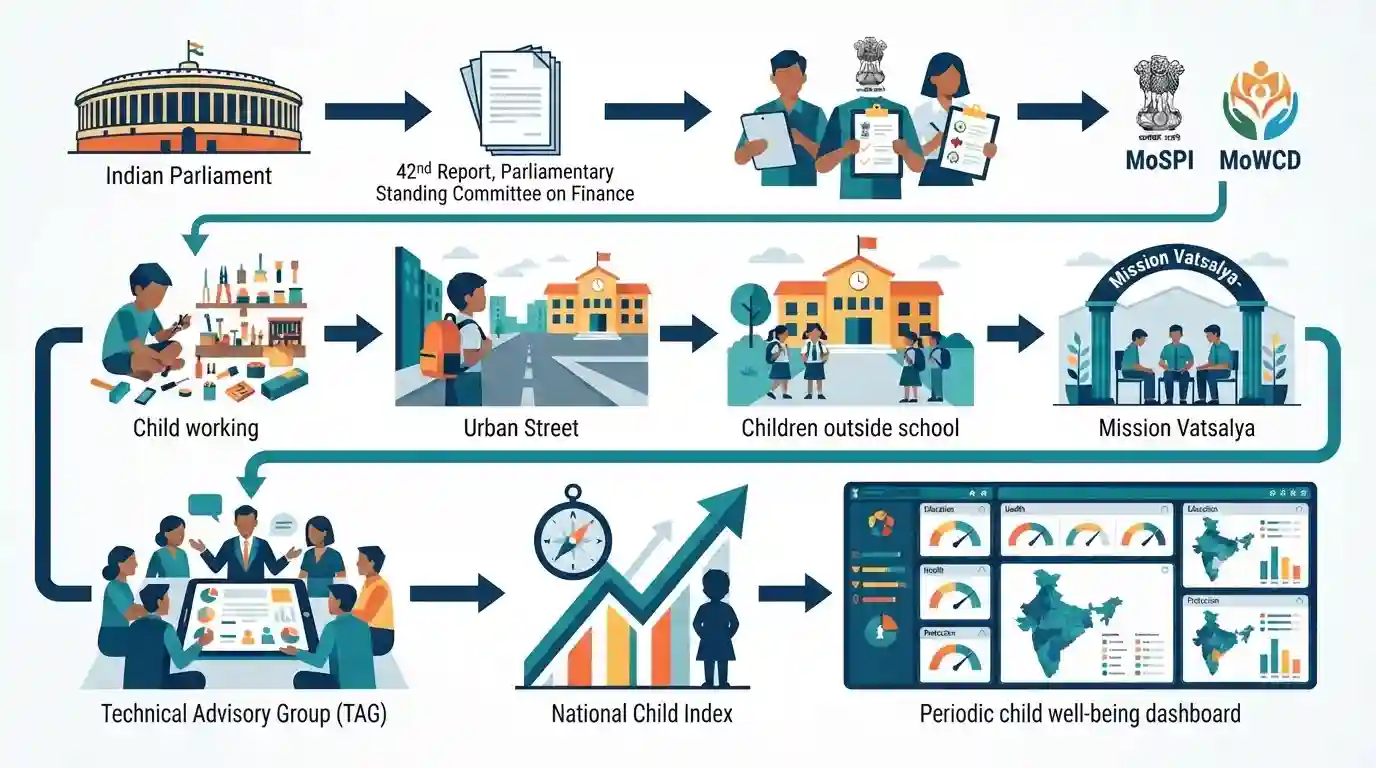
The Indian government is planning a National Child Survey to generate updated and disaggregated national data on vulnerable children. Initiated following recommendations from the 42nd report of the Parliamentary Standing Committee on Finance, the survey is a collaborative effort between MoSPI and MoWCD. It aims to identify and map the needs of children in the informal sector, street children, out-of-school children, and juveniles under the Mission Vatsalya framework. Additionally, a Technical Advisory Group (TAG) will be constituted to define the scope and methodology, alongside plans to develop a National Child Index and a periodic child well-being dashboard to assess state and district-level performance in welfare delivery.
মূল বিষয়
- The Central Government is planning to conduct a National Child Survey to address the absence of comprehensive, updated, and disaggregated national data on children.
- The 42nd report of the Parliamentary Standing Committee on Finance urged the Ministry of Statistics and Programme Implementation (MoSPI) and the Ministry of Women and Child Development (MoWCD) to move 'beyond the discussion stage' to launch this survey.
- The survey's key objective is to map children's needs under Mission Vatsalya, focusing specifically on children in need of care and protection, out-of-school children, street children, those working in the informal sector, and juveniles requiring legal and social rehabilitation.
- The Parliamentary Committee recommended establishing a periodic child well-being statistical dashboard and a 'National Child Index' to benchmark and evaluate district and state-level performance.
- To operationalize the survey, MoWCD will set up a Technical Advisory Group (TAG) chaired by a domain expert in child welfare, which is tasked with recommending the objective, scope, coverage, and feasibility of data collection within three months.
- Mission Vatsalya (formerly the Integrated Child Protection Scheme) acts as the umbrella administrative framework for child rights advocacy, welfare, and strengthening the juvenile justice care and protection system.
গুরুত্বপূর্ণ শব্দ
Mission Vatsalya

An umbrella centrally sponsored scheme by MoWCD focused on child rights, protection, and rehabilitation, aiming to secure a healthy childhood for vulnerable minors and strengthen the juvenile justice system.
UPSC context
GS Paper 2 (Vulnerable Sections). Evaluates knowledge of child protection frameworks and rehabilitation initiatives.
Integrated Child Protection Scheme
A former centrally sponsored scheme aimed at building a protective environment for children in difficult circumstances. It has now been revamped and subsumed under the broader Mission Vatsalya framework.
UPSC context
GS Paper 2 (Social Sector). Important for understanding the historical evolution of child welfare policies in India.
Ministry of Statistics and Programme Implementation (MoSPI)
The central government ministry responsible for planned statistical development, conducting large-scale national surveys, and providing robust data foundations for effective policy monitoring and targeted welfare delivery.
UPSC context
GS Paper 2 (Governance). Highlights the role of statistical data and evidence-based governance in assessing welfare scheme impact.
Ministry of Women and Child Development (MoWCD)
The nodal central ministry for formulating and administering rules, regulations, and laws relating to women and child development, including the implementation of child welfare schemes like Mission Vatsalya.
UPSC context
GS Paper 2 (Vulnerable Sections). Critical for topics on child rights, social justice, and institutional care mechanisms.
Standing Committee on Finance
A Departmentally Related Standing Committee of Parliament that scrutinizes the policies, bills, and grant demands of specific ministries, currently pushing for data-driven accountability in child welfare programs.
UPSC context
GS Paper 2 (Polity). Tests knowledge of parliamentary committees and their oversight over executive policy and expenditure.
Technical Advisory Group (TAG)
An expert panel to be constituted to determine the methodology, scope, and data collection feasibility for the proposed National Child Survey regarding vulnerable children.
UPSC context
GS Paper 2 (Governance). Illustrates the role of domain experts in formulating rigorous, evidence-based social sector initiatives.
প্রিলিমস ফাঁদ
The Child Labour Act completely bans the employment of children below 14 years across all sectors without any exceptions.
The 2016 amendment permits children under 14 to work in family-run businesses or home-based enterprises (provided it is after school hours or during vacations) and as child artists.
সংযুক্ত স্থির ধারণা
What is the primary mandate and funding structure of Mission Vatsalya?
- Core Philosophy: Prioritizes family-based non-institutional care (adoption, foster care, sponsorship) over institutional care, which is treated strictly as a last resort.
- Funding Split: Operates as a Centrally Sponsored Scheme with a 60:40 split; 90:10 for Himalayan/Northeast states and UT of J&K; and 100% for other UTs.
- Implementation Units: Executed through state and district-level child protection units, integrating statutory bodies like Juvenile Justice Boards (JJBs) and Child Welfare Committees (CWCs).
What are the key statutory distinctions under the Child Labour Amendment Act, 2016?
- Age Categorization: Defines a 'child' as anyone below 14 years, and an 'adolescent' as anyone aged between 14 and 18 years.
- Differential Bans: Imposes a complete ban on child labour under 14 (except family-run businesses and child artists); adolescents are prohibited only from hazardous occupations and processes.
- Hazardous List Revision: Empowers the Central Government to add or omit occupations from the hazardous list based on recommendations from the Technical Advisory Committee.
আন্তঃবিষয় প্যাটার্ন
Legislative oversight of social policy
Highlights how Parliamentary Standing Committees push the executive to bridge critical statistical gaps, proving that legislative accountability directly shapes grassroots welfare interventions.
Data deficits and informal economy
Explores how the absence of disaggregated data on street and informal-sector children hinders targeted rights-based enforcement under Article 21A and Article 24 of the Constitution.

2026 Prelims may test statutory exceptions under the 2016 Child Labour Act alongside the institutional funding split of Mission Vatsalya.
সংযুক্ত PYQ · 3
সংযুক্ত PYQ · 3
- 2019MainsGS2
Performance of welfare schemes that are implemented for vulnerable sections is not so effective due to absence of their awareness and active involvement at all stages of policy process. Discuss.
- 2018PrelimsGS1
International Labour Organization's Conventions 138 and 182 are related to
- 2023MainsGS2
The crucial aspect of development process has been the inadequate attention paid to Human Resource Development in India. Suggest measures that can address this inadequacy.
