President Murmu Expresses Anguish Over Monsoon Calamities
Source:The Hindu ↗
Why It Matters
The increasing frequency of monsoon-related disasters, particularly cloudbursts in Himalayan states and floods in riverine plains, is a critical area for UPSC candidates under Disaster Management. It highlights the vulnerability of Indian geography to climate extremities and the importance of prompt institutional disaster response mechanisms.
Summary
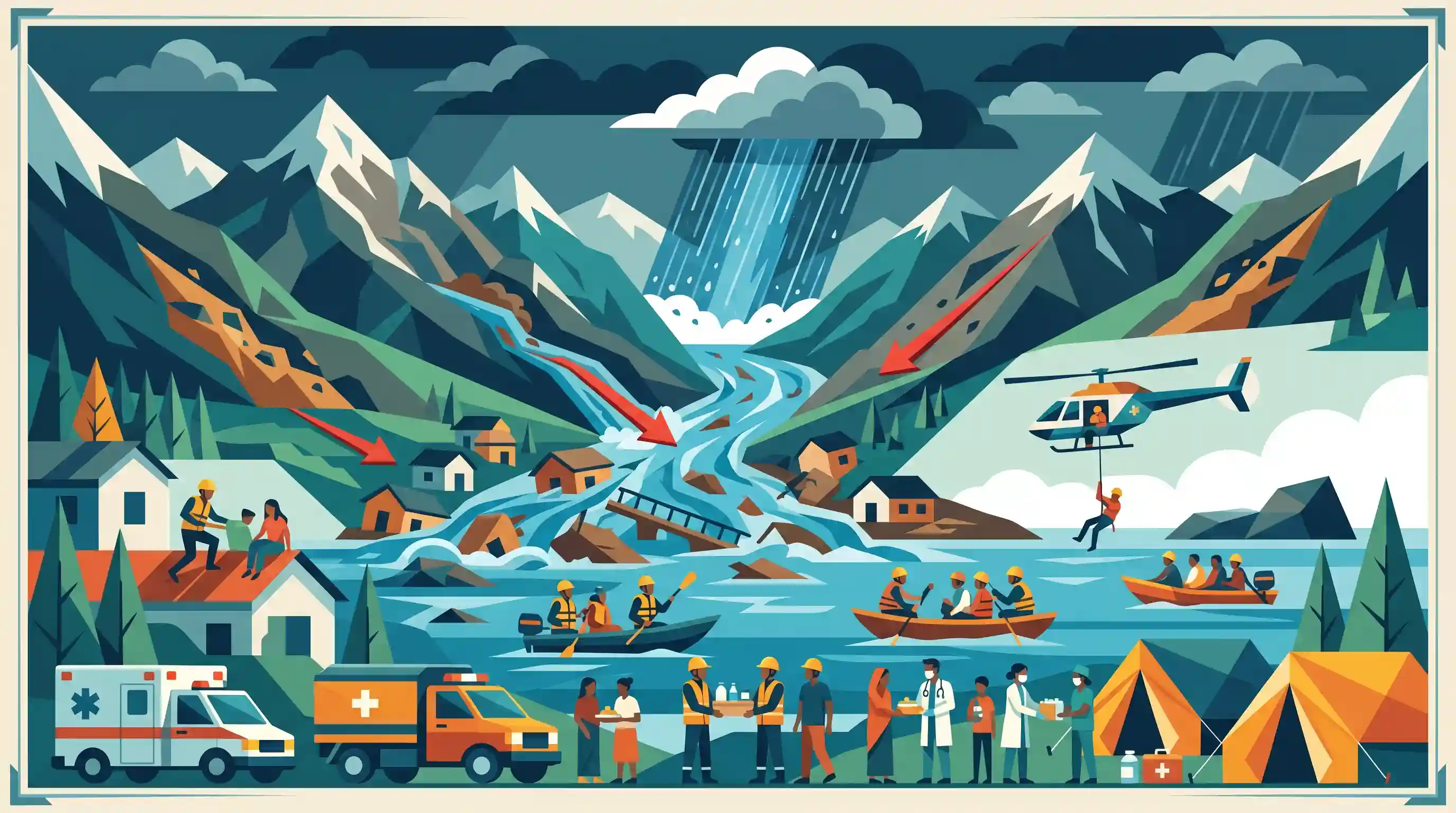
President Droupadi Murmu conveyed her anguish over the devastating impact of monsoon-induced natural calamities, such as floods and cloudbursts, affecting several states including Uttarakhand, Himachal Pradesh, and Assam. She offered her condolences to the families of the victims, expressed solidarity with those affected, and acknowledged the critical role of administration and rescue agencies in ongoing relief and recovery efforts.
Key Points
- President Droupadi Murmu expressed profound grief over the loss of lives caused by recent natural calamities, including cloudbursts and floods, across various Indian states.
- The monsoon season has severely impacted regions like Uttarakhand, Himachal Pradesh, Jammu and Kashmir, Punjab, and Assam due to extreme weather events.
- The President emphasized national solidarity with the affected individuals and commended the relentless efforts of the administration and rescue teams involved in relief operations.
Prelims Trap
"IMD defines a cloudburst as any sudden, heavy rainfall exceeding 50 mm per hour occurring anywhere in the Indian subcontinent."
IMD strictly defines a cloudburst as rainfall exceeding 100 mm per hour over a localized geographical area of 20-30 sq. km.
Static Concepts Connected
What explains the high frequency of cloudbursts in the Himalayan region?
- Orographic lifting: Warm, moisture-laden monsoon winds are rapidly forced upwards by the steep mountainous topography.
- Rapid condensation: The sudden vertical lift of air causes extreme cooling and massive, instantaneous condensation into rain.
- Valley funneling: Narrow mountain valleys trap moisture and concentrate the precipitation into a highly localized area (20-30 sq km).
What is the institutional structure under the Disaster Management Act, 2005?
- National level: The National Disaster Management Authority (NDMA) is the apex body, chaired by the Prime Minister.
- State level: The State Disaster Management Authority (SDMA) coordinates state-level response and is chaired by the Chief Minister.
- District level: The District Disaster Management Authority (DDMA) is headed by the District Magistrate or Collector.
Cross-Topic Patterns
Himalayan geomorphology + Infrastructure development
Cloudbursts are meteorological, but their conversion into devastating flash floods is exacerbated by unplanned road expansion and unregulated hydropower projects altering the region's natural drainage.
Brahmaputra hydrology + Assam flooding
The Brahmaputra's massive sediment load from steep Himalayan descents causes severe riverbed aggradation. This reduces water-carrying capacity, triggering annual plains flooding.

Expect a 2026 Prelims question testing the exact IMD numerical criteria for cloudbursts combined with Doppler Weather Radar applications.
Linked PYQs · 4
Linked PYQs · 4
- 2022MainsGS3
Explain the mechanism and occurrence of cloudburst in the context of the Indian subcontinent. Discuss two recent examples.
- 2016MainsGS3
Rehabilitation of human settlements is one of the important environmental impacts which always attracts controversy while planning major projects. Discuss the measures to be adopted to mitigate the impact of the recent incidents of cloudbursts in many places of Uttarakhand.
- 2024MainsGS3
Flooding in urban areas is an emerging climate-induced disaster. Discuss the causes of this disaster. Mention the features of two such major floods in the last two decades in India. Describe the policies and frameworks in India that aim at tackling such floods.
- 2020MainsGS1
Account for the huge flooding of million cities in India including the smart ones like Hyderabad and Pune. Suggest lasting remedial measures.
