Nashik Simhastha Kumbh Mela Infrastructure Preparations
Source:Indian Express ↗
Why It Matters
The Kumbh Mela is a major component of India's Intangible Cultural Heritage. Its execution poses significant challenges and case studies for civil servants regarding urban infrastructure, disaster management (crowd control/stampede prevention), and environmental conservation (managing river pollution during mega-events).
Summary
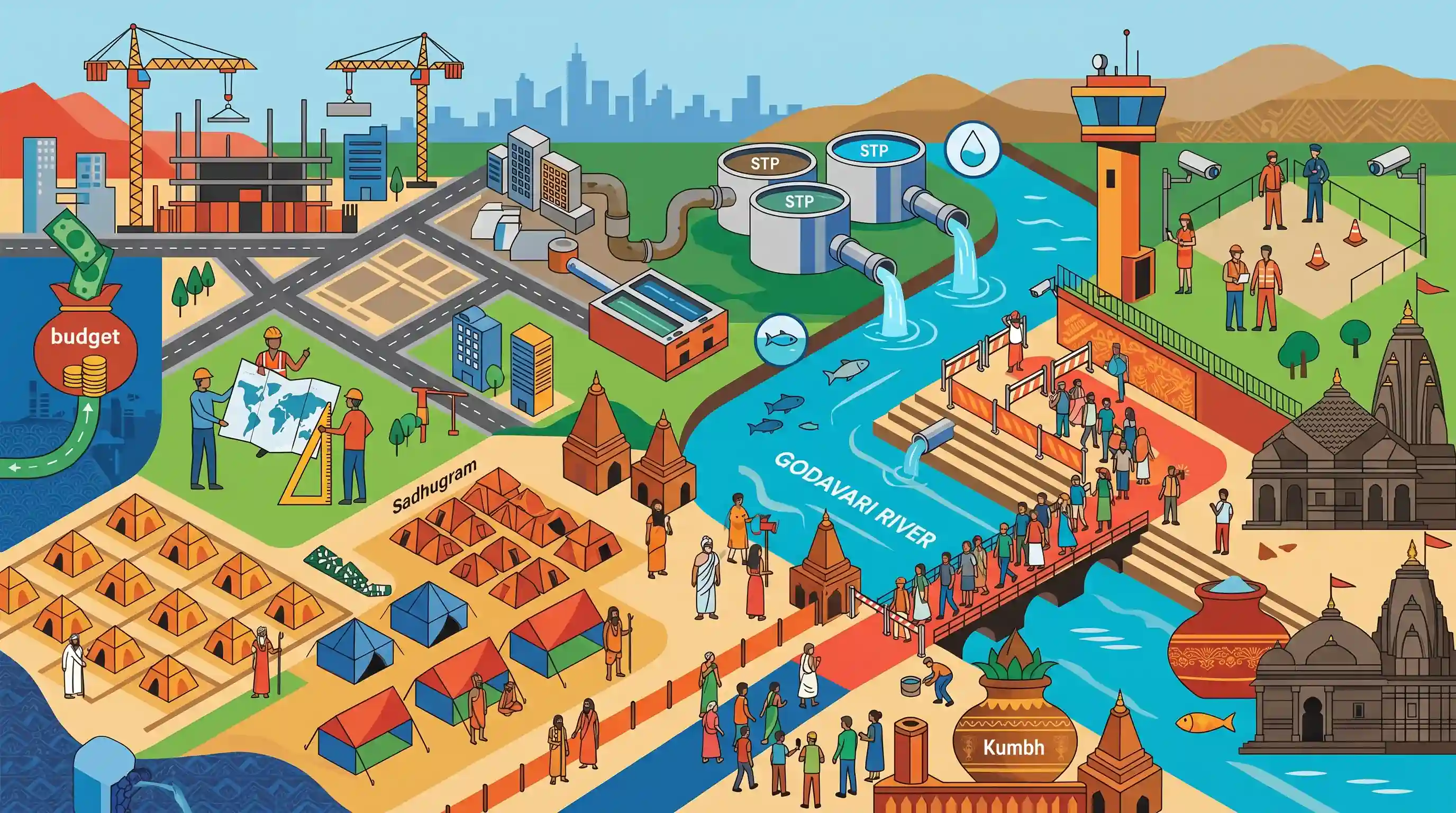
The Maharashtra government has initiated extensive preparations for the upcoming Nashik Simhastha Kumbh Mela, set to begin in Trimbakeshwar in October 2026. A substantial budget of Rs 6,000 crore has been allocated for critical civic infrastructure, emphasizing crowd management, land acquisition for 'Sadhugram', and environmental measures. Specifically, authorities are prioritizing the installation of Sewage Treatment Plants (STPs) and cleaning initiatives for the Godavari River to mitigate pollution during the massive religious congregation.
Key Points
- The Nashik Simhastha Kumbh Mela is scheduled to take place in Trimbakeshwar from October 31, 2026, to July 24, 2028.
- The Maharashtra government has approved massive tenders worth approximately Rs 6,000 crore for infrastructure and civic preparations.
- Key environmental priorities include setting up Sewage Treatment Plants (STPs), maintaining the flow of the Godavari River, and cleaning the riverbanks.
- Extensive urban planning and disaster management protocols are being implemented for land acquisition (Sadhugram), crowd control, transport, and sanitation to accommodate millions of pilgrims.
Important Terms
Simhastha Kumbh Mela

A major Hindu festival held every 12 years in Nashik-Trimbakeshwar and Ujjain when Jupiter enters the Leo (Simha) zodiac. It involves ritual bathing in the Godavari or Shipra rivers.
UPSC context
GS Paper I (Art & Culture); important for understanding intangible cultural heritage and Puranic traditions like Samudra Manthan.
Sadhugram
A massive temporary settlement or 'tent-town' developed to provide accommodation and basic services (sanitation, water, electricity) for thousands of ascetics (Sadhus) during the Kumbh Mela.
UPSC context
GS Paper III (Disaster Management/Urban Planning); tests knowledge of large-scale temporary infrastructure and public health management.
Godavari River
The second-longest river in India, known as 'Dakshin Ganga'. Its origin at Brahmagiri Hill in Trimbakeshwar makes it the focal point for ritual dips during the Nashik Simhastha.
UPSC context
GS Paper I (Geography/Culture); vital for drainage systems, river cleaning projects (STPs), and sacred geography.
Purohit Sangh
A local organization of hereditary priests in Nashik and Trimbakeshwar who manage religious rituals, including the 'Dhwajarohan' (flag-hoisting) ceremony that signals the festival's commencement.
UPSC context
GS Paper I (Art & Culture); represents traditional institutional roles and socio-religious hierarchy in Indian heritage.
Akhadas
Ancient monastic orders or schools for Hindu ascetics (e.g., Saivite, Vaishnavite) that lead the ceremonial processions and ritual baths during the Kumbh Mela.
UPSC context
GS Paper I (Art & Culture); significant for questions on the evolution of Hindu religious institutions.
Amrut Snan
The newly adopted term for the ceremonial 'royal bath' (formerly 'Shahi Snan') taken by seers and pilgrims on auspicious dates to cleanse sins and seek spiritual liberation.
UPSC context
GS Paper I (Art & Culture); reflects terminology shifts and modern standardization of religious practices.
Sewage Treatment Plant (STP)
Critical infrastructure designed to treat urban wastewater before discharge into the Godavari, ensuring water quality meets 'bathing standards' during high-pilgrimage periods.
UPSC context
GS Paper III (Environment); relates to pollution control, urban governance, and the Godavari purification projects.
Prelims Trap
"All four locations of the Kumbh Mela are known as the Simhastha Kumbh."
Simhastha exclusively refers to the Kumbh Melas at Nashik and Ujjain, which occur when Jupiter enters the Leo (Simha) constellation. Prayagraj and Haridwar are not Simhastha.
Static Concepts Connected
What are the four geographical locations of the Kumbh Mela?
- Prayagraj: Located at the confluence (Triveni Sangam) of the Ganga, Yamuna, and mythical Saraswati.
- Haridwar: Situated on the banks of the Ganga river in Uttarakhand.
- Nashik: Held on the banks of the Godavari river in Maharashtra.
- Ujjain: Located on the banks of the Shipra river in Madhya Pradesh.
What is the geographical and cultural profile of the Godavari's origin?
- Geographical Origin: Rises in the Brahmagiri mountains at Trimbakeshwar in the Western Ghats (Maharashtra).
- Cultural Significance: Trimbakeshwar is a sacred pilgrimage town housing one of the 12 Jyotirlingas.
- Drainage: Flows eastwards through Maharashtra, Telangana, and Andhra Pradesh before emptying into the Bay of Bengal.
Cross-Topic Patterns
Heritage sites & NDMA crowd protocols
GS3 Disaster Management frequently tests crowd control at mega-events. Pilgrimage sites require AI surveillance and unidirectional barricading per NDMA guidelines to prevent stampedes.
River conservation driven by religious tourism
The ecological burden of millions of pilgrims forces localized STP deployment and urban planning, linking GS1 Culture directly to GS3 Environmental Pollution and river rejuvenation.

A 2026 Prelims multi-statement question will likely map Kumbh sites to their specific rivers, Jyotirlingas, and UNESCO ICH status.
Linked PYQs · 4
Linked PYQs · 4
- 2024PrelimsGS1
Which one of the following was the latest inclusion in the Intangible Cultural Heritage List of UNESCO?
- 2025PrelimsGS1
With reference to ancient India (600-322 BC), consider the following pairs: Territorial region River flowing in the region I. Asmaka : Godavari II. Kamboja : Vipas III. Avanti : Mahanadi IV. Kosala : Sarayu How many of the pairs given above are correctly matched?
- 2024MainsGS3
Industrial pollution of river water is a significant environmental issue in India. Discuss the various mitigation measures to deal with this problem and also the government's initiatives in this regard.
- 2024MainsGS3
Flooding in urban areas is an emerging climate-induced disaster. Discuss the causes of this disaster. Mention the features of two such major floods in the last two decades in India. Describe the policies and frameworks in India that aim at tackling such floods.
