Nashik Farmers Reject NAFED Onion Procurement Rates Over Input Costs
Source:Indian Express ↗
Why It Matters
The article provides a real-world case study for GS Paper 3 on how state intervention in agricultural markets (procurement by NAFED/NCCF) often fails to resolve farmer distress if prices do not cover input costs. It directly links to UPSC syllabus topics like MSP, APMC dynamics, and supply chain management, offering concrete examples for answers on agricultural economics.
Summary
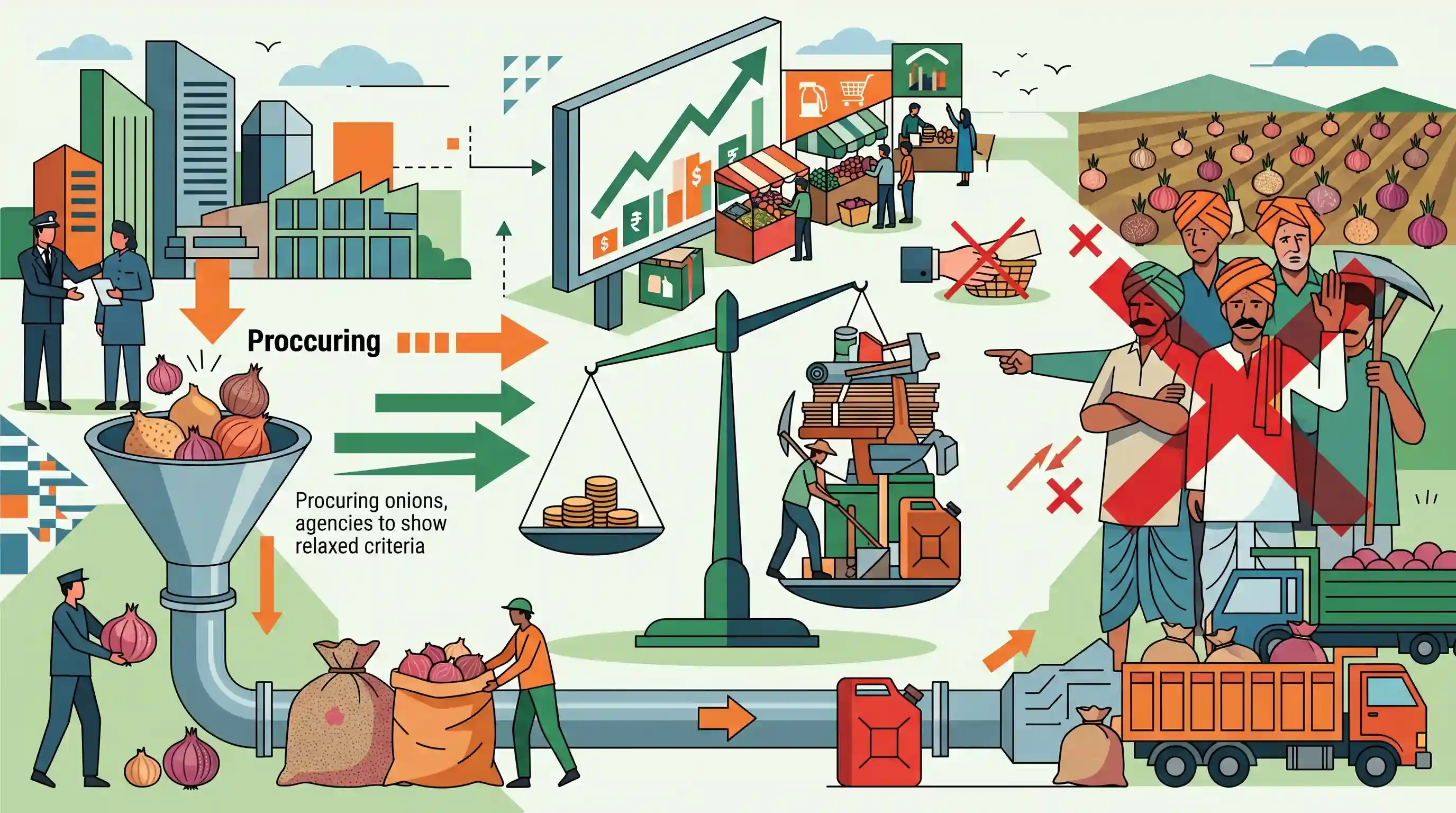
The Union government recently relaxed the procurement criteria for onions, allowing NAFED and NCCF to purchase onions of varying sizes and lower quality grades to provide relief to farmers. However, farmers in Nashik have rejected the government's procurement price of Rs 15.80/kg, citing that it fails to cover their production cost of Rs 18-20/kg and remains below the open market rate at the Lasalgaon APMC. While the Maharashtra government has waived APMC market fees to alleviate some burden, the situation underscores the broader systemic issues in agricultural pricing, market intervention, and the recurring distress caused when state procurement rates do not reflect actual input costs.
Key Points
- The Union government relaxed procurement norms for onions under NAFED and NCCF, increasing the permissible size limit and allowing a higher percentage of defects to aid farmers.
- Despite these relaxations, Nashik onion farmers are refusing to sell to government agencies because the procurement price of Rs 15.80/kg is lower than their production cost of Rs 18-20/kg.
- The procurement rate is also lower than the prevailing open market price of Rs 18-19/kg at the Lasalgaon APMC.
- To further support farmers, the Maharashtra state government announced a waiver of the APMC market fee, which was previously passed onto the farmers by traders.
- The ongoing price crisis highlights the persistent mismatch between government intervention schemes and actual agricultural input costs, directly impacting farm incomes and crop viability.
Important Terms
NAFED (National Agricultural Cooperative Marketing Federation of India)

India's apex cooperative organization (est. 1958) for agricultural marketing. It acts as the nodal agency for government procurement of oilseeds, pulses, and onions to stabilize market prices.
UPSC context
GS3: Agricultural Marketing. Tests understanding of institutional mechanisms for price support and buffer stock management beyond food grains.
APMC (Agricultural Produce Market Committee)
A statutory body established by state governments to regulate agricultural trade. It provides 'mandis' for transparent auctions, aiming to prevent farmer exploitation by intermediaries.
UPSC context
GS3: Agriculture. Critical for questions on marketing reforms, 'distress sales', and the transition toward 'One Nation, One Market' (e-NAM).
Price Stabilisation Fund (PSF)
A central fund under the Ministry of Consumer Affairs used to maintain buffer stocks of perishables like onions and pulses to mitigate extreme price volatility for consumers.
UPSC context
GS3: Food Security and Inflation. Relevant for interventions in 'TOP' (Tomato-Onion-Potato) crops and consumer price protection mechanisms.
Market Intervention Scheme (MIS)
A price support mechanism for perishable/horticultural crops (like onions) not covered under MSP. It is triggered during bumper harvests when market prices fall significantly below production costs.
UPSC context
GS3: Agriculture Subsidies. Important for distinguishing between permanent support (MSP) and ad-hoc interventions for horticultural commodities.
NCCF (National Cooperative Consumers Federation of India)
The apex body of consumer cooperatives in India. It procures and distributes essential commodities at subsidized rates (e.g., Bharat Dal) to stabilize retail inflation and support farmers.
UPSC context
GS3: Public Distribution System. Increasingly tested alongside NAFED for its role in direct-to-consumer retail interventions.
Input Costs / Cost of Production
The total expenditure (seeds, fertilizer, labor) incurred by farmers. Protests arise when government procurement prices (Market Intervention Prices) fail to cover these actual production costs.
UPSC context
GS3: Farm Income. Essential for analysis of the 'remunerative price' debate and the Swaminathan Commission (C2+50%) recommendations.
Prelims Trap
The government announces the Minimum Support Price (MSP) for onions and potatoes based on CACP recommendations.
Onions are not covered under MSP. They are procured via the Price Stabilization Fund (PSF) or Market Intervention Scheme (MIS) to build buffer stocks and prevent distress sales.
Static Concepts Connected
What are the roles of NAFED and NCCF in agricultural procurement?
- NAFED: Apex cooperative marketing body under the Ministry of Agriculture; procures oilseeds, pulses, and onions to stabilize prices and support farmers.
- NCCF: Apex consumer cooperative under the Ministry of Consumer Affairs; procures commodities to ensure retail availability and protect consumers from price shocks.
- Buffer Agencies: Both act as central nodal agencies for the physical procurement of perishables to build buffer stocks under the Price Stabilization Fund.
How does the Price Stabilization Fund (PSF) differ from the Market Intervention Scheme (MIS)?
- Objective Focus: PSF primarily aims to tame retail inflation for consumers, while MIS protects farmers from distress sales during bumper crops.
- Nodal Ministry: PSF is managed by the Department of Consumer Affairs, whereas MIS is implemented by the Department of Agriculture and Farmers Welfare.
- Commodity Coverage: PSF mainly targets onions, potatoes, and pulses; MIS covers varied perishable horticultural crops lacking MSP support upon state government requests.
Cross-Topic Patterns
Inflation targeting vs farm viability
Building buffer stocks under PSF to curb urban retail inflation frequently suppresses farm-gate prices, demonstrating the policy tension between inflation targeting and the goal of doubling farmers' income.
Fragmented APMC markets and e-NAM
Maharashtra's APMC fee waiver underscores agriculture's status as a State Subject, showing how disparate state-level market regulations complicate the transition to a unified national market like e-NAM.

Expect a multi-statement question contrasting MSP (Agri Ministry) with PSF/MIS for perishable crops (Consumer Affairs) in Prelims 2026.
Linked PYQs · 4
Linked PYQs · 4
- 2014MainsGS3
There is also a point of view that Agricultural Produce Market Committees (APMCs) set up under the State Acts have not only impeded the development of agriculture but also have been the cause of food inflation in India. Critically examine.
- 2018MainsGS3
What do you mean by Minimum Support Price (MSP)? How will MSP rescue the farmers from the low income trap?
- 2025MainsGS3
Elaborate the scope and significance of supply chain management of agricultural commodities in India.
- 2019PrelimsGS1
The economic cost of food grains to the Food Corporation of India is Minimum Support Price and bonus (if any) paid to the farmers plus
