Political Exit in Uttar Pradesh and Party Dynamics
Source:Indian Express ↗
Why It Matters
While pure political developments are not directly asked in the UPSC, understanding the dynamics of political parties, regional leadership, and vote bank politics is essential for addressing questions on electoral reforms, the anti-defection law, and democratic representation in General Studies Paper 2.
Summary
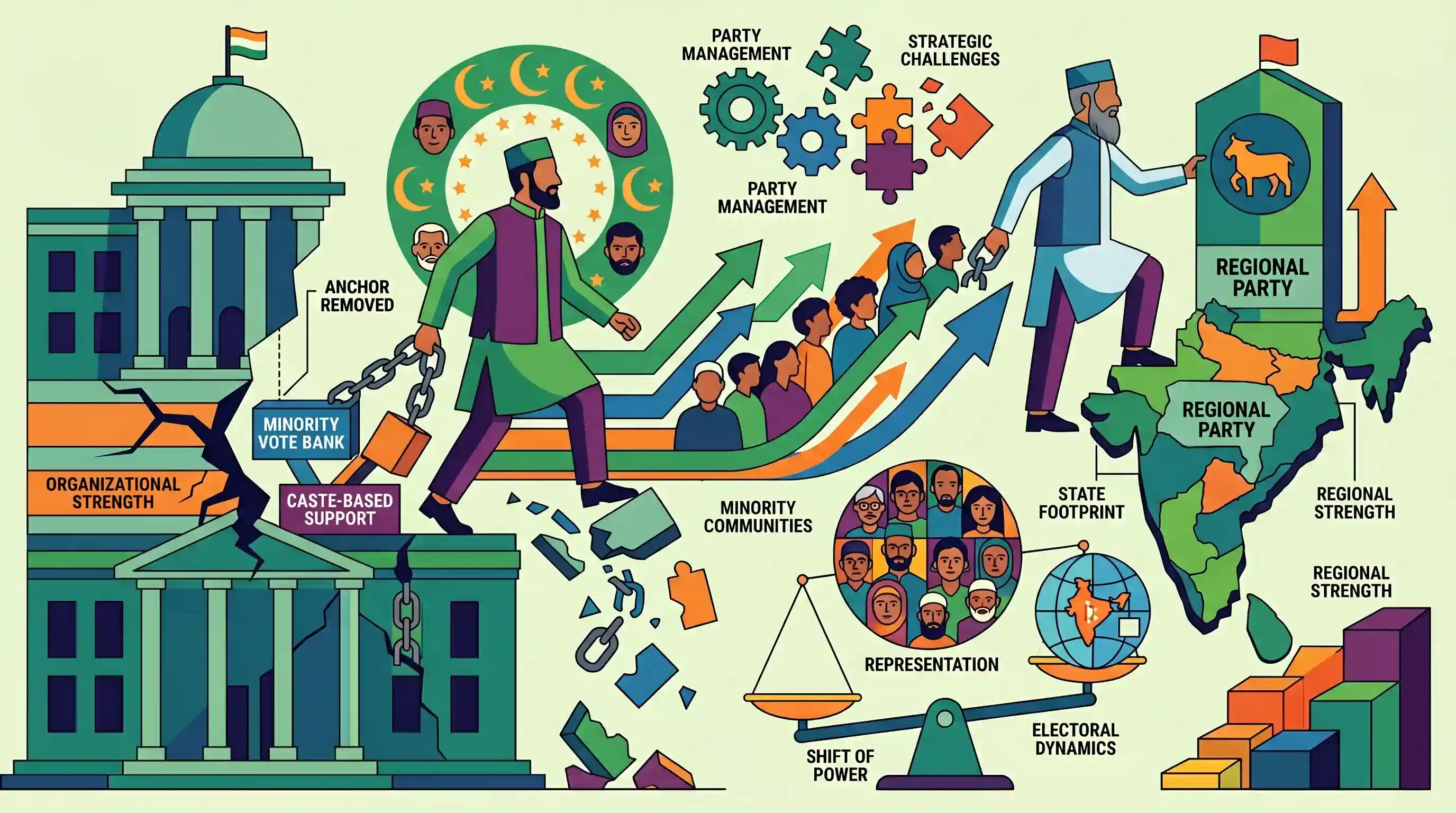
The departure of prominent Muslim leader and former minister Naseemuddin Siddiqui from the Congress highlights a significant setback for the party's organizational strength in Uttar Pradesh. His exit illustrates the challenges national political parties face in retaining influential regional faces who act as key anchors for minority and caste-based vote banks. The development reflects the broader realities of electoral dynamics and political party management in states where regional parties maintain strong footholds.
Key Points
- Former UP minister and prominent Muslim leader Naseemuddin Siddiqui has exited the Congress party, marking a major political setback for the party in Uttar Pradesh.
- His departure underscores the organizational struggles of the Congress in retaining influential regional leaders and maintaining a solid support base among minority communities.
- The event highlights the broader dynamics of Indian electoral politics, where regional leaders serve as crucial anchors for caste and religious vote banks.
- The exit reflects the challenges national parties face in states dominated by strong regional parties where political allegiances often shift based on electoral viability.
Important Terms
Indian National Congress (INC)

India’s oldest political party, founded in 1885. It historically led the independence movement and advocates for secularism and inclusive growth as a 'big tent' national party.
UPSC context
GS Paper I (Modern History) & GS Paper II (Polity); tests understanding of national party evolution and secularism.
Bahujan Samaj Party (BSP)
A national party founded in 1984 by Kanshi Ram to represent the 'Bahujans' (Dalits, STs, OBCs, and minorities). It is a major regional force in Uttar Pradesh.
UPSC context
GS Paper II (Polity/Social Justice); tests the role of caste-based mobilization and regional party dynamics.
Samajwadi Party (SP)
A socialist party founded in 1992 by Mulayam Singh Yadav. It primarily represents Other Backward Classes (OBCs) and Muslims, advocating for social equality and secularism.
UPSC context
GS Paper II (Electoral Politics); relevant for understanding regionalism and identity-based political coalitions.
Vote Bank Politics
A strategy where political parties seek the collective support of a specific social, religious, or linguistic group through targeted policies or representation.
UPSC context
GS Paper II (Polity); tests critical analysis of electoral strategies and their impact on democratic governance.
Minority Representation
The constitutional and political presence of minority communities in legislative and organizational bodies to ensure their interests and grievances are addressed.
UPSC context
GS Paper II (Constitution/Polity); tests knowledge of Article 29-30 and the effectiveness of representative democracy.
Organizational Strength
The capacity of a political party to maintain grassroots networks, manage internal leadership, and mobilize voters effectively across different regions.
UPSC context
GS Paper II (Polity); tests understanding of party systems and the challenges of party management in federalism.
Prelims Trap
The Tenth Schedule penalizes political leaders who switch parties.
The Anti-Defection Law (10th Schedule) applies exclusively to elected MPs/MLAs inside the legislative house, not to regular party members, office bearers, or un-elected leaders quitting.
Static Concepts Connected
What criteria grant a political party 'National Party' status?
- 6% Votes & Seats: Secure 6% of valid votes in 4+ states in LS/Assembly polls AND win 4 LS seats.
- 2% Lok Sabha: Win 2% of total Lok Sabha seats (minimum 11) from at least 3 different states.
- State Party Recognition: Be formally recognized as a State Party in four or more states by the ECI.
What constitutes a 'corrupt practice' regarding identity under RPA 1951?
- Section 123(3): Appealing to voters to vote or refrain from voting on the grounds of religion, race, caste, community, or language.
- Legal Consequences: The High Court can declare the election void and disqualify the offending candidate from contesting future elections.
Cross-Topic Patterns
Internal Democracy vs Tenth Schedule
The Law Commission's 170th report highlights how the lack of internal party democracy and rigid 10th Schedule whips stifle independent leadership, often forcing prominent faces to defect or quit.
Identity Politics & RPA Checks
While parties heavily rely on regional caste/minority anchors for vote banks, Section 123(3) of RPA 1951 paradoxically bans direct electoral appeals on these very identities as corrupt practices.

Expect a Prelims question interlinking RPA Section 123(3) on corrupt practices with ECI criteria for State and National party recognition.
Linked PYQs · 3
Linked PYQs · 3
- 2024MainsGS2
Examine the need for electoral reforms as suggested by various committees with particular reference to "one nation one election" principle.
- 2025PrelimsGS1
Consider the following statements : I. If any question arises as to whether a Member of the House of the People has become subject to disqualification under the 10th Schedule, the President's decision in accordance with the opinion of the Council of Union Ministers shall be final. II. There is no mention of the word 'political party' in the Constitution of India. Which of the statements given above is/are correct?
- 2014PrelimsGS1
Which one of the following Schedules of the Constitution of India contains provisions regarding anti-defection?
