NASA Partners to Rescue Orbiting Swift Space Telescope
Source:Indian Express ↗
Why It Matters
The article illustrates the tangible impacts of space weather (solar cycles) on orbital infrastructure, a concept previously tested by UPSC. It also introduces students to the growing field of satellite servicing (ISAM), which is critical for future space sustainability, extending the lifespan of expensive space assets, and mitigating the proliferation of space debris.
Summary
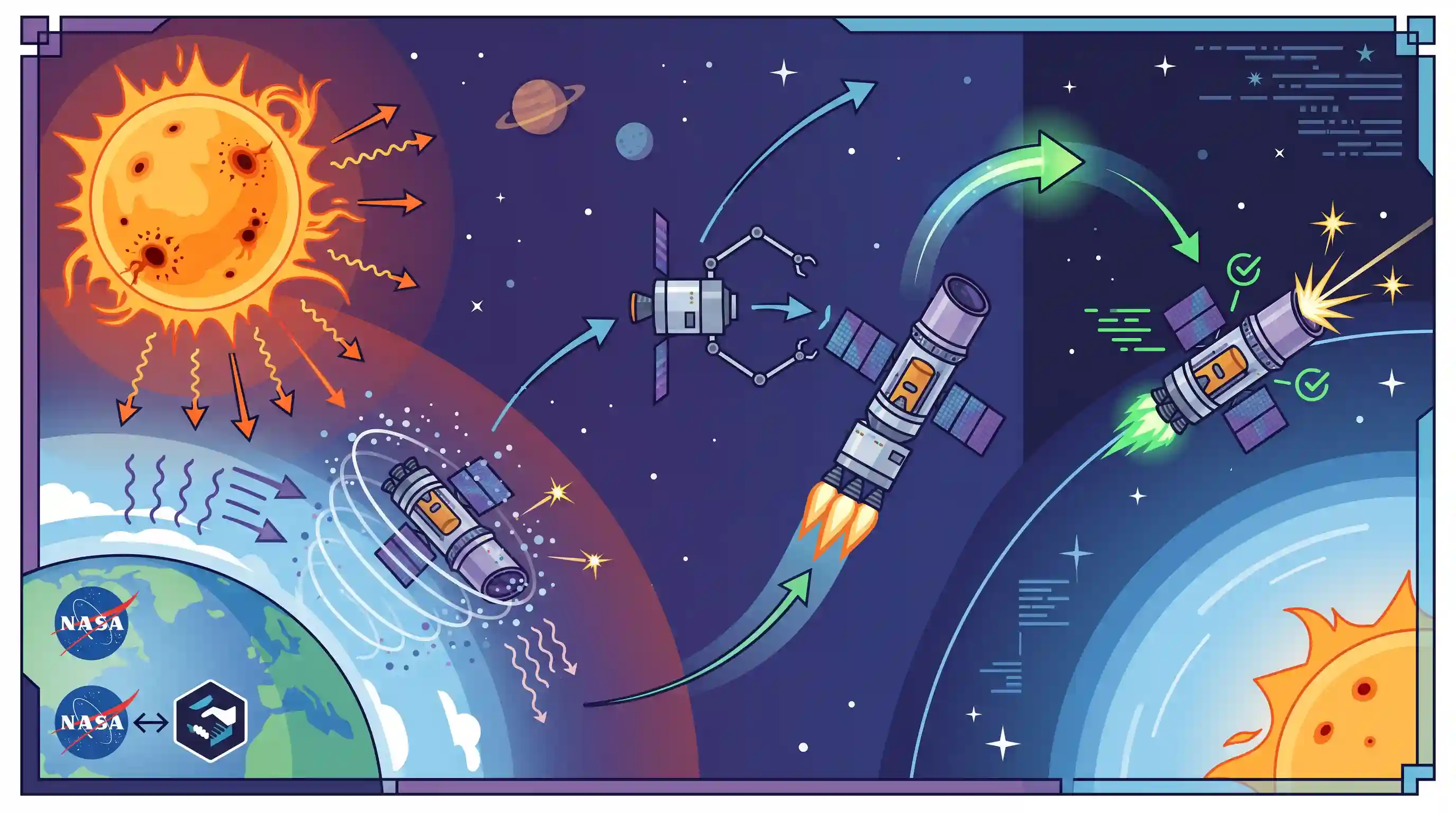
NASA has partnered with startup Katalyst Space Technologies for the "Swift Boost" mission to rescue the Neil Gehrels Swift Observatory. The space telescope, essential for studying gamma-ray bursts, is suffering from rapid orbital decay due to increased atmospheric drag caused by the current solar maximum. The mission will deploy a servicer spacecraft called "Link" to capture and boost Swift to a higher, stable orbit. This endeavor not only aims to extend the life of a vital scientific asset but also demonstrates advanced capabilities in the emerging field of in-orbit satellite servicing.
Key Points
- The Neil Gehrels Swift Observatory, launched in 2004, studies gamma-ray bursts to help scientists understand massive cosmic explosions and the formation of heavy elements.
- Increased solar activity during the current solar maximum has heated and expanded Earth's atmosphere, causing increased atmospheric drag on satellites in Low Earth Orbit (LEO).
- Due to this drag, Swift is experiencing rapid orbital decay. To prevent it from falling back to Earth, NASA initiated the 'Swift Boost' rescue mission.
- Katalyst Space Technologies will use a servicer spacecraft called 'Link', launched via a Pegasus XL rocket, to rendezvous with and boost the telescope to a higher orbit.
- The mission represents a major milestone in In-space Servicing, Assembly, and Manufacturing (ISAM), as it involves capturing a satellite that lacks a standard docking port or propulsion system.
Important Terms
In-orbit Satellite Servicing (IOSS)

The practice of repairing, refueling, or re-boosting satellites while they are in space to extend their operational lifespan and promote a sustainable space environment.
UPSC context
GS III (Space Technology); relevant for sustainable space operations and the transition from a 'throwaway' space economy to a circular one.
Neil Gehrels Swift Observatory
A NASA multi-wavelength space telescope launched in 2004 specifically designed to detect and study the afterglow of gamma-ray bursts across the electromagnetic spectrum.
UPSC context
GS III (Science and Technology); significant for astrophysics and international collaboration in space exploration.
Solar Maximum
The period of greatest solar activity in the Sun's 11-year cycle, causing the Earth’s atmosphere to expand and increasing orbital drag on low-altitude satellites.
UPSC context
GS I (Geography - Space Weather) and GS III; impacts on satellite communication and infrastructure.
Gamma-ray Bursts (GRBs)
The most energetic and powerful explosions in the universe, typically occurring during the collapse of massive stars or the merger of neutron stars.
UPSC context
GS III (Science and Technology); fundamental concept in high-energy physics and observational astronomy.
Swift Boost Mission
A collaborative NASA-Katalyst Space Technologies effort to rendezvous with and boost an aging telescope to a higher orbit using the 'Link' robotic servicer.
UPSC context
GS III (S&T/Current Affairs); demonstrates private sector participation and robotic servicing capabilities in space.
Orbital Decay
The gradual reduction in the altitude of a satellite’s orbit caused primarily by atmospheric drag, leading to eventual re-entry and destruction.
UPSC context
GS III (Space Debris Management); crucial for understanding satellite life-cycles and mitigation of orbital hazards.
Prelims Trap
"Solar maximum reduces atmospheric drag in Low Earth Orbit as satellites are pushed outward by solar wind."
Solar maximum actually INCREASES atmospheric drag in LEO. Intense solar radiation heats and expands Earth's upper atmosphere, enveloping LEO satellites in denser gas and accelerating their decay.
Static Concepts Connected
How does a Solar Maximum affect satellites in Low Earth Orbit (LEO)?
- Solar Cycle: The Sun goes through an 11-year cycle of magnetic activity, peaking during the 'solar maximum' with high sunspot and solar flare activity.
- Atmospheric Expansion: Intense UV and X-ray radiation heats Earth's thermosphere, causing the upper atmosphere to swell and extend further into space.
- Increased Drag: Satellites in LEO encounter denser atmospheric gases, generating friction (drag) that decelerates them and causes rapid orbital decay toward Earth.
What are Gamma-Ray Bursts (GRBs) and what do they reveal?
- Extreme Energy: They are the most luminous and energetic explosions in the universe, emitting highly penetrating electromagnetic radiation.
- Cosmic Origins: They typically originate from the collapse of massive stars (supernovae) or the collision of extremely dense bodies like neutron stars or black holes.
- Scientific Value: Studying GRBs helps astrophysicists understand the formation of black holes and the synthesis of heavy elements (like gold) in the universe.
Cross-Topic Patterns
ISAM meets ISRO's SpaDeX
Global missions like Swift Boost mirror ISRO’s strategic goals. India's Space Docking Experiment (SpaDeX) is the foundational step toward indigenous in-orbit servicing and building the Bharatiya Antariksha Station.
Orbital decay and Kessler Syndrome
Uncontrolled satellite decay exacerbates debris risks. Active in-orbit servicing prevents defunct payloads from triggering Kessler Syndrome in highly congested Low Earth Orbit environments.

Expect a multi-statement question linking solar maximums to atmospheric expansion, increased LEO drag, and satellite orbital decay in 2026.
Linked PYQs · 2
Linked PYQs · 2
- 2022PrelimsGS1
If a major solar storm (solar flare) reaches the Earth, which of the following are the possible effects on the Earth? 1. GPS and navigation systems could fail. 2. Tsunamis could occur at equatorial regions. 3. Power grids could be damaged. 4. Intense auroras could occur over much of the Earth. 5. Forest fires could take place over much of the planet. 6. Orbits of the satellites could be disturbed. 7. Shortwave radio communication of the aircraft flying over polar regions could be interrupted. Select the correct answer using the code given below:
- 2023PrelimsGS1
Consider the following pairs: Objects in space Description 1. Cepheids: Giant clouds of dust and gas in space 2. Nebulae: Stars which brighten and dim periodically 3. Pulsars: Neutron stars that are formed when massive stars run out of fuel and collapse How many of the above pairs are correctly matched?
