International Space Station Human Spaceflight Mission Collaboration
Source:Indian Express ↗
Why It Matters
The Axiom-4 mission represents a major stepping stone for India's human spaceflight ambitions, providing crucial international training and microgravity research experience for ISRO astronauts ahead of the Gaganyaan mission. It also signifies the deepening strategic and technological partnership between India and the United States.
Summary
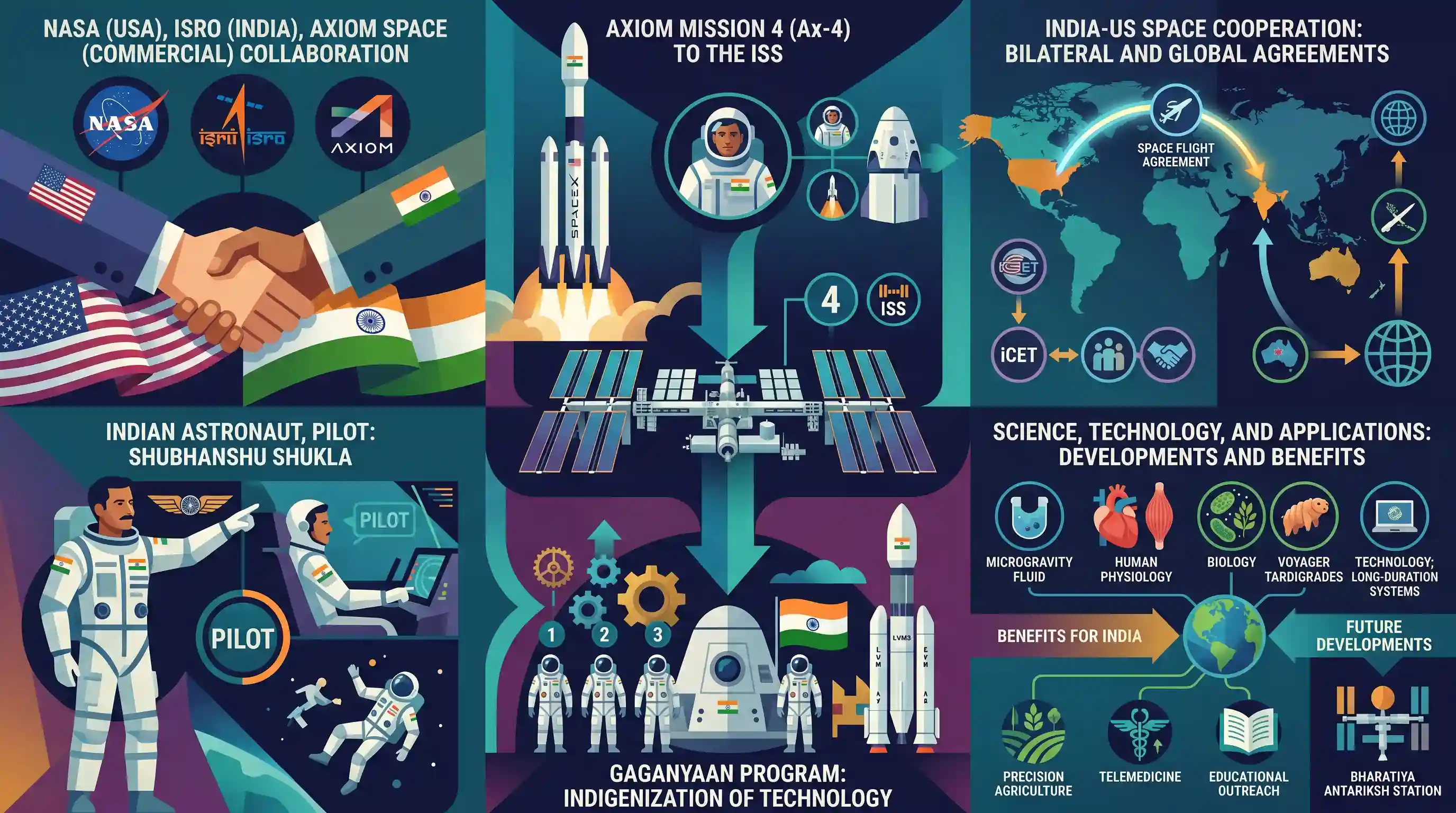
NASA, in collaboration with ISRO and Axiom Space, is set to launch Axiom Mission 4 (Ax-4) to the International Space Station, piloted by Indian astronaut Shubhanshu Shukla, marking a major milestone for US-India space cooperation and India's Gaganyaan program.
Key Points
- Axiom Mission 4 (Ax-4) is an upcoming private astronaut flight to the International Space Station (ISS), set to launch aboard a SpaceX Dragon spacecraft.
- Indian Air Force Group Captain Shubhanshu Shukla will serve as the mission pilot, making him the second Indian to travel to space after Rakesh Sharma.
- The 14-day mission fulfills a bilateral space cooperation commitment between the US and India.
- Shukla will carry out seven microgravity research experiments designed by Indian scientists, studying topics such as edible microalgae, salad seeds, and muscle regeneration in space.
- The mission provides crucial in-orbit experience and preparation for ISRO's indigenous human spaceflight mission, Gaganyaan, scheduled for 2026.
Important Terms
Axiom Mission 4 (Ax-4)

A private astronaut mission to the International Space Station (ISS) operated by Axiom Space. It facilitates international collaboration and research in microgravity, serving as a precursor to future commercial space stations.
UPSC context
GS Paper III (Space Technology); tests understanding of international space collaborations and commercialization of space.
Gaganyaan
India's first indigenous human spaceflight program by ISRO, aimed at sending a crew to Low Earth Orbit (LEO) and returning them safely to Earth.
UPSC context
GS Paper III (Indigenization of Technology); tests knowledge of India's flagship technological self-reliance programs.
Shubhanshu Shukla
Indian Air Force Group Captain and ISRO astronaut selected as the pilot for Axiom-4, marking him as the second Indian to journey into space.
UPSC context
GS Paper III (Achievements of Indians in Science & Tech); tests awareness of key personnel in national missions.
Axiom Space
A private U.S. space infrastructure company that organizes commercial ISS missions and is developing a modular space station to succeed the ISS.
UPSC context
GS Paper III (Science & Tech); highlights the rising role of private entities in the global 'New Space' economy.
ISRO (Indian Space Research Organisation)
India's national space agency. It leads the Gaganyaan program and collaborates internationally to enhance India's presence in the global space sector.
UPSC context
GS Paper III (Space Tech); central agency for scientific developments and international space diplomacy.
NASA (National Aeronautics and Space Administration)
The United States' federal space agency. It partners with ISRO under the iCET framework to foster strategic civil and commercial space cooperation.
UPSC context
GS Paper II (International Relations); reflects India-US strategic and technology sharing agreements.
International Space Station (ISS)
A modular research laboratory in Low Earth Orbit where international crews conduct scientific experiments in a microgravity environment.
UPSC context
GS Paper III (Space Tech); primary platform for global microgravity research and international space cooperation.
Prelims Trap
Ax-4 is an ISRO indigenous spaceflight mission making Shubhanshu Shukla the first Indian in space.
Shukla is the second Indian (after Rakesh Sharma). Also, Ax-4 is a private US commercial mission to the ISS, distinct from ISRO's upcoming indigenous Gaganyaan mission.
Static Concepts Connected
What are the core parameters of India's Gaganyaan Mission?
- LVM3 Rocket: Uses the heavy-lift Launch Vehicle Mark-3 (LVM3) re-configured with strict human-rating requirements (HLVM3).
- Orbit Profile: Designed to safely carry a crew of 3 members to a 400 km Low Earth Orbit (LEO) for a 3-day mission.
- Crew Escape System: Equipped with a critical CES and an Orbital Module (Crew Module + Service Module) to ensure astronaut safety during aborts and reentry.
What is microgravity and why is it crucial for ISS experiments?
- Continuous Freefall: The ISS and its crew are in constant freefall toward Earth, matching the Earth's curvature, creating a state of apparent weightlessness.
- Research Value: Allows scientists to study fluid dynamics, protein crystallization, and biological processes (like microalgae growth) without the masking effects of Earth's gravity.
Cross-Topic Patterns
iCET framework and Space Diplomacy
The mission operationalizes human spaceflight commitments under the US-India Initiative on Critical and Emerging Technology (iCET), linking bilateral tech diplomacy with ISRO's operational readiness.
Commercialization of the Space sector
Ax-4 utilizes SpaceX and Axiom Space, demonstrating the global shift toward private space exploration—a transition India is currently mirroring domestically via IN-SPACe and NSIL.

Expect a 2026 Prelims question comparing Ax-4 and Gaganyaan, testing LEO parameters, microgravity, and iCET tech pillars.
Linked PYQs · 2
Linked PYQs · 2
- 2025PrelimsGS1
Consider the following space missions : I. Axiom-4 II. SpaDeX III. Gaganyaan How many of the space missions given above encourage and support micro-gravity research?
- 2016MainsGS3
Discuss India's achievements in the field of Space Science and Technology. How the application of this technology has helped India in its socio-economic development?
