NASA Perseverance Rover Detects Potential Biosignatures on Mars
Source:The Hindu ↗
Why It Matters
Advances in space exploration and the search for extraterrestrial life are critical components of the Science & Technology syllabus. Understanding the objectives and discoveries of major missions like Perseverance helps contextualise global space advancements and comparative studies with ISRO's interplanetary missions (like the Mars Orbiter Mission).
Summary
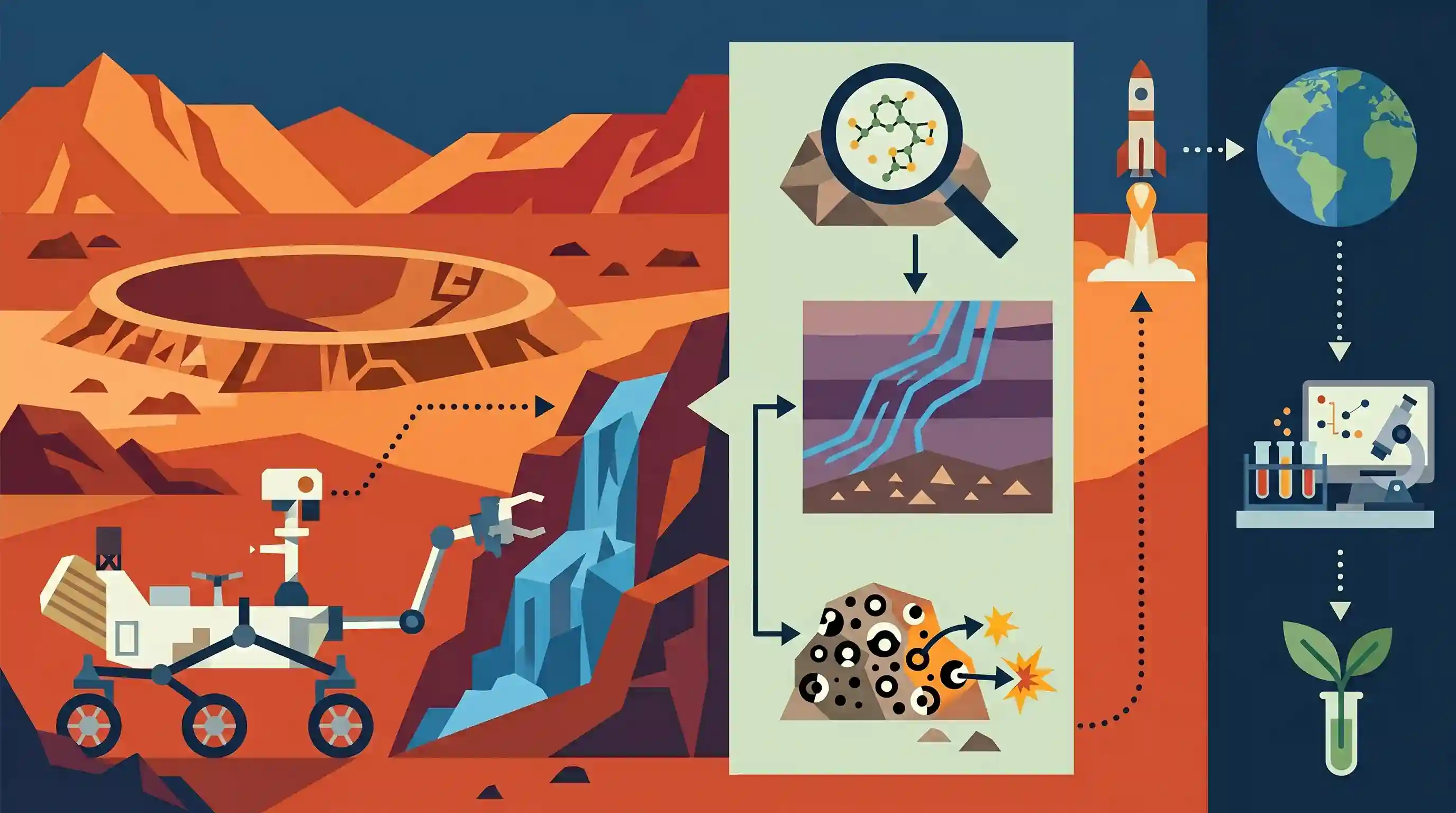
NASA's Perseverance rover has identified a rock on Mars, dubbed 'Cheyava Falls' within the Jezero Crater, that exhibits compelling potential signatures of ancient life. The rock features organic matter, evidence of water flow, and chemical reaction sites ('leopard spots') that could have provided energy for microbial life. This discovery marks a significant milestone in astrobiological research, although definitive proof of past life will likely require returning the sample to Earth for advanced laboratory analysis.
Key Points
- NASA's Perseverance rover has discovered a rock nicknamed 'Cheyava Falls' in Mars's Jezero Crater, containing potential signs of ancient life.
- The rock exhibits organic compounds, a morphology shaped by flowing water, and 'leopard spots' indicating chemical reactions that could have served as an energy source for microbes.
- While the discovery is significant for astrobiology, further analysis (potentially through a Mars Sample Return mission) is required to definitively prove the presence of past biological activity, as non-biological processes could also produce similar features.
Important Terms
Perseverance rover

NASA's semi-autonomous rover launched in 2020 to seek signs of ancient microbial life and collect rock samples for future return to Earth.
UPSC context
GS Paper III: Space Technology. Focuses on interplanetary missions, astrobiology, and international space exploration milestones.
Jezero Crater
A Martian crater and ancient river delta landing site for Perseverance, chosen for its potential to preserve evidence of past microbial life.
UPSC context
GS Paper III: Space Exploration. Tests knowledge of specific planetary landing sites and their geological significance in the search for life.
Organic Matter
Carbon-based molecules that serve as life's building blocks; their presence on Mars indicates habitability but does not definitively prove the existence of past life.
UPSC context
GS Paper III: General Science. Tests understanding of chemical indicators for life and the difference between biological and non-biological origins.
Astrobiology
An interdisciplinary field studying the origin, evolution, and distribution of life in the universe, guiding missions to identify habitable environments beyond Earth.
UPSC context
GS Paper III: Science and Tech developments. Relevant for understanding the scientific framework behind deep-space exploration and planetary science.
Biosignature
Any feature, molecule, or substance that provides scientific evidence of past or present life, such as the "leopard spots" identified in Martian rocks.
UPSC context
GS Paper III: Space Technology. Important for distinguishing between potential signals of life and definitive proof in scientific discoveries.
Mars Sample Return Mission (MSR)
A proposed joint NASA-ESA mission to retrieve Martian samples collected by Perseverance and bring them to Earth for intensive laboratory analysis.
UPSC context
GS Paper III: International collaboration in Space. Tests knowledge of multi-stage missions and global cooperation in advanced space tech.
Prelims Trap
"The discovery of organic matter on Mars is definitive proof of ancient microbial life."
Organic compounds simply contain carbon-hydrogen bonds. They can form via non-biological processes like hydrothermal activity or meteorite impacts; they are not definitive proof.
Static Concepts Connected
What are 'biosignatures' in astrobiology?
- Definition: Substances, elements, or morphological patterns providing scientific evidence of past or present life, such as specific isotopes or complex molecules.
- Abiotic Caveat: Organic molecules can form without life via hydrothermal vents or meteorite impacts. Definitive biosignatures must rule out these non-biological origins.
Key instruments and objectives of the Perseverance Rover
- Core Objective: To search for signs of ancient microbial life and cache rock samples in the Jezero Crater, a suspected ancient lakebed.
- Key Instruments: Includes SHERLOC (laser spectrometer for organics) and previously carried MOXIE (oxygen generation from CO2) and Ingenuity (first Martian helicopter).
Cross-Topic Patterns
Astrobiology + Abiotic Chemistry
UPSC tests basic science in space contexts. Distinguishing biological biosignatures from abiotic organic formation (volcanism, meteorites) links space tech to fundamental chemistry.
International Space Cooperation (NASA-ESA)
The multi-agency Mars Sample Return mission (NASA+ESA) highlights collaborative deep-space exploration, a growing syllabus theme tested via missions like NISAR and Artemis.

Expect a 2026 multi-statement question mixing Perseverance's SHERLOC findings with the NASA-ESA Mars Sample Return mission.
Linked PYQs · 2
Linked PYQs · 2
- 2017MainsGS3
India has achieved remarkable successes in unmanned space missions including the Chandrayaan and Mars Orbitter Mission, but has not ventured into manned space missions. What are the main obstacles to launching a manned space mission, both in terms of technology and logistics? Examine critically.
- 2023MainsGS3
What is the main task of India's third moon mission which could not be achieved in its earlier mission? List the countries that have achieved this task. Introduce the subsystems in the spacecraft launched and explain the role of the Virtual Launch Control Centre' at the Vikram Sarabhai Space Centre which contributed to the successful launch from Sriharikota.
