NASA partners with startup for robotic rescue of Swift telescope
Source:The Hindu ↗
Why It Matters
The mission is highly relevant for UPSC candidates as it intersects space technology (satellite servicing, orbital mechanics), astronomy (space telescopes, gamma-ray bursts), and space weather (the impact of solar cycles and atmospheric drag on LEO satellites). It also touches upon the growing role of private startups in deep space logistics and space debris mitigation.
Summary
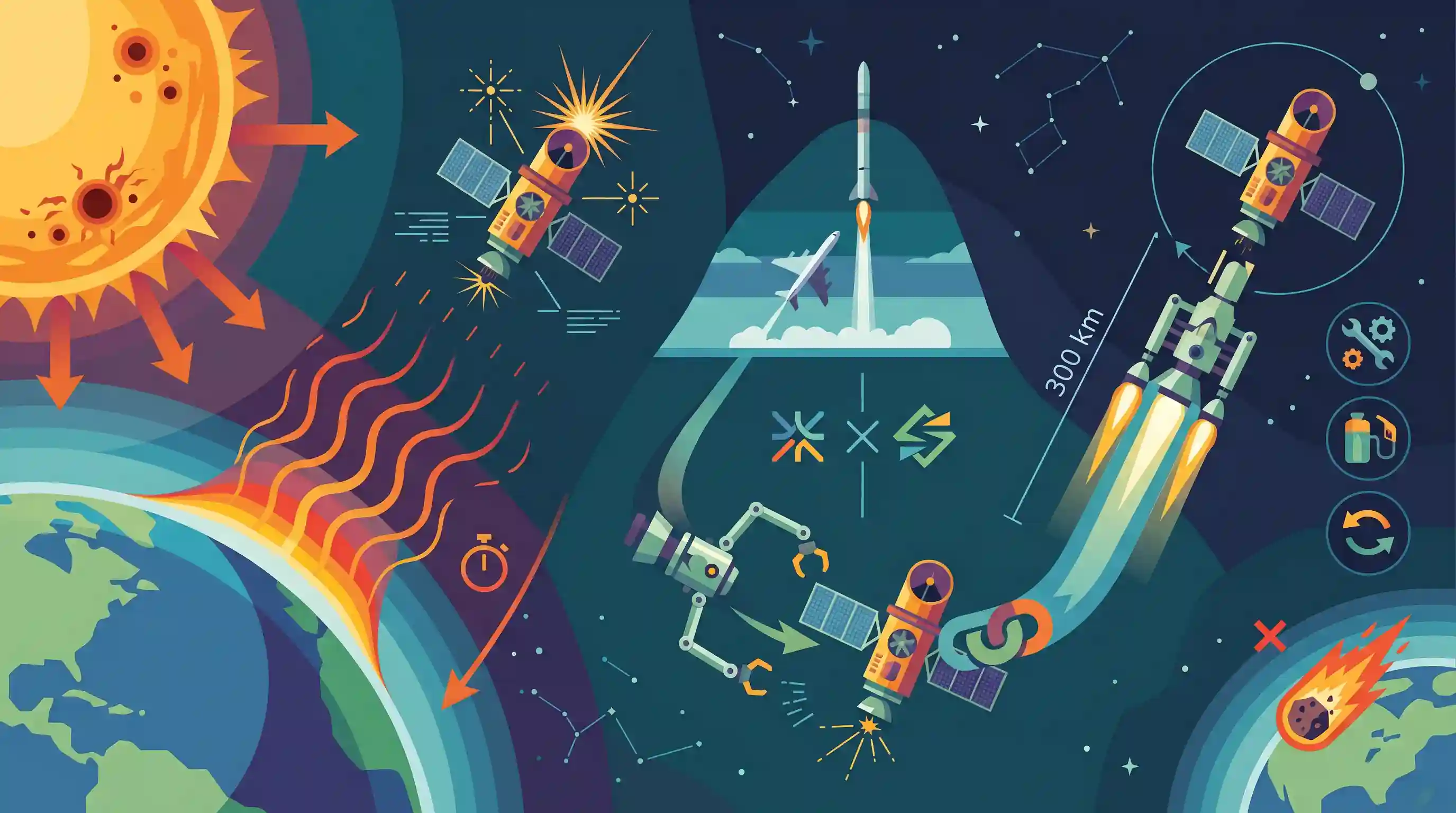
NASA has partnered with the space startup Katalyst for a pioneering robotic rescue mission named LINK to save the Neil Gehrels Swift Observatory. Launched in 2004, the Swift telescope studies highly energetic cosmic phenomena like gamma-ray bursts and supernovas. However, the current active solar cycle has caused Earth's atmosphere to expand, increasing drag and causing Swift's orbit in Low Earth Orbit (LEO) to rapidly decay. The LINK robot will be deployed via a Pegasus rocket, latch onto the falling telescope, and push it 300 kilometers higher. This operation heralds a new era of 'satellite servicing,' where expensive space assets can be refueled, repositioned, and repaired rather than becoming space debris or burning up upon re-entry.
Key Points
- NASA is launching a first-of-its-kind robotic rescue mission called LINK, developed by startup Katalyst, to save the aging Swift space telescope from burning up in Earth's atmosphere.
- The Swift Observatory, launched in 2004 to study gamma-ray bursts, has experienced accelerated orbital decay due to increased atmospheric drag caused by heightened solar activity.
- During solar maximums, solar activity heats and expands Earth's atmosphere, increasing the drag on satellites in Low Earth Orbit (LEO).
- The LINK robot will be launched via a Pegasus rocket (dropped from an aircraft), intercept Swift in orbit, and boost its altitude by approximately 300 km.
- This mission signals a shift toward a 'satellite servicing' model—extending the lifespan of space assets through repair, refueling, and repositioning, rather than treating them as disposable.
Important Terms
Neil Gehrels Swift Observatory

A NASA multi-wavelength space telescope launched in 2004 to study gamma-ray bursts (GRBs) and high-energy cosmic events like supernovas. It serves as a "first responder" for time-domain astrophysics.
UPSC context
GS Paper III (Science & Technology); focuses on space-based observatories and international collaborations in astronomy.
LINK Mission
A pioneering robotic rescue mission developed by NASA and Katalyst Space Technologies to autonomously capture the Swift telescope and boost its orbit, preventing destructive atmospheric re-entry.
UPSC context
GS Paper III (Science & Technology); highlights private-sector participation and emerging capabilities in on-orbit satellite maintenance.
Satellite Servicing
The emerging technology of repairing, refueling, upgrading, or repositioning satellites in orbit. It promotes space sustainability by extending asset lifespans and reducing the creation of space debris.
UPSC context
GS Paper III (Environment/Science); critical for space debris management and the shift toward a circular space economy.
Orbital Decay
The gradual reduction in a satellite's altitude caused by friction with atmospheric particles. This process is often accelerated by intense solar activity that expands the Earth's upper atmosphere.
UPSC context
GS Paper III (Science & Technology); tests knowledge of orbital mechanics and the impact of space weather on infrastructure.
Solar Cycle
The 11-year periodic fluctuation in the Sun’s magnetic activity. Peaks (Solar Maximum) increase atmospheric drag on Low Earth Orbit (LEO) satellites by heating and expanding the Earth's thermosphere.
UPSC context
GS Paper I (Geography) and III (Science); essential for understanding solar-terrestrial physics and its technological impacts.
Pegasus Rocket
A three-stage, air-launched rocket deployed from a carrier aircraft at high altitude. It offers a flexible, low-cost alternative to ground-based launches for small satellite missions.
UPSC context
GS Paper III (Science & Technology); covers different types of launch vehicles and their strategic advantages.
Prelims Trap
Solar maximums decrease atmospheric drag on Low Earth Orbit (LEO) satellites.
High solar activity heats and expands Earth's thermosphere. This increases atmospheric density at LEO altitudes, causing more aerodynamic drag and faster orbital decay.
Static Concepts Connected
How does a Solar Maximum affect satellites in Low Earth Orbit (LEO)?
- Atmospheric Expansion: High EUV radiation heats the thermosphere, causing it to expand outward into LEO paths.
- Orbital Decay: The expanded atmosphere increases aerodynamic drag on satellites, accelerating their descent and requiring frequent re-boosts.
- Communication Interference: Heightened solar activity causes ionospheric disturbances, disrupting GPS and radio communication signals.
Why must Gamma-Ray Bursts (GRBs) be observed from space?
- Atmospheric Shielding: Earth's atmosphere completely absorbs high-energy gamma rays, making ground-based optical or radio telescopes useless for direct GRB detection.
- Transient Nature: GRBs last only milliseconds to minutes. Space-based observatories like Swift can rapidly and autonomously re-point to capture these energetic transient events.
Cross-Topic Patterns
Satellite Servicing & ISRO's SpaDEX
NASA's LINK mission parallels ISRO's upcoming Space Docking Experiment (SpaDEX), reflecting a global policy shift towards sustainable in-orbit servicing to mitigate space debris and prevent the Kessler Syndrome.
Space Weather & Aditya-L1
The rapid orbital decay of the Swift telescope perfectly illustrates why missions like Aditya-L1 are crucial for predicting space weather anomalies to protect expensive orbital assets.

Expect a multi-statement question linking solar maximum effects (atmospheric drag) with satellite servicing concepts like ISRO's SpaDEX.
Linked PYQs · 3
Linked PYQs · 3
- 2022PrelimsGS1
If a major solar storm (solar flare) reaches the Earth, which of the following are the possible effects on the Earth? 1. GPS and navigation systems could fail. 2. Tsunamis could occur at equatorial regions. 3. Power grids could be damaged. 4. Intense auroras could occur over much of the Earth. 5. Forest fires could take place over much of the planet. 6. Orbits of the satellites could be disturbed. 7. Shortwave radio communication of the aircraft flying over polar regions could be interrupted. Select the correct answer using the code given below:
- 2022MainsGS3
Launched on 25th December, 2021, James Webb Space Telescope has been much in the news since then. What are its unique features which make it superior to its predecessor Space Telescopes ? What are the key goals of this mission ? What potential benefits does it hold for the human race?
- 2023PrelimsGS1
Consider the following pairs: Objects in space Description 1. Cepheids: Giant clouds of dust and gas in space 2. Nebulae: Stars which brighten and dim periodically 3. Pulsars: Neutron stars that are formed when massive stars run out of fuel and collapse How many of the above pairs are correctly matched?
